When refering to evidence in academic writing, you should always try to reference the primary (original) source. That is usually the journal article where the information was first stated. In most cases Physiopedia articles are a secondary source and so should not be used as references. Physiopedia articles are best used to find the original sources of information (see the references list at the bottom of the article).
If you believe that this Physiopedia article is the primary source for the information you are refering to, you can use the button below to access a related citation statement.
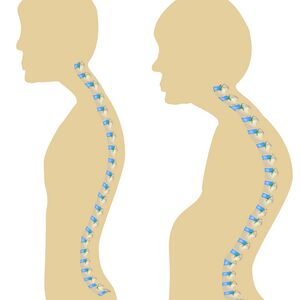
These postural changes can have a significant impact on speech and swallowing function.[1] For example:
Lordosis of the cervical spine inhibits laryngeal elevation and affects swallowing[2]
Ossification of the anterior longitudinal ligament can lead to dysphagia - the extent of which is influenced by the thickness of osteophytes, cervical mobility, and cranio-cervical alignment[3]
When observing patients, it is important to compare the patient's posture with "normal" posture. When specific postural abnormalities are detected, it is important to determine if the client’s posture can be corrected, or if the postural condition is fixed.
Structured Posture
Structured postures are postural disorders where there are underlying morphological abnormalities in the bone and soft tissues. Examples of structured postures are:[4]
These conditions are more clinically significant than some other postural changes as they are less flexible and can only be modified with difficulty.[1] They require a specific diagnosis and management.[4]
Non-Structured Posture
A non-structured posture is modifiable either actively or with the help of the therapist.[1] Individuals with non-structured postures may have similar clinical features as those with structural abnormalities.[4] For instance, scheuermann's disease is often mistaken for adolescent postural kyphosis, so it is necessary to differentiate the two conditions based on the physical examination and radiographic analysis.[5]
Antalgic Posture
Antalgic postures are technically modifiable but, if corrected, the patient complains of pain.[1]
Compensatory Posture
Compensatory postures can be actively and passively corrected, but the patient does not tend to stay in the corrected position. If the cause of the compensation is not treated, the postural destabilisation will, in time, return.[1]
Common Non-Structural Postures
Figure 2. Common non-structured postures.
Side View
Common postural deformities can be viewed from the side, as is seen in Figure 2.
The head line and the baseline usually overlap and pass anteriorly to the lumbar vertebral bodies and posterior to the hip joint axis - the head may be shifted anteriorly to the baseline
Thoracic kyphosis, which extends into the upper lumbar spine
Shorter lumbar lordosis
Normal or slightly decreased anterior pelvic tilt
The dorsal spine is displaced posteriorly while the head and pelvis are anterior to the plumb line
It is possible to observe changes in a client's posture during swallowing, phonation or singing. These changes will provide the therapist with information about patterns and compensatory movements.[1] If active correction is possible, it is advisable to encourage postural re-education techniques.[1] If active corrections are not easy or limited, it is advisable to treat the patient with passive manual techniques, elongation of retracted muscle chains and manual therapy.[1]
Posterior View
Four specific conditions related to the ascending or descending syndrome can be observed from a posterior view.[1]
All sectors (head, shoulders and pelvis) are displaced to the same side
This is a more common presentation after trauma
Muscle Chains
These postural syndromes are associated with abnormalities in muscle or myofascial chains. It is proposed that muscles do not function as independent units, but rather they are part of a "tensegrity-like, body-wide network, with fascial structures acting as linking components.”[6] Muscle chains are the functional anatomical expression of neuromuscular control and they:[1]
Induce movement
Facilitate cross-movement
Transmit mechanical tension to the postural system
Because the postural system has to compensate to maintain a static position or to support dynamic movement, muscle chains are part of the proprioceptive system.[1]
Proprioceptors (e.g. muscle spindles, golgi tendon organs) inform the upper control centres about the state of the body (e.g. limb position and movement, sense of tension or force, balance or effort[7]). They facilitate complex movement, but also cause remote compensations.[1]
Limitations:
There is a lack of consistency in the literature about which muscles are included in each chain [8]
It is difficult to describe in a reliable way the relationships between body parts that are further apart. It is easier to assess the effect of retractions that are in closer proximity (e.g. neck - shoulder - head - larynx – mandible)[1]
Trauma and the Compensatory Mechanism
It is possible to understand postural compensation by comparing it to the processes that occur after trauma, such as an ankle sprain.[1]
Acute phase
The traumatic event destabilizes the system
There is pain and changes in the motor (e.g. gait) and postural patterns[1]
Post-acute phase
Even without pain, postural changes occur during the acute phase
These changes need to be re-educated in order to avoid alterations in tension in the postural muscle chains[1]
Forward Head Position
Figure 3. Forward head posture.
A forward head position (see Figure 3) can be associated with other postural issues and pain conditions:
Forward head posture is more pronounced in individuals with shoulder pain (associated with an overuse syndrome of the shoulders)[9]
Shoulder injury can have a negative influence on neck alignment.[10] There can be alterations in trapezius kinematics in patients who have neck pain and shoulder dysfunctions[1]
Increasing thoracic kyphosis results in an increased retraction and anterior tilt of the scapula[1][11]
Increasing thoracic kyphosis has also been associated with a decreased posterior tilt of scapula and increased elevation[1]
In the presence of cervical arthrosis, forward head position can cause strain on the oesophagus due to its proximity to the cervical spine
The oesophagus originates in the neck, at the pharyngoesophageal junction (i.e. the C5-6 vertebral interspace at the inferior border of the cricoid cartilage) and it travels down anteriorly to the vertebral column[12]
When there is an extension of the upper part of the cervical spine associated with a forward head posture, there is elevation of the mandible:
This can disturb the hyoid bone, which also influences the larynx[1]
It also causes changes in the vocal tract, with associated alterations in the vocal spectrum and in the structures that produce sound
When there is flexion of the upper cervical spine associated with a forward head position, the vocal tract will not be in an optimal position[1]
Stomatognathic System
The stomatognathic system is a functional unit which includes the maxilla and mandible, dental arches, soft tissues (salivary glands, nervous and vascular supplies), the temporomandibular joint (TMJ) and masticatory muscles.[13] It plays a significant role in postural control,[13] influencing the system through:[1]
Muscle tension
Fascial retractions
Neurological stimulation
The TMJ has connections to the cervical spine via muscles and ligaments, forming a functional complex called the cranio-cervico-mandibular system.[13] The posterior system is, therefore, connected to the anterior muscle chains. Speaking and swallowing are related to the mandibular, pharyngeal and laryngeal system (pharingo-glosso chain) and occlusal stresses are applied to the maxillary bones. The styloid muscles (stylohyoid, stylopharyngeus, and styloglossus muscles[14]) act on the cranial system, tongue, pharynx and hyoid bone.[1]
The Larynx
The laryngeal structure, including the hyoid, is an important crossing point of myofascial tensions.[1]
The hyoid bone is positioned in the middle of the neck anteriorly at the base of the mandible and posteriorly at C4.[15] It is just superior to the thyroid cartilage. While it does not connect to other bones, it is closely associated with an extended tendon-muscular complex. It is anchored by muscles from the larynx, pharynx, tongue, and the floor of the mouth.[15]
In a neutral position, the larynx should maintain its position in relation to the cervical spine and mandible, but this position often changes between people.[1]
When assessing the larynx, it is essential to note prevailing movement - in a normal condition, after moving, the larynx typically returns to a neutral position. If there are abnormal tensions, there will be a restriction of mobility in the opposite parameters. Examples of aberrant movement include:[1]
Upward movement without returning to neutral
Upward movement combined with a lateral movement
Tilting position with a poor return
Inefficient tilting or anterior tilting of the larynx
Muscle Chains Associated with the Larynx
The laryngeal muscles are part of global muscle chains and they can be affected by tensions from within these functional groups.[1]
Posterior Cross Chain
The posterior cross chain is an extension chain. While it is not directly connected to the larynx, it includes muscles that attach to the cranium and the sub-nuchal line. They, therefore, affect the laryngeal tract.[1]
This chain helps to stabilise the mandible through the bi-condylar axis.[1]
Rear Cross Chain
The rear cross chain crosses frontally with the hyoid and laryngeal fulcrum and inserts posteriorly at the contralateral scapula with the omohyoid.[1]
Pharyngo-Vertebral Chain (Deep Chain)
The pharyngo-vertebral chain is the myofascial system related to swallowing and breathing. It is connected to the vertebral tract and the cranial base. Muscles within this chain include:
Pharyngeal constrictor muscles
Styloid muscles (Styloglossus, Stylohyoid, and Stylopharyngeus)
This chain is affected by problems of the cervical spine including forward head position and the formation of osteophytes.[1]
Summary
There are specific postural changes that become more pronounced with age
Common postural abnormalities can be viewed from the side or from the rear
Some postural abnormalities are more amenable to physical correction than others
Changes in posture can affect speech and swallowing, so they are highly relevant in the field of speech therapy