When refering to evidence in academic writing, you should always try to reference the primary (original) source. That is usually the journal article where the information was first stated. In most cases Physiopedia articles are a secondary source and so should not be used as references. Physiopedia articles are best used to find the original sources of information (see the references list at the bottom of the article).
If you believe that this Physiopedia article is the primary source for the information you are refering to, you can use the button below to access a related citation statement.
The lumbar spine supports much of the upper body's weight. Intervertebral discs maintain the spaces between the vertebrae. These discs act like shock absorbers throughout the spinal column to cushion the bones as the body moves. Ligaments hold the vertebrae in place, and tendons attach the muscles to the spinal column.
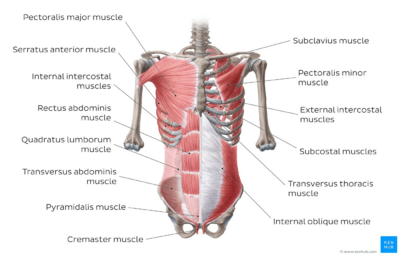
The skeletal support of the abdominal wall includes the vertebral column and lower ribs. The abdominal wall contains skin, fascia, and muscle.
Abdominal wall
It provides coverage for the organs, generates intra-abdominal pressure, and moves the vertebral column. This article discusses the key anatomical structures of the lumbar vertebrae and abdominal wall, including the bony structures, articulations, ligaments, muscles, nerves and the vascular supply.
Key Terms
Axes: lines around which an object rotates. The rotation axis is a line that passes through the centre of mass. There are three axes of rotation: sagittal passing from posterior to anterior, frontal passing from left to right, and vertical passing from inferior to superior. The rotation axes of the foot joints are perpendicular to the cardinal planes. Therefore, motion at these joints results in rotations within three planes. Example: supination involves inversion, internal rotation, and plantarflexion.
Bursae: reduce friction between the moving parts of the body joints. A bursa is a fluid-filled sac. There are four types of bursae: adventitious, subcutaneous, synovial, and sub-muscular.
Capsule: one of the characteristics of the synovial joints. It is a fibrous connective tissue which forms a band that seals the joint space, provides passive and active stability and may even form articular surfaces for the joint. The capsular pattern is "the proportional motion restriction in range of motion during passive exercises due to tightness of the joint capsule."
Closed pack position: the position with the most congruency of the joint surfaces. In this position, joint stability increases. For example, the closed pack position for the interphalangeal joints is full extension.
Degrees of freedom: the direction of joint movement or rotation; there is a maximum of six degrees of freedom, including three translations and three rotations.
Ligament: fibrous connective tissue that holds the bones together.
Open (loose) pack position: position with the least joint congruency where joint stability is reduced.
Planes of movement: describe how the body moves. Up and down movements (flexion/extension) occur in the sagittal plane. Sideway movements (abduction/adduction) occur in the frontal plane. The transverse plane movements are rotational (internal and external rotation).
Lumbar Spine Structure
Lumbar vertebrae
There are usually five lumbar vertebrae, which are known as L1-L5. However, 10–17.4% of adults present with a 6th lumbar vertebra[1] (or a sacral vertebra[2]). Having an additional vertebra may influence sagittal parameters. For instance, it may result in a diminished sacral tilt (i.e. the sacrum is in a more vertical position).[3] Individuals who have additional lumbar vertebrae may also have fewer thoracic vertebrae (e.g. 11 rather than 12 thoracic vertebrae).
Lmbar vertebra
The lumbar vertebrae are located between the 12th (or last) thoracic vertebra and the sacrum bone. They are the largest vertebrae of the human body. Each lumbar vertebra contains the following structural elements:
Vertebral body
Kidney-shaped
Wider side to side than front to back
The posterior aspect of the vertebral body changes from concave to convex
Vertebral foramen
Triangular in shape
Larger than in the thoracic vertebrae, but smaller than in the cervical vertebrae
Two pedicles
Posterior element of the lumbar vertebra
Attach to the cranial half of the vertebral body
Change in shape from L1-L5
Two laminae
Flat and broad
Two pedicles and two laminae form the vertebral arch
Centrally connect to the spinous process
Spinous process
Projects perpendicularly from the body
Short and sturdy
Described as "hatchet-shaped"
Provides an attachment point for muscles and ligaments
Two transverse processes
Located on the posterior surface
Project laterally on each side of the vertebra
Long and slender
Provide attachment points for muscles and ligaments
Two superior articular facets and two inferior articular facets
The point where two facets join is called the zygapophyseal joints
Lumbar Lordosis
Lumbar lordosis
Lordosis = the natural curve for the lumbar spine. This curve defines lumbar spine alignment in the sagittal plane. However, the pelvis is "the cornerstone of spinal sagittal alignment".[5] The curve of the sacrum determines the lumbar curve.
Optimal sagittal alignment of the lumbar spine offers the following benefits during locomotion:[5]
Allows the body's centre of mass to be positioned above the hip, knee, and ankle joints
Minimises the muscular force used for postural control
Assessment of lumbar spine alignment must include an analysis of the alignment of the lower limbs. For instance, measuring the degree of knee flexion and pelvic shift might help clinicians identify compensatory mechanisms resulting from sagittal plane malalignment.[6]
Abdominal Wall Structure
The skeletal support of the abdominal wall comes from the vertebral column and lower ribs posteriorly. Anteriorly, it connects to the thoracic cage (rib cage) superiorly and the pelvic bones inferiorly. It is defined by the following landmarks:
superior border = the xiphoid process and costal cartilage of ribs 7–10
Bones, Articulations and Kinematics of the Lumbar Spine
Facet joint
Bones and Articulations
The lumbar spine has two types of joints located between each lumbar vertebra:
intervertebral disc joint
zygapophyseal joint or facet joint
Bones
Articulations
Characteristics
Key palpation points
Vertebral body
Intervertebral disc joint
This joint is formed between the inferior surface of one vertebral body and the superior surface of the vertebral body that lies below (for example, the inferior surface of L1 and the superior surface of L2). An intervertebral disc separates the vertebral bodies.
To find each segment of the lumbar spine, position the patient prone. The location of the spinous processes will determine the location of each segment. You can palpate the spinous processes in the centre of the patient's back.
Start with finding T12 by palpating the patient's lowest rib and following your finger along the border of the rib towards the centre of the spine. The T12 spinous process is in line with the 12th rib (which inserts into T12 spinal segment). Below T12, you can palpate L1 and continue along the spinous process of L2, L3, and L4. If you start your palpation from the distal end of the lumbar spine, you must consider the following: the spinous process of L4 "is usually determined by the position of the highest point on both sides of PSIS"[7], but the accuracy of palpation is only 36%.[7]
Articular processes
Zygapophyseal joint (Facet joint)
Formed between the articular processes of each lumbar vertebra.
Located on the left and right sides of the spine.
They link one vertical segment to the other. For example, the facet joint between L3 and L4 will connect L3 to L4.
The superior articular surface is vertical and concave, and the inferior is vertically convex.
Their primary role includes the stabilisation of the spinal motion segment.[8] They also contribute to axial compressive load transmission.
The facet joint CANNOT be directly palpated due to overlying soft tissue. When you move your fingers two to three centimetres in the lateral direction from the spinous process, you will be on the muscles overlying the facet joint.
Kinematics
The lumbar spine is considered a three-joint complex or an articular triad.[8] The zygapophyseal (facet) joints and intervertebral disc joint are part of a "spinal motion segment". The various parts of the spinal motion segment work together to allow spinal motion and protect the spine from excessive movements.
The spinal motion segment has the following characteristics:[9]
The intervertebral disc joint transmits mostly vertical compressive loads
The facet joints guide and stabilise the motion segment
In an erect standing position and erect sitting posture, spine load is also transmitted through the facet joints
A series of short ligaments that connect the laminae of each vertebra.[2] There are two ligamenta flava at each vertebra.
Each ligament is divided into:
The medial portion: passes to the back of the next lower lamina and across the gap between the adjacent vertebrae, fusing with the interspinous ligament
The lateral portion: passes in front of the facet joint, attaches to the anterior aspect of the inferior and superior articular processes and forms the anterior capsule. Most lateral fibres extend beyond the superior articular process to the pedicle below.
The lower half of the anterior surface of the lamina above
The posterior surface and upper margin of the lamina below
Their high elastin content prevents them from buckling into the spinal canal.[2]
Assists with lumbar spine flexion and extension.
Compresses the intervertebral discs.
Intertransverse ligaments
Transverse processes of the vertebra above
Transverse processes of the vertebra below
Contributes to the stability of the lumbar spine.
Limits lateral flexion.
To palpate the transverse process, position the patient in sitting. The transverse processes of the lumbar spine are most likely located directly in line with the spinous process of the corresponding vertebra. Start by palpating the spinous process of the L1 vertebra and move directly lateral to find the transverse process of L1.
Supraspinous ligament
Tip of spinous processes of the vertebra above from the seventh cervical vertebra to the third or fourth lumbar vertebra
Tip of spinous processes of the vertebra below
Prevents the separation of the spinous processes during forward flexion, thus limiting lumbar spine flexion
You can palpate the spinous processes in the centre of the patient's back.
Start with finding T12 by palpating the patient's lowest rib and following your finger along the border of the rib towards the centre of the spine.T12 spinous process is in line with the 12th rib that inserts into the spinal segment. Below T12, you can palpate L1 and continue along the spinous process of L2, L3, and L4.
Interspinous ligament
Spinous processes of the vertebra above between the ligamenta flava anteriorly and the supraspinous ligament posteriorly
Spinous processes of the vertebra below between the ligamenta flava anteriorly and the supraspinous ligament posteriorly
Limits forward flexion of the vertebral column.
Muscles of the Lumbar Spine and Abdominal Wall
The muscles of the back can be grouped according to their function and location.
Lumbar and abdominal muscles
When grouped according to function, the muscles of the lumbar spine can be organised as follows:
Rotators: multifidus, internal and external obliques
When grouped according to location, the muscles of the lumbar spine can be divided as follows:
The intrinsic (deep) group:
Superficial layer: erector spinae muscles
Middle (deep) layer: multifidus
Deepest layer: interspinales lumborum and intertransversarii lumborum
The abdominal wall group: transverse abdominis, the internal oblique, rectus abdominis, and the external obliqueAbdominal muscles
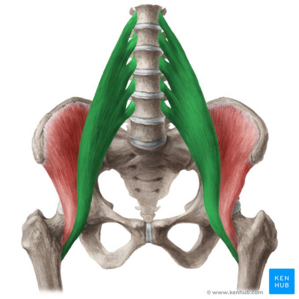
The hip group: psoas major, psoas minor, quadratus lumborumPsoas major and minor
The following tables group muscles according to their function. Please note that when a muscle has multiple functions, it is included in all relevant tables. These tables only list muscle actions associated with the lumbar spine and abdominal wall. These actions are discussed on the relevant page if a muscle acts on other joints. For example, psoas major is also a major hip flexor - this role is detailed on the Functional Anatomy of the Hip page.
Lumbar Spine Flexors
Muscle
Origin
Insertion
Innervation
Action
Psoas major
Vertebral bodies of T12-L4
Intervertebral discs between T12-L4
Transverse processes of L1-L5 vertebrae
Lesser trochanter of femur
Anterior rami of spinal nerves L1-L3
Contribute to lumbar spine flexion when acting bilaterally and when the insertion point is fixed.[2]
Psoas minor
Vertebral bodies of T12 to L1
Iliopubic eminence
Anterior ramus of spinal nerve L1
Weak trunk flexor. This muscle is absent in 40% of people.[2]
Internal obliques
Thoracolumbar fascia
Iliac crest
Inguinal ligament
Lower four ribs
Linea alba
Pubic crest
Lower intercostal nerves Branches of the lumbar plexus: iliohypogastric nerve and ilioinguinal nerve
Bilateral action: lumbar flexion
Assist in raising intra-abdominal pressure
External obliques
Ribs five to twelve
Linea alba
Pubic tubercle
Iliac crest
Intercostal nerves T7- T11 and the T12 subcostal nerve
Bilateral action: lumbar flexion
Rectus abdominis
Pubis, pubic symphysis
Xiphoid process of the sternum
Costal cartilage of ribs 5-7
Thoracoabdominal nerves
Lumbar spine flexion
Assists in raising intra-abdominal pressure
Lumbar Spine Extensors
Muscle
Origin
Insertion
Innervation
Action
Quadratus lumborum
Iliac crest
Iliolumbar ligament
The inferior border of the 12th rib
Transverse processes of L1-L4 vertebrae
Subcostal nerve
Anterior rami of spinal nerves L1-L4
Bilateral action: trunk extension
Interspinales lumborum
Superior aspects of spinous processes of L2-L5
Inferior aspects of spinous processes of L1-L4
Posterior rami of spinal nerves
Stabilise the lumbar spine Extend the lumbar spine
Multifidus
Sacrum
Posterior superior iliac spine
The mammillary processes of the lumbar vertebrae
Transverse processes of T1-3 Articular processes of C4-C7
Spinous processes of the vertebrae above their origin
Medial branches of the posterior rami of the spinal nerves in the corresponding lumbar region
Vascular Supply of the Lumbar Spine and Abdominal Wall
Artery
Origin
Branches
Supply
Lumbar artery (LA):
Left (LLA)
Right (RLA)
Abdominal aorta
Medial
Middle
Lateral
Skin and muscles of the posterior abdominal wall
Joints of the lumbar spine
The lumbar portion of the deep back muscles
Lower two-thirds of the spinal cord
Internal thoracic artery
Subclavian artery
Anterior collaterals
Posterior collaterals
Terminal branches
The superior aspect of the abdominal wall
External iliac artery
Common iliac artery
Inferior epigastric,
Deep circumflex iliac arteries
Lower abdominal wall
Clinical Relevance
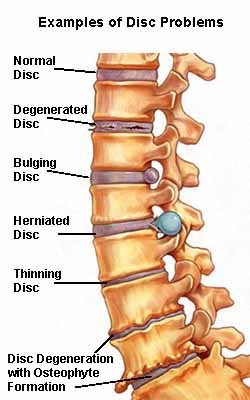
Disc herniationDisc herniations are a common low back condition. They occur when the nucleus pulposus displaces from the intervertebral space. According to Yoon et al.,[10] when there is imaging confirmation of lumbar disc herniation that is "consistent with clinical findings, and failure to improve after six weeks of conservative care", surgical intervention may be required.[10] You can read more about the management of disc herniation symptoms here.
Spinal stenosis is a narrowing of the spinal canal. A range of conditions, such as tumours or bone spurs, can cause spinal stenosis. You can learn about low back pain assessment and prognosis here.
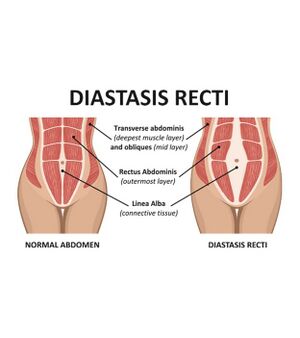
Diastasis recti occurs when the linea alba stretches and produces a gap between the two sides of the rectus abdominis muscle (e.g. in pregnancy, obesity).[2] Learn more about this common condition[11]here.Diastasis recti
↑Waxenbaum JA, Reddy V, Williams C, Futterman B. Anatomy, Back, Lumbar Vertebrae. 2022 Aug 1. In: StatPearls [Internet]. Treasure Island (FL): StatPearls Publishing; 2023 Jan–.
↑ 5.05.1Diebo BG, Varghese JJ, Lafage R, Schwab FJ, Lafage V. Sagittal alignment of the spine: What do you need to know? Clin Neurol Neurosurg. 2015 Dec;139:295-301.
↑Schwab F, Lafage V, Boyce R, Skalli W, Farcy JP. Gravity line analysis in adult volunteers: age-related correlation with spinal parameters, pelvic parameters, and foot position. Spine (Phila Pa 1976). 2006 Dec 1;31(25):E959-67.