When refering to evidence in academic writing, you should always try to reference the primary (original) source. That is usually the journal article where the information was first stated. In most cases Physiopedia articles are a secondary source and so should not be used as references. Physiopedia articles are best used to find the original sources of information (see the references list at the bottom of the article).
If you believe that this Physiopedia article is the primary source for the information you are refering to, you can use the button below to access a related citation statement.
Breast cancer and its' treatment, usually localised surgery with chemotherapy, radiotherapy and endocrine therapy, increase the risk of musculoskeletal problems, especially in the upper limb[1]. Research suggests 67% of women may have shoulder or arm problems up to 3 years after treatment[2].
Osteoporosis and osteoporotic fractures - certain treatments, such as aromatase inhibitors, or chemotherapy-induced ovarian failure, decrease estrogen and lead to bone loss[4]
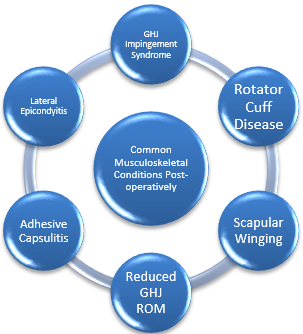
Reduced shoulder range of motion[2]due to pain or fear of movement leading to adapting a flexed protective posture or avoidance of use, leading to muscles shortening (especially pectoralis major) and tightening of the joint capsule.[5]
Post-mastectomy pain syndrome (PMPS) is a neuropathic condition defined as pain located in the anterior surface of the chest, arm pit, shoulder or upper half of the arm that persists for longer than 3 months after surgery. The nature of PMPS is inflammatory and/or neuropathic pain, possibly due to sensitization of peripheral nociceptors, neuroma formation and fibrotic entrapment. [11]
Treatments include physiotherapy, mindfulness-based cognitive therapy, oral medications, surgical intervention (fat grafting, neuroma or lymphedema surgery as required), anesthesia, nerve blocks and neurolysis, laser, neuromodulators and topical capsaicin. [12]
Physiotherapy Management
Physiotherapy intervention will be patient-specific, but can include:
Overall, evidence supports exercise for breast cancer patients to improve physical and mental health.
One controlled trial of 209 patients comparing a three-month rehabilitation program of physical training and psycho-educational sessions to usual care found improvements in Sit and Reach Test, maximal incremental exercise test, Six-Minute Walk Test, BMI and body fat percentage and the European Organization for Research and Treatment of Cancer Quality of Life Questionnaire Core 30.[18]
A self-completed questionnaire completed by 94 women who had had breast cancer found increased physical activity habits and physiotherapy treatments contributed for the perception of lower number of musculoskeletal disorders.[19]
The UK PROSPER trial assessed 392 women undergoing breast cancer surgery at 17 UK NHS cancer centres, and found an exercise program to be clinically and cost effective. Patients were randomised to either usual care (information leaflets) or usual care plus a physiotherapy programme (with stretching, strengthening, physical activity, and behaviour change techniques for exercise adherence). Upper limb function improved after exercise compared with usual care (mean Disabilities of the Arm, Shoulder and Hand (DASH) questionnaire 16.3 (SD 17.6) for exercise (n=132); 23.7 (22.9) usual care (n=138); adjusted mean difference 7.81, 95% confidence interval 3.17 to 12.44; P=0.001). Moreover at 12 months there was lower adjusted mean difference on numerical rating scale (P=0.02) and less arm disability symptoms (P=0.001). There was no increase in complications or adverse events in the exercise group.[13]
Multidisciplinary Team Management
Primary care and gynaecology services, including doctors, nurses and midwives are able to provide assessment, treatment, education and referrals for physical and psychosocial changes post breast cancer.[20]
Occupational therapy has been found to improve global quality of life, role functions, physical, emotional, cognitive, and social functions, fatigue, insomnia, financial impact, systemic therapy side effects, breast symptoms scales and engagement in meaningful activities.[21]
Dietitians can provide diet and nutritional support and education, which has been linked with positive changes in psychological, physiological and behavioural outcomes.[22]