When refering to evidence in academic writing, you should always try to reference the primary (original) source. That is usually the journal article where the information was first stated. In most cases Physiopedia articles are a secondary source and so should not be used as references. Physiopedia articles are best used to find the original sources of information (see the references list at the bottom of the article).
If you believe that this Physiopedia article is the primary source for the information you are refering to, you can use the button below to access a related citation statement.
The thorax is an area of the spine that has, historically, been under-explored. It can, however, be a silent contributor to many presentations in clinical practice.[1]
One cross-sectional survey in Denmark[2] looked at the prevalence of spinal pain. It found that in one year[2]:
However, between 36 to 41 percent of individuals who present with neck or back pain will also have thoracic pain (i.e. around 4 in 10 patients).[3] This is, therefore, a region that should not be ignored in physiotherapy practice.[1]
Anatomy
There are 136 joints in the thoracic spine and 112 muscle attachments. The orientation of the thoracic joints and ribs limit flexion, extension and lateral flexion, but facilitate rotation.[1]
The total rotation available in the thoracic spine is 85 degrees (+/- 14.8 degrees).[5] It contributes 80 percent of the total range of axial trunk rotation.[6] Each thoracic segment rotates between 6 and 8 degrees. This is significantly more than the lumbar segments, which only rotate 2 to 3 degrees.[7]
Thoracic movement is critical for optimal performance in rotational sports and the thoracic spine kinematically links the upper and lower quarters.[8][9] It also contributes 55 percent of the total force during a throw.[10]
Regions of the Thorax
Vertebromanubrial:
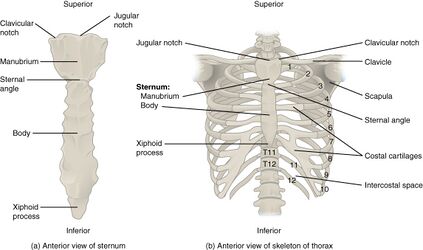
Includes: T1 and T2, ribs 1 and 2, the manubrium and clavicle
NB: True ribs attach directly to the sternum via cartilage, false ribs attach to the lowest true ribs and floating ribs only have posterior attachments to the spine.
Ribs
Ribs 1, 11 and 12 articulate with the named vertebra (i.e. rib 1 articulates with T1)
Ribs 2 to 10 articulate with the named vertebra, as well as the body above, the intervertebral disc and the anterior surface of the transverse process of the named vertebra
'The "thoracic ring” consists of two adjacent vertebrae and the related intervertebral disc, the right and left ribs (attached to the vertebra-disc-vertebra complex at the costovertebral joints), and the anterior attachments to the sternum/manubrium and related cartilages.'[11]
There are 13 articulations per thoracic ring[1][11]:
Zygapophyseal / facet = 2 articulations
Costovertebral = 4 articulations
Intervertebral = 1 articulation
Costotransverse = 2 articulations
Costochondral = 2 articulations
Sternocostal = 2 articulations
Because of the strong anatomical connections between the ribs and the thoracic spine, mobilising a rib laterally will cause motion at the vertebral segments of that thoracic ring, as well as the rib on the opposite side of the body.[1]
Thoracic Function
Lee[11] has described the thoracic spine as a “slinky" or a "shock-absorbing spring”. It consists of a dynamic stack of 10 thoracic rings[11] and has the following functions[7]:
Force transmission
NB: many patients with chronic low back pain or cervical pain have a stiff thoracic spine and increasing thoracic mobility allows for more even distribution of load through the spine with movement[12][13][14]
It is normal for there to be thoracic asymmetry of the facet orientation in the thoracic spine.[17] Asymmetrical anatomy may, however, cause changes in the coupled motion at a segment.[18]
Regional Interdependence
The regional interdependence theory proposes that: “seemingly unrelated impairments in remote anatomical regions of the body may contribute to and be associated with a patient’s primary report of symptoms.”[19] It has been proposed that there may also be central mechanisms involved in mediating regional interdependence.[20]
Examples of interdependency in the thoracic spine include the following:[1]
1. Cervical spine
Tsang and colleagues[22] found that motion of the thoracic spine, particularly the upper thoracic spine, contributes to neck mobility. The upper thoracic spine contributes:[22]
25 percent to cervical flexion and extension
10 percent to cervical rotation
Thoracic spine changes are, therefore, implicated in a loss of cervical range of motion, so this area should always be assessed in patients with neck dysfunction.[22]
Similarly, Engell and colleagues have found that when manual therapy techniques (e.g. high-velocity low-amplitude spinal manipulative therapy) are applied to the thoracic spine, forces can be transmitted to the neck.[23] A randomized placebo-controlled trial by Cevik and Pala concluded that mobilisation applied to the upper thoracic region improve pain, ROM and functionality in patients with mechanical neck pain.[24]
2. Shoulder
The scapula is a sesamoid bone, which rests upon the thorax. It is influenced by the position of the thoracic spine elements and the ribs. Postures such as thoracic kyphosis, thoracic scoliosis or flattened / inverted thoracic spine, can change the resting position of the scapula.[1]
Thoracic kyphosis is associated with a loss of glenohumeral range of motion and impingement symptoms.[25] However, a systematic review and meta analysis by Manoso-Hernando indicated that thoracic kyphosis may not contribute to the development of shoulder pain.[26]
Treating the thoracic spine has been shown to alter shoulder symptoms[27][28][29]
Even minor curves cause wedging of the vertebrae and discs[33]
80 percent of athletes who experience asymmetrical loading on their trunk and shoulders (e.g. javelin throwers, tennis players) have thoracic scoliosis[34]
It could, therefore, be proposed that scoliosis provides a mechanical advantage in asymmetrical sports[1]
Summary
Patients presenting for physiotherapy with back or neck pain will have an associated thoracic spine dysfunction which needs to be assessed and managed[35]
Biomechanics and knowledge of the clinical anatomy of the thorax will help you to better understand the underlying pathogenesis of these conditions
Thoracic rotation is essential for optimal sports performance and functional activities
Postural dysfunctions such as tight hamstrings or hip flexors may force compensatory 'gives' in the thoracic spine - it is essential to look for the source of the problem
↑Kenhub - Learn Human Anatomy. Thoracic Spine - Definition & Components - Human Anatomy | Kenhub. Available from: https://www.youtube.com/watch?v=3mniZ_zQuRE [last accessed 28/8/2021]
↑Heneghan NR, Hall A, Hollands M, Balanos GM. Stability and intra-tester reliability of an in vivo measurement of thoracic axial rotation using an innovative methodology. Manual Therapy. 2009; 14(4):452-5.
↑McConnell J. Recalcitrant chronic low back and leg pain--a new theory and different approach to management. Man Ther. 2002;7(4):183-92.
↑Mohanty PP, Pattnaik M. Mobilisation of the thoracic spine in the management of spondylolisthesis. J Bodyw Mov Ther. 2016;20(3):598-603.
↑Cleland JA, Childs JD, McRae M, Palmer JA, Stowell T. Immediate effects of thoracic manipulation in patients with neck pain: a randomized clinical trial. Man Ther. 2005;10(2):127-35.
↑Edmondston SJ, Singer KP. Thoracic spine: anatomical and biomechanical considerations for manual therapy. Man Ther. 1997;2(3):132-43.
↑Kudzinskas A, Callahan AL. Anatomy, Thorax. [Updated 2023 Jul 30]. In: StatPearls [Internet]. Treasure Island (FL): StatPearls Publishing; 2025 Jan-.
↑Masharawi Y, Rothschild B, Dar G, Peleg S, Robinson D, Been E et al. Facet orientation in the thoracolumbar spine: three-dimensional anatomic and biomechanical analysis. Spine (Phila Pa 1976). 2004;29(16):1755-63.
↑Andriacchi T, Schultz A, Belytschko T, Galante J. A model for studies of mechanical interactions between the human spine and rib cage. J Biomech. 1974;7(6):497–507.
↑Ghamkhar L, Arab AM, Nourbakhsh MR, Kahlaee AH, Zolfaghari R. Examination of regional interdependence theory in chronic neck pain: interpretations from correlation of strength measures in cervical and pain-free regions. Pain Med. 2020;21(2):e182-e190.
↑ 22.022.122.2Tsang SM, Szeto GP, Lee RY. Normal kinematics of the neck: the interplay between the cervical and thoracic spines. Man Ther. 2013;18(5):431-7.
↑Engell S, Triano JJ, Howarth SJ. Force transmission between thoracic and cervical segments of the spine during prone-lying high-velocity low-amplitude spinal manipulation: A proof of principle for the concept of regional interdependence. Clin Biomech (Bristol, Avon). 2019;69:58-63.
↑Barrett E, O'Keeffe M, O'Sullivan K, Lewis J, McCreesh K. Is thoracic spine posture associated with shoulder pain, range of motion and function? A systematic review. Man Ther. 2016;26:38-46.
↑Yoo HS, Nahm FS, Lee PB, Lee CJ. Early thoracic sympathetic block improves the treatment effect for upper extremity neuropathic pain. Anesth Analg. 2011;113(3):605-9.
↑Berglund KM, Persson BH, Denison E. Prevalence of pain and dysfunction in the cervical and thoracic spine in persons with and without lateral elbow pain. Man Ther. 2008;13(4):295-9.