When refering to evidence in academic writing, you should always try to reference the primary (original) source. That is usually the journal article where the information was first stated. In most cases Physiopedia articles are a secondary source and so should not be used as references. Physiopedia articles are best used to find the original sources of information (see the references list at the bottom of the article).
If you believe that this Physiopedia article is the primary source for the information you are refering to, you can use the button below to access a related citation statement.
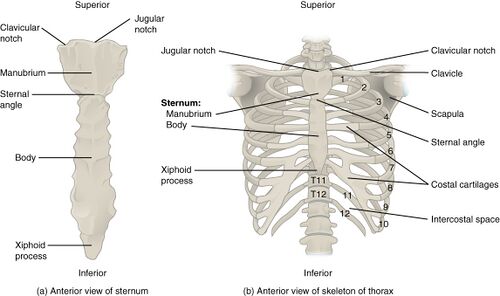
The sternum completes the anterior chest wall as the ventral breastplate. The sternum is a flat cancellous bone with a compact cortex, it is slightly convex anteriorly, with multiple indentations along its lateral borders (costal notches). [1][2][3]
Structure
Parts of sternum
The sternum develops as three distinct parts:
The manubrium is flat and four-sided, wider superiorly
The body is a flat rectangular bone that has facets on its lateral border for articulation with the ribs. It is: approximately 20 cm long; 3-4 cm wide; 1 cm thick
The xiphoid process is a thin bony projection inferiorly
They articulate via secondary cartilaginous joints via hyaline cartilage with a fibrocartilaginous intervening disc. [1]
Function
Changes in the position of the skeletal components of the chest wall cause the changes in the dimensions of the chest. Two very different types of motion of the ribs and sternum create these changes in diameter.
Anteriorly, the ribs are connected to the sternum, which can be viewed as a handle on a mechanical water pump that is activated manually. The manubrium (the ‘‘handle’’) has little motion, so its upward and anterior excursion is relatively limited. The joint between the manubrium and the body of the sternum allows the body and the xiphoid process to have a greater anterior and cephalad excursion, which causes the lower ribs to move more cephalad and anterior than the upper ribs, resulting in a greater increase in diameter in the lower chest.
The accessory muscles of inspiration cause these increases in thoracic diameter, which result in forced inspiration. Conversely, the accessory muscles of expiration cause the sternum to move downward and inward, decreasing these diameters and causing forced expiration[4]
Superiorly the manubrium attaches to the neck where the two deep layers of cervical investing fascia insert
The manubrium: articulates with the first rib (primary cartilaginous), clavicle (atypical synovial), and body of the sternum (secondary or primary cartilaginous joint).
The body: articulates with the second rib at the sternomanubrial angle and the 3rd to 7th rib and costal cartilages
Inferiorly articulates with xiphisternal joint, a secondary cartilaginous joint (symphysis)
Arterial supply: nutrient branches from internal thoracic (mammary) artery; deep to the sternum is the internal thoracic artery laterally
Venous drainage: tributaries of the internal thoracic veins, posterolateral to the sternum
Nerve supply is via intercostal nerves which arise from the anterior rami of thoracic spinal nerves
Clinical relevance
The slight movements that take place at the manubriosternal joint are essential for movements of the ribs.
In the anomaly called ‘funnel chest’, the sternum is depressed in another anomaly called ‘pigeon chest’, there is forward projection of the sternum like the keel of a boat, and flattening of the chest wall on either side.
For cardiac surgery, the manubrium and/or body of sternum need to be splitted in midline and the incision is closed with stainless steel wires. See Sternal Precautions
Sternal fracture are associated with severe blunt trauma to the chest, such as in a vehicular accident.
Costochondritis is the most common cause of sternal pain and occurs when the cartilage between the sternum and ribs become inflammed and/ or irritated.
Sternum pain is pain or discomfort in the area of the chest that contains the sternum and the cartilage connecting it to the ribs. See Sternal Pain - Different Causes