When refering to evidence in academic writing, you should always try to reference the primary (original) source. That is usually the journal article where the information was first stated. In most cases Physiopedia articles are a secondary source and so should not be used as references. Physiopedia articles are best used to find the original sources of information (see the references list at the bottom of the article).
If you believe that this Physiopedia article is the primary source for the information you are refering to, you can use the button below to access a related citation statement.
Because of the rising popularity of media devices such as smartphones and computers, frequent users often exhibit incorrect posture.
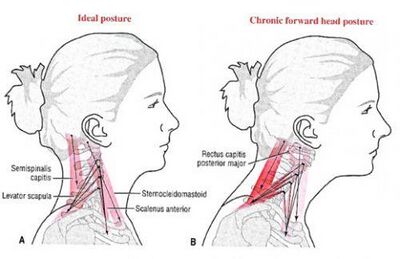
Forward head posture (FHP) is a poor habitual neck posture. It often co-exists with Upper Crossed Syndrome
Defined by hyperextension of the upper cervical vertebrae and forward translation of the cervical vertebrae.[1]
Thoracic Kyphosis is a complication of the combination of slouched-forward shoulders and rounded upper back.
Can lead to a painful shortening of the muscles of the back of the neck, as well as compression of the cervical vertebrae—the uppermost portion of the spine that supports the head and protects the spinal cord.
Due to the increased compressive forces through the neck joints and increased muscle tension, pain is the common outcome. Some of the types of problems associated with FHP are:
Pain, pins & needles and numbness in the arms and hands
Many people develop chronic or recurrent problems because they receive treatment for the pain (e.g. pain killers or anti-inflammatory medication) but never receive treatment for the underlying cause which is their FHP.[2] This 4 minutes video is a brief summary of FHP
FHP evaluation is clinically important for diagnosis and rehabilitation treatment.
Typical forward head posture
FHP increases compressive loading on tissues in the cervical spine, particularly the facet joints and ligaments.
Studies have reported that symptoms including neck pain, headache, temporomandibular pain, and musculoskeletal disorders are related to FHP
FHP greatly influences respiratory function by weakening the respiratory muscles[1].
FHP can have a negative impact on static balance.[4]
Forward head and round-shoulder postures (FHRSP) can result in shoulder pain and dysfunction because of altered scapular kinematics and muscle activity and consequently, consequently placing increased stress on the shoulder.[5][6]
There is new evidence that there is no relation between FHP and neck pain; additionally, individual with neck pain had lower range of motion (ROM) and slower neck movement.[7]
Epidemiology/ Etiology
The overall prevalence of neck pain in the general population is high, reaching 86.8%.[8]
Risk factors associated with forward head posture include female gender, older age, being an ex-smoker, high job demands, and low social or work support.[8]
Etiologies include:
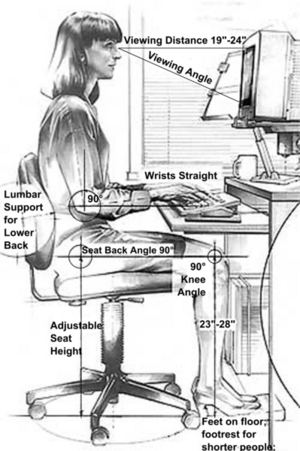
Occupational posture: forward or backward leaning of head for long durations, slouched or relaxed sitting, faulty sitting posture while using computer or screen.
Effect of gravity: slouching, poor ergonomic alignment.
Other faulty postures like pelvic and lumber spine posture.
With temporomandibular joint symptoms, the muscles of mastication may have increased tension (Pterygoid, Masseter, temporalis muscles).[11][12]
Assessment
Assessment of FHP is important to assess the impact of the therapeutic interventions.
Clinical assessment of FHP is done through observation of the position of the head relative to the reference anatomical landmarks.
Radiographic techniques can be used to measure postural angles, but it is not always practical.
The craniovertebral angle is one of the most reliable methods and common angles for evaluating the FHP. It examines head status relative to the seventh cervical vertebrae (C7). [13]
Physiotherapy Management
To Decrease Pain:Source: Yamavu Author: Yamavu Permission: Universal public domain
↑Szczygieł E, Sieradzki B, Masłoń A, Golec J, Czechowska D, Węglarz K, Szczygieł R, Golec E. Assessing the impact of certain exercises on the spatial head posture. International journal of occupational medicine and environmental health. 2019 Feb 5;32(1):43-51.