When refering to evidence in academic writing, you should always try to reference the primary (original) source. That is usually the journal article where the information was first stated. In most cases Physiopedia articles are a secondary source and so should not be used as references. Physiopedia articles are best used to find the original sources of information (see the references list at the bottom of the article).
If you believe that this Physiopedia article is the primary source for the information you are refering to, you can use the button below to access a related citation statement.
This page outlines some Manual Techniques and Exercises for the Thoracic Spine.
Range of motion (ROM) in the thoracic region is necessary for a number of daily activities and sports such as golf, throwing sports, tennis, and rowing. Dysfunction of the thoracic spine can also play a role in breathing difficulties and may be linked to postural issues in the later stages of life. Additionally, reduced ROM or strength in the thoracic spine will affect the entire kinetic chain.
Restrictions in motion have the potential to impact performance and may manifest as local or distant musculoskeletal pathology.
Movement of the thoracic spine is coupled with movement of the adjoining ribs. Thoracic extension involves concurrent posterior rotation (external torsion) and depression of the posterior ribs with elevation of the anterior ribs. Lateral flexion involves a combination of spinal segments side bending, ribs on the same come together while ribs on the opposite side separate. Inability to move well in all directions predisposes people to injury and pain.[1]
Motion restrictions may be due to contractile or non-contractile structures, and interventions to address each specific tissue restriction can vary depending on the source of the involved tissue.
Contractile restrictions - eg.muscle tightness, trigger points, may be addressed via muscle stretching or manual interventions such as soft-tissue mobilization or sustained pressure.
Non-contractile restrictions - eg hypermobile, or hypomobile joints
Joint hypermobility is usually addressed with therapeutic exercise to improve neuromuscular control
Joint hypomobility may be addressed with manual interventions including joint mobilization and manipulation. Hypomobility of vertebral and costovertebral joints in the thoracic spine may prevent the patient from attaining full motion of the thorax.
Most interventions to address thoracic spine mobility are dependent on the clinician providing the intervention.
The ability for the patient to incorporate self-mobilizations of the thoracic spine into therapeutic exercise programs may help maximize intervention outcomes.[2]
Range of Options - Manual Therapy Thoracic Spine
There are a multitude of techniques available - choosing the appropriate ones are usually to do with therapist expertise and choice. The following have great site links for detailed information.
Active Release Techniques: A practitioner determines where adhesions are through touch, the practitioner then couples a patient's active movement with his/her touch. [3]
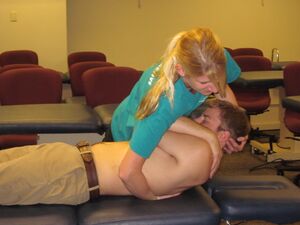
Joint Manipulation: A passive, high velocity, low amplitude thrust applied to a joint complex within its anatomical limit* with the intent to restore optimal motion, function, and/ or to reduce pain.[4]
Joint Mobilisation: A manual therapy technique comprising a continuum of skilled passive movements to the joint complex that are applied at varying speeds and amplitudes, that may include a small-amplitude/ high velocity therapeutic movement (manipulation) with the intent to restore optimal motion, function, and/ or to reduce pain.[4]
Mobilisations
Joint mobilisations have been defined by Maitland as an externally imposed, small amplitude passive motion that is intended to produce gliding or traction at a joint[5].
They are often used in Physiotherapy management in order to produce mechanical and neurophysiological effects[5].
These videos demonstrate 3 common mobilisation styles.
This first 2 minute video shows a good upper thoracic function mobilisation for extension, and extension combined with rotation.
Stretching and Strengthening of the thoracic extensor muscles can be achieved by following exercises:
Cat-Cow stretch
To perform: Begin in quadruped (hands and knees) with knees under hips and hands under shoulders. Inhale while arching the back and pressing the chest towards the floor as you lift the head up. Relax your shoulders. From there, inhale as you move from this “cow” position to an angry “cat” position, rounding out your back and pushing shoulder blades away from you as your spine forms a “C” curve in the opposite direction. Go through this cycle 10 times.
Open Book
This stretch is a great way to improve rotation in the thoracic spine.
Begin by lying on your left side with knees bent and arms straight out in front of you, palms touching. Gently lift your right hand straight up off of the left hand, opening up the arm like it’s a book or door while following the top hand with your head and eyes until your right hand is on the other side of your body, palm up, with your head and eyes turned towards the right. Hold this stretch for a few breaths before returning to the starting position with palms facing each other. Repeat up to 10 times on each side.
Thoracic extension over Foam Roller
If using a foam roller, place the foam roller perpendicular to torso. Sit in front of the foam roller, and gently hammock the head with your hands, interlocking the fingers and supporting the weight of your head without pulling it.
Lean backwards so that your upper back is reaching backwards over the foam roller. Gently allow your shoulders to reach towards the floor while the foam roller supports your upper back. Carefully lift the hips to roll up and down the muscles of the upper back or move the foam roller up and inch after each stretch, leaning backwards over the roller until a gentle stretch is felt. Repeat several times, without forcing your body into discomfort. This stretch can be very intense, so start with small movement and don’t spend more than a couple minutes in this position.
Doorway Stretch (Pec stretch)
Use the walls of a standard doorway to stretch out the pecs.
Bring each forearm up against one side of the doorway. Gently lean forward through the doorway keeping the arms on one side to stretch out the chest. Hold for 30 seconds.[11]
Stretching the Extensor Muscles and strengthening the Anterior Neck Flexors: The patient stands with his back against the wall and retracts the chin. There will be an upper cervical spine flexion and lower cervical spine extension. Hold this position for 15 seconds. [4]
Exercises - Motor Control
Motor control can be defined as ‘the maintenance of spinal integrity during skilled movement’[12]. A 2020 systematic review found seven exercises as beneficial for aiding developing motor control of the thoracic spine and classifying them into three subgroups:[13]1. segmental movement control. 2. spinal dissociation 3. whole body coordination
Spinal dissociation - challenging control by maintaining a neutral, static thoracic posture while moving other body regions
Bird dog
Wall squat
Segmental movement control - challenge dynamic control of thoracic spine multiplanar movement
Flexion/extension control in 4ptk/quadruped position
Open book
Sitting side flexion
Whole body coordination - challenge dynamic control and coordination of thoracic spine movements with movements of other body regions
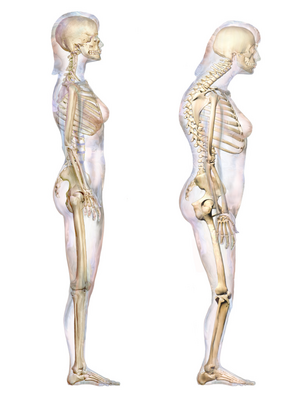
posture can be a contributing factor towards thoracic pain for certain patients
Suggestions to improve posture include regular exercise and stretching, ergonomic furniture and paying attention to the way the body feels.
It is is important that the patient understands his problem and the cause of his problem. Postural education and training is an important aspect of treatment.
Postural awareness training steps:
Explaining the patient how their current posture is contributing to their symptoms (if posture is contributing for that specific patient. Posture is not a factor for all patients - read more on this at posture)
Demonstrating correct posture, explaining every motion that should be made:
Belly button in & down (soft contraction)
Knees slightly bent
Shoulders back ie scapular retraction, it can help to do external rotation in the shoulder to accompany this motion
Chest up
Chin slightly tucked in
Have the patient try this him/herself, the first time still going over every cue. Once the patient has practiced the posture a sufficient amount of times to immediately be able to resume good posture on command, taping and random reminders (timer) can be used to ensure the posture is kept during the day.
The training of all the postural muscles is important to assure the stability of the spine. Training of the postural muscles can be achieved by eg.balance training
a balance exercise example, Single leg stance - With this exercise it is important to give the following instructions: The upper back and abdominal muscles should be working at all times as well as the pelvic floor. Roll shoulder blades backwards, “Lengthen” your neck, Don’t raise your leg to high (+- 10cm of the floor)
Because pain in the thoracic region is often caused by muscle tension and poor posture, initial treatment efforts focus on relieving the tension with
Physical therapy - using some of the techniques given above eg. home exercises that stretch and strengthen the back, shoulder and stomach muscles, massage, postural education, joint mobilisations, heat and/or ice therapy etc.
2. Over-the-counter medications such as acetaminophen or ibuprofen.
The majority of clients usually will improve with these measures
↑George, J.W., Tunstall, A.C., Tepe, R.E. and Skaggs, C.D., 2006. The effects of active release technique on hamstring flexibility: a pilot study. Journal of manipulative and physiological therapeutics, 29(3), pp.224-227. Available from: https://www.sciencedirect.com/science/article/pii/S0161475406000376
↑ 4.04.1Mintken PE, et al. A Model for Standardizing Manipulation Terminology in Physical Therapy Practice. J Orthop Sports Phys Ther 2008;38(3):A1-A6.
↑ 5.05.1Edmond S. Joint Mobilization/Manipulation - E-Book. 3rd ed. Elsevier Health Sciences.; 2016.
↑Spencer S, Wolf A, Rushton A. Spinal-exercise prescription in sport: classifying physical training and rehabilitation by intention and outcome. Journal of athletic training. 2016 Aug 1;51(8):613-28.