
Pelvic Fractures:Low Impact
Original Editor - Lucinda hampton
Top Contributors - Lucinda hampton, Mahbubur Rahman, Kim Jackson, Angeliki Chorti and Janine van Dyk
Definition / Description

A pelvic fracture is a disruption of the bony structures of the pelvis. An anatomic ring is formed by the fused bones of the ilium, ischium and pubis attached to the sacrum. A pelvic fracture can occur by low-energy mechanism or by high-energy impact. Due to the increasing life expectancy we are seeing more low energy/fragility fractures of the pelvis (FFPs). Studies have shown a significant increase in low-energy pelvic ring injuries in ages 60 and older. [1] These kinds of fractures may even occur spontaneously in patients with severe osteoporosis.
- Low-energy fractures of the elderly population sustained from a ground level fall frequently result in pelvic fractures that do not damage the true integrity of the ring structure and are often treated non-operatively. These fractures include superior and inferior pubic rami fractures as well as non-displaced sacral alar fractures.[1]
- In some patients, an insidious progress of bone damage leads to increasing displacement, nonunion and persisting instability. New concepts for surgical treatment have to be developed to address the functional needs of the elderly patients.
- The majority of pelvic fractures encountered in the elderly are stable and amenable to non-operative treatment but they do incur a substantial demand on healthcare resources since they are often associated with a prolonged hospital stay and requirement for rehabilitation.[1][2]
- Due to some distinct differences, the established classifications for pelvic fractures do not fully reflect the clinical and morphological criteria of FFPs. Most FFPs are minimally displaced and do not require surgical therapy.[3] However, pelvic fractures are more likely to result in significant blood loss in the elderly and require angiography.[4]
Epidemiology /Etiology
Low impact injuries are seen more frequently in elderly and adolescents.
- In the elderly as a result of falls (e.g. stable fractures of the pelvic ring or insufficiency fractures of sacrum and anterior pelvic ring).
- Approximately two-thirds of pelvic fractures in older patients are due to low energy falls, without evidence of trauma.[5][6]
- Falls can be caused by:balance problems; vision problems; medication side effects; having frailty; by encountering unintended obstacles such as pets underfoot, slippery floors, or un-anchored throw rugs .[7][8]
- In adolescents, typically as a result of athletic injuries (e.g. avulsion fractures of superior or inferior iliac spines or apophyseal avulsion fracture of the iliac wing or ischial tuberosity) or falls [9]
Expected Outcomes/Mortality Rates
- Low-energy pelvic injuries do not appear to increase rate of mortality (compared to the US population).
- Fracture pattern, race, sex, discharge disposition and length of stay do not seem to have an effect on mortality.
- Elderly patients with an average age of 84.5 years and more than two comorbidities had higher rates of mortality; however, these patients are more likely to sustain earlier mortality regardless of low-energy pelvic fracture. [1]
- Pelvic fractures in the elderly are associated with an increased hospital stay and mortality, even when they are isolated injuries. [10]
Management
Management after FFPs should aim at effective treatment and management of related complications. [11] High-quality evidence for rehabilitative interventions after PF in terms of duration and modality of therapy, rehabilitation setting, care pathways, and long-term functional outcomes are lacking. [11]Nevertheless, treatment is almost invariably non-operative with a short period of initial bed rest and analgesia with mobilisation as soon as pain allows.
- To facilitate rehabilitation it is important to achieve adequate analgesia (failing to do so hampers regaining mobility, increases the risk of complications and prolongs the hospital stay). Patients with cognitive impairment may find it difficult to communicate analgesic needs and this should be taken into account in their management. Care is needed in choosing analgesic management, opioid medication can increase confusion and non-steroidal analgesics are best avoided due to renal and cardiovascular side-effects.
- Patients with pelvic fractures experience a reduction in their health-related quality of life (HRQoL). Most do not return to the HRQoL of their pre-injury state within 1 year after trauma. Prognostic factors for decreased HRQoL are a low pre-injury score, high ISS and female gender. [12]
Physiotherapy

In pelvic fractures in the elderly population, the rehabilitation process will be focused on optimising their quality of life.
- Rapid mobilisation and sufficient pain relief are the main objectives of treatment [13]
- Appointment of the home to assess the need for eg rails, ramps, increased lighting, removal of loose mats.
- Appropriate walking aids should be supplied, and gait training.
- Falls education eg clearing the floors of loose obstacles (eg, throw rugs, mats), placing sticky mats in the shower and on the bathroom floor, installing grab bars or rails for the shower, toilet, and stairs, wearing nonslip house shoes, and preventing pets from walking near your feet.
- A falls prevention outpatient programme could be of benefit.
- Reduce pain eg heat therapy,TENS, stretching exercises, strengthening exercises, joint mobilisation, manual therapy.
- A home rehabilitation program should be implemented. [14] to strengthen and stretch the muscles around hip, upper leg, and core to help prevent future problems, such as fatigue and walking difficulty eg the Otago Exercise Program
- Restore strength
- Restore range of motion (hip, spine, and leg motion)
- Restore balance
- Aid speed of healing
- Speed up clients return to activity and sport
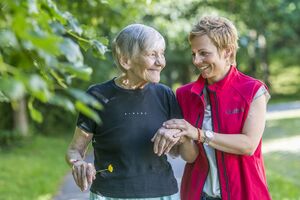

The goals of the physiotherapy programme should provide the patient with an optimal return of function by improving functional skills, self-care skills and safety awareness.[15]
References
- ↑ 1.0 1.1 1.2 1.3 Ghassibi M, Boyalakuntla DS, Gentile J. Low-Energy Pelvic Ring Fractures in the Elderly Population: Expected Outcomes and Associated Mortality Rates. J Clin Med Res. 2019 Nov;11(11):725-8.
- ↑ Keller JM, Sciadini MF, Sinclair E, O'Toole RV. Geriatric trauma: demographics, injuries, and mortality. J Orthop Trauma. 2012 Sep;26(9):e161-5.
- ↑ Rommens PM, Hofmann A. Comprehensive classification of fragility fractures of the pelvic ring: recommendations for surgical treatment. Injury. 2013 Dec 1;44(12):1733-44.
- ↑ Henry SM, Pollak AN, Jones AL, Boswell S, Scalea TM. Pelvic fracture in geriatric patients: a distinct clinical entity. J Trauma. 2002 Jul;53(1):15-20.
- ↑ Soles GL, Ferguson TA. Fragility fractures of the pelvis. Curr Rev Musculoskelet Med. 2012 Sep;5(3):222-8.
- ↑ Tsiridis E, Upadhyay N, Giannoudis PV. Sacral insufficiency fractures: current concepts of management. Osteoporos Int. 2006 Dec;17(12):1716-25.
- ↑ Davis DD, Tiwari V, Kane SM, et al. Pelvic Fracture. [Updated 2024 Feb 29]. In: StatPearls [Internet]. Treasure Island (FL): StatPearls Publishing; 2024 Jan-. Available from: https://www.ncbi.nlm.nih.gov/books/NBK430734/ [8/12/2024]
- ↑ Boufous S, Finch C, Lord S, Close J. The increasing burden of pelvic fractures in older people, New South Wales, Australia. Injury. 2005 Nov;36(11):1323-9.
- ↑ Ferraro SL, Batty M, Heyworth BE, Cook DL, Miller PE, Novais EN. Acute Pelvic and Hip Apophyseal Avulsion Fractures in Adolescents: A Summary of 719 Cases. J Pediatr Orthop. 2023 Apr 1;43(4):204-210.
- ↑ O'brien DP, Luchette FA, Pereira SJ, Lim E, Seeskin CS, James L, Miller S, Davis K Jr, Hurst JM, Johannigman JA, Frame SB. Pelvic fracture in the elderly is associated with increased mortality. Surgery. 2002 Oct;132(4):710-4; discussion 714-5.
- ↑ 11.0 11.1 Piccione F, Maccarone MC, Cortese AM, Rocca G, Sansubrino U, Piran G, Masiero S. Rehabilitative management of pelvic fractures: a literature-based update. Eur J Transl Myol. 2021 Sep 17;31(3):9933.
- ↑ Brouwers L, de Jongh MAC, de Munter L, Edwards M, Lansink KWW. Prognostic factors and quality of life after pelvic fractures. The Brabant Injury Outcome Surveillance (BIOS) study. PLoS One. 2020 Jun 11;15(6):e0233690.
- ↑ Oberkircher L, Ruchholtz S, Rommens PM, Hofmann A, Bücking B, Krüger A. Osteoporotic pelvic fractures. Deutsches Ärzteblatt International. 2018 Feb;115(5):70.
- ↑ Zidén L, Kreuter M, Frändin K. Long-term effects of home rehabilitation after hip fracture - 1-year follow-up of functioning, balance confidence, and health-related quality of life in elderly people. Disabil Rehabil. 2010;32(1):18-32.
- ↑ Piccione F, Maccarone MC, Cortese AM, Rocca G, Sansubrino U, Piran G, Masiero S. Rehabilitative management of pelvic fractures: a literature-based update. Eur J Transl Myol. 2021 Sep 17;31(3):9933.