When refering to evidence in academic writing, you should always try to reference the primary (original) source. That is usually the journal article where the information was first stated. In most cases Physiopedia articles are a secondary source and so should not be used as references. Physiopedia articles are best used to find the original sources of information (see the references list at the bottom of the article).
If you believe that this Physiopedia article is the primary source for the information you are refering to, you can use the button below to access a related citation statement.
Hip abduction is the movement of the leg away from the midline of the body. This action is used daily eg when we step to the side, get out of bed, get out of the car. We also use it in walking to stop unsupported leg from falling "into space".
The Hip abductor muscle group are located on the lateral thigh.
Many hip and knee problems arise due to weak hip abductors. Hip abduction strengthening exercises help to prevent and treat pain in the hips and knees[2].
Function
Trendelenburg Gait
The hip abductor muscles contribute to various actions, including pelvic stabilization during walking and running; abduction and rotation at the hip joint[3].
The hip abductor muscles stabilize the hip within the frontal plane during the single-limb support phase of walking.
High demand is placed on the hip abductors occurs with walking. eg The right abductor muscles must work when the right leg is in the single-limb support phase of gait, as the left limb is swinging forward. The right hip abductors must supply an adequate contraction force to keep the pelvis from dropping down to the L. Weakness of these muscles results in an unstable pelvis while walking or while attempting to stand on one leg[1].
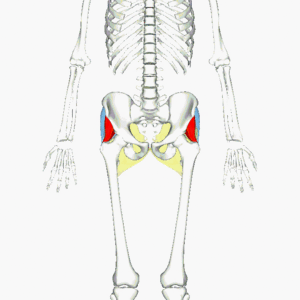
Gluteal Muscles. The Maximus (yellow), medius (blue) and minimus (red).Gluteus medius is the prime mover of abduction at hip joint. It is located on the lateral aspect of the upper buttock, below the iliac crest. The superior muscle is broad with the muscle narrowing towards its insertional tendon giving it a fan-shape. The anterior portion of Gluteus medius abducts and assists in flexion and medial rotation of hip. The posterior portion of Gluteus medius abducts and assists in extension and lateral rotation of hip.[4]
Gluteus minimus muscle is the smallest one of the three gluteal muscles, it lies deep to the gluteus medius muscle. The gluteus minimus is similiar to the gluteus medius in function, structure, nerve and blood supply. The gluteus minimus acts in synergy with the gluteus medius to abduct and internally rotate the thigh, and contributes to the stabilization of the hip and pelvis[5].
The tensor fasciae latae (TFL) is a muscle of the proximal anterolateral thigh that lies between the superficial and deep fibres of the iliotibial (IT) band. The TFL works in conjunction with the gluteus maximus, gluteus medius, and gluteus minimus in a wide variety of hip movements, including flexion, abduction, and internal rotation.The TFL is most important clinically for assisting in pelvis stability while standing and walking[6].
Tensor Fascia latae (and others)
The secondary hip abductors include the
Piriformis is a flat muscle and the most superficial muscle of the deep gluteal muscles. It assists in hip abduction when hip is flexed.[7]
The Sartorius muscle is a thin, long, superficial muscle in the anterior compartment of the thigh. It runs over 2 joints (hip and knee joints) and is the longest muscle in the human body. At the hip it flexes, weakly abducts, and rotates the thigh laterally[8].
Superior fibers of the Gluteus Maximus, the largest and heaviest muscle in the body. It is the most superficial of all gluteal muscles that are located at the posterior aspect of the hip joint.
Physiotherapy Implications
Lateral Thigh Pain
Hip abductor weakness results in insufficient pelvic stabilised during locomotion. This altered biomechanics causes problems in the kinetic chain eg
Stress the outer hip soft tissues and lead to pain and injury
Can increase medial femoral rotation and valgus knee moments, causing an increased Q-angle, subsequently alter tracking of the patella and increase lead to injury and pain.
Further up the kinetic chain the pelvis may tilt anterior causing hyperlordosis of the lumbar spine.
Q angle
See these relevant pages
Trendelenburg Gait The trendelenburg gait is caused by a unilateral weakness of the hip abductors, mostly the gluteal musculature.
Gluteal Tendinopathy (GT) Pelvic control in a single leg stance is controlled 70% by the abductor muscles. Weakness and/or muscle bulk changes impact the balance of the abductor mechanism and increase the compression of the gluteal tendons leading to GT and Greater Trochanteric Pain Syndrome
Hip osteoarthritis Hip abductor weakness due to the progression of hip osteoarthritis (OA) commonly causes poor functional mobility. The hip abductor strength is as a clinically relevant factor for successful functional outcomes when treating hip OA.[9]
Knee Osteoarthritis Hip abductor strengthening improves function and reduces pain in people with medial knee OA[10].
Total Hip replacement Physiotherapy directed hip abductor strength training improved gait speed and cadence in people who have been discharged from hospital after total hip replacement[11].
Hip Dysplasia Clinical features vary for mild hip instability, limited abduction in the infant, less mobility or flexibility on one side, limping or toe walking, and osteoarthritis in the adult