When refering to evidence in academic writing, you should always try to reference the primary (original) source. That is usually the journal article where the information was first stated. In most cases Physiopedia articles are a secondary source and so should not be used as references. Physiopedia articles are best used to find the original sources of information (see the references list at the bottom of the article).
If you believe that this Physiopedia article is the primary source for the information you are refering to, you can use the button below to access a related citation statement.
The hip extensor group of muscles produce the greatest torque across the hip in comparison to the other hip muscle groups.
The extensor torque is often used to rapidly accelerate the body upward and forward from a position of hip flexion, such as when pushing off into a sprint, arising from a deep squat, or climbing a very steep hill.[2]
The hip flexors and extensors have to work together to maintain a neutral pelvis and allow a powerful and safe range of motion through the hip (when the femur is stabilized, activation of the hip extensors cause posterior pelvic tilt)[1].
Anatomy
Deep Squat: Hip extensors getting a work out
Gluteus Maximus the largest and heaviest muscle in the body, and is the chief extensor of the thigh. It is the most superficial of all gluteal muscles that are located at the posterior aspect of the hip joint. It is the largest muscle at the hip representing 16% of the total cross-sectional area.
The gluteus maximus is supplied by the inferior gluteal nerve (root L5, S1 and S2). Cutaneous supply is mainly provided by L2 and 3.
Sciatic nerve posterior thigh
The hamstring muscle group plays a prominent role in hip extension and knee flexion. The semitendinosus, semimembranosus, and biceps femoris muscles comprise the hamstring muscle group. Beginning at the pelvis and running posteriorly along the length of the femur, the majority muscles within the hamstring complex cross both the femoroacetabular and tibiofemoral joints.[3]
Semitendinosus, Semimembranosus, Biceps Femoris Long head and Adductor magnus Hamstring part are all suppled by the tibial part of the sciatic nerve[4]
Gluteus maximus and the hamstrings work together to extend the trunk from a flexed position, eg standing up from a bent forward position. Eccentric control is also provided when bending forward.[5]
Physiotherapy Relevance
Prone, hip extension.
The below all have relevance to physiotherapists
The gluteus maximus is the primary hip extensor and can be evaluated by having the patient lie prone and asking her or him to extend her or his leg off the table against resistance. See Muscle Strength Testing
Paralysis of hip extensors (L5, S1, S2): The hip extensor muscles are primarily active during the beginning of stance and are used to prevent hip flexion. Clients with paralysis of the hip extensor muscles generate hip extensor torques by hyper-extending the hips. Hip hyper-extension is achieved by dorsiflexing the ankle, extending the knee and hyper-extending the lumbar spine.[6]
Weak Hip Extensors will cause a person to take a smaller step to lessen the hip flexion required for initial contact, resulting in a lesser force of contraction required from the extensors. Overall gait will be slower to allow time for limb stabilisation. Compensation is increased posterior trunk positioning to maintain alignment of the pelvis in relation to the trunk[7]
Unfortunately, people who sit for long periods of time sitting tend to have tighter hip flexor muscles and weaker hamstrings, termed Lower crossed syndrome.(LCS)
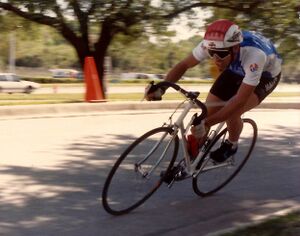
A racing cyclist needs good hip extensor strength Athletes with relative LCS will exhibit decreased hip extension at terminal stance phase or “toe off.” [8] This will negatively effect performance.
Sports that use hip extensors maximally include: ice skating; sprint racing and running; cycling; uphill walking; swimming.
Achieving full or near full extension of the hips has functional advantages, eg increases the metabolic efficiency of relaxed stance and walking.
When in full or nearly full hip extension a person's line of gravity passes just posterior to the medial-lateral axis of rotation through the femoral heads.
Gravity, in this position assists with maintaining the extended hip while standing, with little activation from the hip extensor muscles[2].