
Single Leg Stance Test
Original Editor - Lucinda hampton
Top Contributors - Lucinda hampton, Clara Foster, Christine Ibeagi, Jessyca Brown, Aminat Abolade, Kim Jackson, Wanda van Niekerk and Saud Alghamdi
Purpose
- The Single Leg Stance (SLS) Test is used to assess static postural and balance control. The SLS Test is a balance assessment that is widely used in clinical settings to monitor neurological and musculoskeletal conditions.
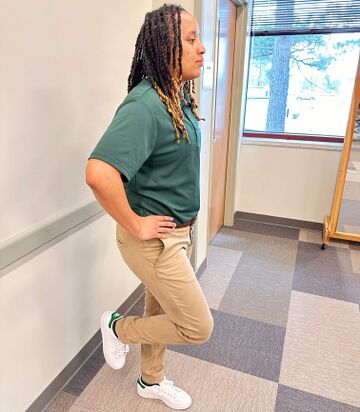
- Abnormal values may indicate conditions such as peripheral neuropathy, intermittent claudication, or other conditions that may impair balance.[1]
- The SLS Test will quantify balance status for those who are at increased risks for fall.[1]

Intended population
Method
- The test should be performed with eyes open and hands on the hips.
- Instruct the patient to stand on one leg unassisted.
- Begin timing when the patient's foot leaves the ground;
- Stop the time the patient's foot touches the ground and/or when their hands leave the hips.
Age-Related Normative Values
Healthy Older Adults:
- Inability to perform a single leg stance for at least 5 seconds is a predictor of injurious falls (but not of all falls). [2]
- The perform a single leg stance for at least 10s is independently associated with a lower all-cause mortality risk. [3]
Clinical Implications
Ability to control anticipatory postural adjustments (APAs) prior to lifting one leg while standing in unsupported equilibrium represents a complex motor task that is significantly impaired by:
- Neurological conditions like multiple sclerosis, Parkinson’s disease, Alzheimer’s disease, and dementia
- Stroke
- Traumatic brain injury
- General geriatric population
- Lower extremity pathology like knee osteoarthritis (OA), one of the most common chronic health conditions, is associated with significant impairment and disability, and predominantly affects the elderly population[4][5][6].
Evidence
Total Knee Arthroplasty:
Hip Osteoarthritis:
Elderly:
- Excellent relative reliability (ICC = 0.86) but poor absolute reliability. [9]
- SEM = 8.7s. [9]
- Unlikely to be sensitive at detecting change in performance in clinical settings in older adults.[9]
- Significant and easy-to-administer predictor of injurious falls, but not of all falls in older adults. [2]
Limitations
Single leg stance test normative values are minimal due to limited data.
References
- ↑ 1.0 1.1 Springer, B. A., Marin, R. H., Cyhan, T., Roberts, H., & Gill, N. W. (2007). Normative Values for the Unipedal Stance Test with Eyes Open and Closed. Journal of Geriatric Physical Therapy, 30(1), 8–15. https://doi.org/10.1519/00139143-200704000-00003
- ↑ 2.0 2.1 Vellas BJ, Wayne SJ, Romero L, Baumgartner RN, Rubenstein LZ, Garry PJ. One‐Leg balance is an important predictor of injurious falls in older persons. Journal of the American Geriatrics Society [Internet]. 1997 Jun 1;45(6):735–8.
- ↑ Araujo CG, De Souza E Silva CG, Laukkanen JA, Singh MF, Kunutsor SK, Myers J, et al. Successful 10-second one-legged stance performance predicts survival in middle-aged and older individuals. British Journal of Sports Medicine [Internet]. 2022 Jun 21;56(17):975–80.
- ↑ Hunt MA, McManus FJ, Hinman RS, Bennell KL. Predictors of single‐leg standing balance in individuals with medial knee osteoarthritis. Arthritis care & research. 2010 Apr;62(4):496-500. Available from:https://onlinelibrary.wiley.com/doi/full/10.1002/acr.20046 (accessed 13.12.2020)
- ↑ Zhang C, Talaber A, Truong M, Vargas BB. KD Balance: An objective measure of balance in tandem and double leg stances. Digital Health. 2019 Oct;5:2055207619885573.Available from:https://www.ncbi.nlm.nih.gov/pmc/articles/PMC6831964/ (accessed 13.12.2020)
- ↑ Bonora G, Mancini M, Carpinella I, Chiari L, Ferrarin M, Nutt JG, Horak FB. Investigation of anticipatory postural adjustments during one-leg stance using inertial sensors: evidence from subjects with Parkinsonism. Frontiers in neurology. 2017 Jul 25;8:361.Available from:https://www.frontiersin.org/articles/10.3389/fneur.2017.00361/full (accessed 13.12.2020)
- ↑ 7.0 7.1 7.2 Sarac DC, Unver B, Karatosun V. Validity and reliability of performance tests as balance measures in patients with total knee arthroplasty. Knee Surgery & Related Research [Internet]. 2022 Mar 10;34(1).
- ↑ 8.0 8.1 8.2 Choi YM, Dobson F, Martin J, Bennell KL, Hinman RS. Interrater and intrarater reliability of common clinical standing balance tests for people with hip osteoarthritis. Physical Therapy [Internet]. 2014 May 1;94(5):696–704.
- ↑ 9.0 9.1 9.2 Goldberg A, Casby A, Wasielewski M. Minimum detectable change for single-leg-stance-time in older adults. Gait & Posture [Internet]. 2011 Apr 1;33(4):737–9.