When refering to evidence in academic writing, you should always try to reference the primary (original) source. That is usually the journal article where the information was first stated. In most cases Physiopedia articles are a secondary source and so should not be used as references. Physiopedia articles are best used to find the original sources of information (see the references list at the bottom of the article).
If you believe that this Physiopedia article is the primary source for the information you are refering to, you can use the button below to access a related citation statement.
An Ankle-Foot Orthosis is a specific type of assistive device that, as its name suggests, covers the foot and ankle. There are three main types of AFOs: flexible, rigid and jointed. Each device has specific advantages and disadvantages. The goal of the orthotist is to create an apparatus that ultimately enables the patient to achieve their highest functional level. Thus, the device should encourage maximal compliance of use and provide assistance for the patient to achieve their highest functional level - it should not hinder the patient.[1]
There are many different types of AFOs which will be discussed below. Each device has indications and contraindications, so an accurate assessment of the patient and their needs is vital. An AFO can be custom made or off-the-shelf, and both have their place in the rehabilitation journey.
When the normal gait cycle is effected by a pathological condition, common complications emerge. These do vary from person to person, but often patterns can be found. The images below show a normal gait cycle and four pathological complications.
There are various pathological gait conditions (see image below), including:[2]
True equinus: is characterised by full extension of the hip and knee, occasionally presenting with knee recurvatum, alongside an equinus foot position that prevents ankle dorsiflexion past plantigrade.[3]
Jump gait: there is an anterior pelvic tilt and lumbar lordosis, the hip and knee are flexed with an equinus foot.
Apparent equinus: there is increased hip and knee flexion, with decreased equinus.[4]
Crouch gait: there is excessive hip and knee flexion, scissoring at the knees and excessive dorsiflexion.[5]
Sometimes individuals post-CVA may be fitted with an off-the-shelf device.
Early intervention will produce the best outcomes and function.
Late intervention often includes the accommodation of a fixed position. The goal is comfort and pain relief, and possibly to prevent worsening of the condition.
This is a progressive condition. Initially an AFO can assist with slowing down the loss of function due to disease progression, but the use of splinting is reduced as the condition progresses further.
A hereditary, progressive disease that affects the nerves. It presents as weakness and numbness which is usually more pronounced in the legs than the arms. The condition begins peripherally and advances up the length of the nerve.
Orthotics can cause damage to tissue as patients commonly have sensory and neuropathic problems. It is crucial that there is minimal pressure from a hard orthotic device on the skin.
Tumour
AFOs can assist with complications due to nerve damage.
Movement can often cause pain in certain pathological conditions or trauma. An AFO can be used to restrict movements causing pain and therefore reduce pain.
Instability
Goal Setting / Prescription for AFO
When setting goals and prescribing an Ankle-Foot Orthosis (AFO), the primary objective is to align with the needs of both the patient and their family.[6] Key considerations include providing support, improving mobility, increasing stability, and decreasing pain. Positioning should prioritize patient comfort by minimizing pain while aiming for the most functional and optimal position possible, especially when neutral alignment cannot be achieved. Additionally, orthotic management should focus on preventing contractures or accommodating existing ones effectively.
Design/ Manufacture
AFOs are broken down to two main categories: Custom made or off-the-shelf
Custom made
Manufactured using a plaster cast
Off-the-shelf
When sizing an off-the-shelf AFO, either measure for a foot plate or the calf
Designed in small, medium, and large
Generally need to be slightly adjusted, especially if there is an underlying condition
Mostly manufactured from a plaster model
Polypropylene/ lamination/ carbon fibre
Use a Three-Point Force System
Three-Point Force System
This system is used to stabilise a joint or segment and it can resist the angular motion. [7] A force is often applied medio-laterally or antero-posteriorly.[8]
The Three-Point Force System (also known as the Three-Point Pressure System) is paramount to creating an orthosis.[9] In this system, a primary force is applied, generally at the joint to be corrected, and counterforces are applied both above and below the primary force. The sum of these three forces applied should be zero. The amount of force, and the position at which the primary force is applied, should be the point where movement needs to be increased or decreased. This will vary depending on the assessment and functional requirements of the patient, along with the established treatment goal.[10][11]
When applying a force, it is important to remember the scientific equation of: Pressure equals Force over Area.[12]
When creating an orthotic device, the longer the lever arm or the longer the orthosis is, and the further away the points of force are, the bigger the correction will be. As there is more surface area to spread the force over, the pressure can be reduced using this principle. This principle can be used to reduce discomfort when wearing an orthosis.
Foot / Ankle Position
When designing an AFO, the goal is to achieve the best foot and ankle position in conjunction with patient requirements. This means:
The least painful position
The best position possible
The patient might not always be able to reach neutral, so the optimum available position is the most desirable outcome
Highest functional level
Casting Procedure
When creating an AFO, a mould of the patient's foot and ankle is made using a plaster cast, a process requiring experience and skill. The cast is removed, creating a negative cast, which can be scanned or filled with plaster to create a positive model of the foot/ankle.. The custom device can be created using this new positive cast.
3D printing is occasionally used to create orthoses. However, a significant challenge associated with 3D printing is that it is difficult to maintain the optimum foot position long enough to take an accurate scan, which is needed to create an accurate device. Once this technology is improved, 3D printing might be an effective way of creating an AFO.[1]
Common Ankle-Foot Orthosis
Flexible AFO
Rigid/Solid AFO
Jointed AFO
1. Flexible AFO
Flexible ankle-foot orthosis (AFO).
A flexible AFO has a certain amount of flexibility around the ankle area. This is achieved by cutting away part of the device around the ankle, reducing the surface area. This loss of surface area reduces the effect of the Three-Point Pressure System and as a result, this approach is not suitable for patients with mediolateral instability. A flexible AFO is useful in patients who have increased, uncontrolled movement in the ankle joint with good mediolateral stability. This type of device can allow for some roll over which encourages a natural gait pattern. It is easier to get out of chairs, and go up and down stairs. It is also easier for children to play on the floor and move around.
Prescription Criteria for a Flexible AFO
Drop foot
In order for the foot to clear the ground, a patient with drop foot will often flex excessively at their hip and knee, swing their leg into circumduction, or toe walk on the opposite side.[13] These compensatory movements lead to increased energy use, which tires the patient, and an increased falls risk.[14] A flexible AFO can correct the position to plantigrade but will allow some movement through midstance. This makes a more natural gait pattern but more importantly, also allows the foot to clear the ground.[15]
Mobile foot/ankle
No tendency to valgus or varus
Common Conditions Include
CVA
Nerve injury / dysfunction
Paediatrics
Off-the-Shelf Flexible AFO
Also known as a posterior leaf spring (PLS) as they essentially have a spring at the back of the AFO.[16]
These AFOs are commonly used in the short-term while a custom splint is being designed or while the patient's condition improves. These are commonly used in hospital or trauma-type settings to maintain range.
2. Rigid AFO
GRAFO with anterior shell
A rigid AFO is an orthotic device, custom made for the individual, that allows no movement. They are often used in more severe situations and in conditions with some mediolateral instability. The rigid AFO allows the Three-Point Pressure System to function in the optimal way. It also influences the ground-reaction forces.
It is important to conduct a gait analysis when constructing these devices because we need to now what type of correction to apply.[17] If the AFO moves the ground-reaction force in front of the knee joint at mid-stance, it will create a hyperextension moment. Alternatively, if the ground-reaction force is moved or remains behind the knee joint, it will create a flexion moment at mid-stance.
A ground-reaction AFO (GRAFO) is essentially the same as a rigid AFO. The difference is that an anterior shell is attached, which will spread the load that is applied as part of the Three-Point Pressure System to the front of the shin. The force is applied at the front of the shin to extend the knee and to maintain the ankle in a plantigrade position.
Prescription Criteria for a Rigid AFO
Slight tendency to flex at knee
Muscle tightness
Dynamic / fixed
A tight muscle which is fixed requires accommodation as the ankle is not in a plantigrade position. The design of the AFO must, therefore, compensate for an equinus or plantarflexed position. This means that when the user of the AFO is standing, the ground-reaction force is in the correct position and the knee is not being pushed into hyperextension or flexion.[18]
Crouch/ equinus gait
Hyper-extension
Escape valgus
Valgus deformities
Often a compensatory movement
Driven by tight tendon Achilles
Can alter foot structure
Can result in long-term issues
Mediolateral instabilities - using a rigid AFO means that the Three-Point Pressure System can be applied
Rocker bottom foot
Needs to be supported to reduce pain and prevent deterioration
Hyper-mobility
Excessive dorsiflexion requires more stability. This is achieved by creating a more rigid base to stand on, and influencing the ground-reaction force which allows the knee and hips to extend
Escape valgus
Dynamic tightness can lead to an escape valgus, where the hindfoot moves into a valgus position because of the tightness in the tendon Achilles. This should be accommodated within a rigid AFO
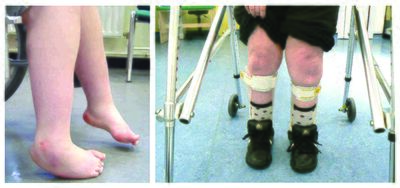
Varus deformity and orthosis.Varus deformities
Often difficult to control
If a patient presents with a fixed deformity
Accommodate the deformity
If a patient presents with a flexible deformity
Correct to the optimum position to allow the patient to function within the rigid AFO
Crouch / excessive dorsiflexion
Aim to produce an extension moment through the rigidity of the AFO, which can affect the flexion at the knee[18]
Common Conditions
Cerebral palsy
Neural tube defect
Stroke
Trauma
Pain
3. Jointed AFO
A jointed AFO is made with a moving part, or joint, which hinges at the ankle joint. It is designed to allow motion at the ankle joint, but still offers the correction that the Three-Point Pressure System offers. The jointed AFO is a good tool to try to optimise a gait pattern.
Disadvantages:
Tends to be bulkier, which can cause difficulty with footwear
Can be noisy
Parts can break
Advantages:
Walking up and down stairs
Getting up from a chair
Moving around the floor, specifically for children
Prescription Criteria for a Jointed AFO
ROM in ankle joint
Tendency to valgus
Tendency to varus
Tendency to crouch
Prescription criteria for Jointed AFO and DAFO/SMO
Hyper mobile foot/ankle
Ankle to plantigrade
Medio-lateral instability
Tuning / Optimising AFOs
Once the AFO has been manufactured and fitted, optimisation can done in conjunction with footwear.[19] Walking in an AFO without footwear is dangerous and slippery. An AFO is always prescribed in conjunction with an appropriate type of footwear. This footwear will influence how the patient functions in the AFO and their gait pattern.[20] The orthotist needs to look at the footwear closely, and then optimise the angles of the AFO to influence the ground-reaction force.[21][22]
References
↑ 1.01.1Fisher D. Introduction to Ankle-Foot Orthoses Course. Plus , 2022.
↑Rodda JM, Graham HK, Carson L, Galea MP, Wolfe R. Sagittal gait patterns in spastic diplegia. J Bone Joint Surg Br. 2004 Mar;86(2):251-8.
↑Barati K, Farahmand F, Behzadipour S. Mechanical energetics of different sagittal gait patterns in children with bilateral spastic cerebral palsy. Journal of Biomechanics. 2025 Dec 27:113142.
↑Hughes H, Rapson R, Killbride C, Marsden J. A scoping review exploring variables associated with crouch gait in ambulatory children with cerebral palsy. Gait & Posture. 2025 Aug 1;121:96-7.
↑Firouzeh P, Morris C, Sonnenberg LK, Manns P, Pritchard L. Development of clinical considerations for ankle-foot orthosis prescription and monitoring in young children with cerebral palsy: a Delphi study. Disability and Rehabilitation. 2025 Jul 17;47(15):3989-4001.
↑Wilson DG. Clinical Evaluation and Management. Musculoskeletal Pain: Evidence-Based Clinical Evaluation and Management. 2025 May 24:423.