When refering to evidence in academic writing, you should always try to reference the primary (original) source. That is usually the journal article where the information was first stated. In most cases Physiopedia articles are a secondary source and so should not be used as references. Physiopedia articles are best used to find the original sources of information (see the references list at the bottom of the article).
If you believe that this Physiopedia article is the primary source for the information you are refering to, you can use the button below to access a related citation statement.
Research links osteochondral lesions to osteoarthitis as it is theorised to be an intermediate stage in a joint cartilage degenerative progression.[1] This process begins with partial-thickness cartilage lesions, advances to osteochondral lesions, and concludes with end-stage osteoarthritis. Early detection of cartilage and osteochondral lesions is important for potentially reducing the risk of osteoarthritis. Understanding the prevalence, size, and location of osteochondral lesions is crucial for identifying athletes at high risk for developing the condition.[2]
Definitions
The 3 types of cartilage
Cartilage is a connective tissue which has the following components:[3]
Polysaccharides (a cellular component composed of ground substance)
Fibrous proteins
Interstitial fluid with water as the main component
Cartilage gets its nutrition via diffusion from surrounding tissues as it has no direct blood supply, lymphatics or nerves.[3]
There are three types of cartilaginous tissues: hyaline, fibrocartilage and elastic cartilage.[3] Each type of cartilaginous tissue has a different composition and function:
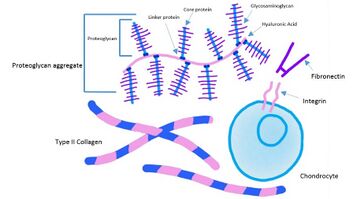
Hyaline cartilage: is a connective tissue located at the ends of bones. Its primary cells are chondrocytes. Their role is to maintain the cartilage extracellular matrix (ECM), which is responsible for the biological and mechanical function of the cartilage. Hyaline cartilage ECM contains:[4]
Fibrocartilage is a "transitional tissue between hyaline cartilage and dense regular connective tissue."[3] This type of tissue can be found in the pubic symphysis, the annulus fibrosus of intervertebral disc, tendons, and ligaments.[5] It contains:[3]
High levels of type I collagen
Type II collagen
A small component of ground substance
Elastic cartilage: is a flexible connective tissue cartilage that can withstand repeated bending.[3] It consists of:[3]
Type II collagen
Elastic fibres
Large chondrocytes
Subchondral bone is located below the hyaline cartilage and cement line (i.e. the border between calcified cartilage and the subchondral bone[6]). It is responsible for providing mechanical (including shock absorption) and nutritional support for cartilage (the subchondral bone containing vessels that directly interact with the hyaline cartilage layer)[7]. The perfusion mechanism of the subchondral bone vessels is responsible for distributing 50% of nutrients to the cartilage.[8]
Osteochondral lesions (OCL) are defects affecting the structure of the cartilaginous surface and underlying subchondral bone. When the lesion's healing phase begins and tissue forms, the new tissue is often fibrocartilage. However, this type of cartilage has mechanical disadvantages to hyaline cartilage. In some cases, hyaline cartilage forms during the repair process, but the mechanism of hyaline vs fibrocartilage formation is unknown.[3]
Healing of Osteochondral Lesions
Osteochondral lesions have poor healing capacity.[9] A study completed in animals[10] demonstrates that OCLs go through the following stages of healing:[9]
Week 1-2: Initial fibrin repair - the damaged site begins to fill with a blood clot and fibrous tissue, mesenchymal cell recruitment begins
Week 4-8: Cartilage formation starts adjacent to the damaged cartilage
Weeks 8 -12: Bone formation begins through endochondral ossification
Three types of trauma lead to the development of OCLs: compaction, shearing or avulsion.
Osteochondral Lesions of the Ankle
Osteochondral injuries Talus: Staging
According to Ferkel et al.,[13] a high percentage of patients with lateral ankle instability develop intra-articular pathology. In the ankle joint, OCLs occur in the talus. Lesions of the talar cartilage (OCT) and subchondral bone can lead to a partial or complete detachment of the fragment. OCLs can be characterised as:
Chondral (cartilage only)
Chondral-subchondral (cartilage and bone)
Subchondral (intact overlying cartilage)
Cystic
Stable or unstable
Non-displaced or displaced
Classification System for Osteochondral Lesions of the Talar Cartilage
The following classification systems for OCT are used primary for research. Clinically the most important factors are lesion location and depth. In general, the bigger the lesion, the more problematic it becomes.[14]
The Berndt and Harty[15] classification system remains the most commonly used system to stage radiographic OCTs. This system is as follows:[16]
Stage I: with the foot in an inverted position, the lateral border is compressed against the face of the fibula, and the collateral ligament remains intact
Stage II: with progressive foot inversion, the lateral ligament is ruptured, and avulsion of the chip begins
Stage III: the chip is fully detached but remains in place
Stage IV: displacement of a detached fragment occurs following inversion
Loomer et al.[17] added a fifth stage to the Berndt and Harty classification system:[16]
Stage I -IV as above
Stage V: the presence of a subchondral cyst
Ferkel et al.[18] developed a classification system based on computed tomography (CT):[19]
Stage I: Cystic lesion with the dome of the talus (intact roof)
Stage IIa: Cystic lesion with communication to the talar dome surface
Stage IIb: An open articular surface lesion with an overlying undisplaced fragment
Stage III: An undisplaced lesion with lucency
Stage IV: Displaced fragment
Hepple et al.[20] developed a classification system based on magnetic resonance imaging (MRI).[19]
MRI classification of OCL. Adapted from AA, Sesin C, Rosselli M. Osteochondral defects of the talus with a focus on platelet-rich plasma as a potential treatment option: a review. BMJ Open Sport Exerc Med. 2018 Feb 1;4(1):e000318.
Clinical Presentation
Patients with ankle osteochondral lesions will report deep ankle pain associated with weight-bearing, limitations in range of motion, impaired function, stiffness, and a feeling of catching and locking. In addition, the patient may experience tenderness and swelling around the medial and lateral ankle.[11] Examination often reveals range of motion restrictions in the subtalar and talonavicular joints, impaired ligamentous ankle stability and hindfoot malalignment.[16][11]
Diagnostic Procedures
Advances in imaging and arthroscopy have improved the visualisation and assessment of osteochondral lesions. Modern diagnostic techniques can now better identify cartilage defects and bone marrow oedema and allow for a more detailed examination:[21]
X-ray - anteroposterior (AP) and lateral views completed in a weight-bearing position[11]
MRI captures the integrity of soft tissue and subchondral cancellous bone[22]
CT offers a better resolution to show bony pathologies but provides less information on the soft tissues and articular cartilage wear[11]
SPECT CT is able to provide information from both MRI and CT; it is important to consider the amount of radiation a patient is exposed to with SPECT CT[11]
Ankle arthroscopy allows for direct visualisation of the entire joint[11]
Outcome Measures
Validated measures for assessing functional outcomes in patients with osteochondral lesions in the foot and ankle include the following:
There is a lack of high-quality evidence for a specific treatment protocol to manage osteochondral lesions of the ankle.[14] Therefore, when establishing goals, planning treatment and choosing interventions, the clinician must consider the biological phases of healing. Rehabilitation will also depend on the size of the lesion and its location. In general, the rehabilitation programme should:[14]
Be comprehensive and include multi-modal functional training
Include a minimum of six weeks of supervised rehabilitation training
Conservative treatment aims to relieve symptoms and promote healing using non-invasive methods. It is best suited for mild injuries, specifically small, stable lesions classified as Berndt and Harty Stage I or II, in patients with minimal pain and no major functional limitations:[14][25]
Stage 1
Take it EASY
Move the talocrural joints, but DO NOT expose to compressive or shear forces
Incorporate cardiovascular fitness
Maintain partial weight bearing
Examples of exercises:
Gentle ankle dorsiflexion and plantarflexion exercises
Lower extremities exercises in partial weight bearing and proper alignment
Stage 2
This phase focuses on function
It is considered a pre-participation phase
Focus on details
Progress from partial to full weight bearing and standing on two feet
Progress the load and complexity of the movement
Example of exercises:
Progression to full weight bearing with proper alignment
↑Kawabata S, Nakasa T, Ikuta Y, Sumii J, Nekomoto A, Adachi N. High incidence of osteoarthritic changes in patients with osteochondral lesions of the talus without chronic lateral ankle instability. Journal of Orthopaedic Science. 2024 Jan 1;29(1):249-55.
↑Imhof H, Sulzbacher I, Grampp S, Czerny C, Youssefzadeh S, Kainberger F. Subchondral bone and cartilage disease: a rediscovered functional unit. Investigative radiology. 2000 Oct 1;35(10):581-8.
↑Shapiro F, Koide S, Glimcher MJ. Cell origin and differentiation in the repair of full-thickness defects of articular cartilage. J Bone Joint Surg Am. 1993 Apr;75(4):532-53.
↑ 12.012.112.212.3Mosca M, Grassi A, Caravelli S. Osteochondral Lesions of Ankle and Knee. Will Future Treatments Really Be Represented by Custom-Made Metal Implants?. Journal of Clinical Medicine. 2022 Jul 1;11(13):3817.




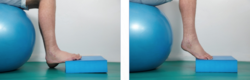 Gentle ankle dorsiflexion and plantarflexion exercises
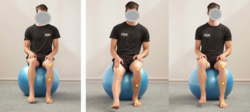 Lower extremities exercises in partial weight bearing and proper alignment

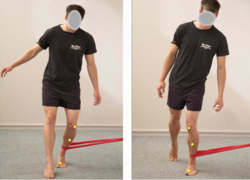 Progression to full weight bearing with proper alignment
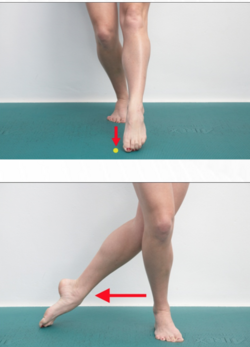 Exercises based on SEBT
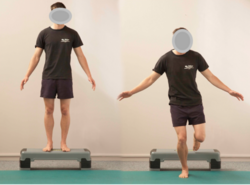 Fitness activities: step down/step up
