When refering to evidence in academic writing, you should always try to reference the primary (original) source. That is usually the journal article where the information was first stated. In most cases Physiopedia articles are a secondary source and so should not be used as references. Physiopedia articles are best used to find the original sources of information (see the references list at the bottom of the article).
If you believe that this Physiopedia article is the primary source for the information you are refering to, you can use the button below to access a related citation statement.
Range of motion (ROM) limitations and joint contracture can significantly limit functional abilities in individuals with a spinal cord injury. Shoulder ROM problems are related to functional limitations and disability, and can affect an individual's perception of health. In addition, persons with tetraplegia can develop upper limb spasticity, which is reported to be one of the most difficult health complications after spinal cord injury.[1][2]
Complications after spinal cord injury can impact an individual's ability to participate in activities of daily living (ADLs), cause pain, fatigue, and sleep disturbances, and affect safety, leading to contractures, pressure ulcers, infections, and negative self-image.[2] This article will discuss therapeutic strategies for the upper limb, including appropriate positioning, stretching, strengthening, the tenodesis grasp and spasticity management. These strategies can help to maintain upper limb range of motion and facilitate function.
Provide adequate support for the weight of the upper limb
Upper Limb Stretching and Strengthening Programmes
Stretching
Stretching is a common technique therapists use to treat and prevent contractures. The importance of stretching for joint mobility has yet to be proven clinically. However, some studies indicate that the effects of stretching accumulate over time.[4] It is recommended that regular stretching become part of a home maintenance programme for people with spinal cord injury to potentially achieve clinically important effects on joint mobility.[4] The following upper limb tissues should be included in a stretching programme for persons with upper or lower tetraplegia:
Patients with tetraplegia depend on their upper limbs to perform activities of daily living, such as transfers and wheelchair propulsion. In addition, good proximal muscle stability (i.e. at the scapula, shoulder) allows for better arm and hand function. Poor scapula position can contribute to neck and shoulder pain and inadequate shoulder stability.[5] Loss of shoulder stability and daily overload of the shoulder girdle in patients with cervical spinal cord injury cause shoulder, elbow, and hand pathologies.
Individuals with "C6 and C7 tetraplegia use a tenodesis grasp to compensate for weak or absent active finger movement to manipulate objects during daily activities."[3] The tenodesis grasp function is achieved by actively extending the wrist, closing the fingers, and flexing the thumb until it touches the index finger.[7]
General Guidelines
Daily passive range of motion exercises of the wrist and fingers are required
Do not overstretch the fingers in extension during passive range of motion exercises
During weight-bearing tasks or transfers, the fingers should be in flexion
It is important to retain tendon tightness in the fingers for a future tenodesis grasp
Family and caregivers should be educated about stretching / over-stretching the fingers and weight bearing during transfers
Characteristics of a Tenodesis Grasp
Position of the wrist and fingers
With an active wrist extension movement, there is passive flexion of the fingers
With wrist flexion, the fingers extend to release an object[3]
Position of the thumb
"Thumb in" position helps to develop a lateral pinch[3]
"Pulp-to-pulp" pinch when the thumb touches the pulps of your fingers[3]
Typical patterns of upper limb spasticity include shoulder adduction and internal rotation, elbow flexion, forearm pronation, wrist flexion, thumb flexion, adduction and first webspace tightness, and finger flexion.[8][9]
The following negative experiences were reported by individuals with a spinal cord injury and associated spasticity:
Poor cosmesis negatively impacts self-esteem and body image[8]
Goals for spasticity management:
To diminish spasticity
To allow voluntary movements
To improve the ability to independently perform ADLs (transfers, dressing, and toileting)
Therapeutic Strategies
Positioning
Spasticity is influenced considerably by changes in posture and muscle length. Position influences stretch reflex activity. Proper positioning can decrease the presence and intensity of upper limb spasticity in patients with tetraplegia.[10]
Wheelchair seating system assessment and recommendations directly impact spasticity management through the patient's posture and positioning in the wheelchair.[3]
Adequate positioning helps reduce fatigue while sitting, thus decreasing spasticity.[3]
Neurodynamic mobilisation
Neurodynamic mobilisation is a "group of techniques that aim to place the neuraxis in tension and stretch it with appropriate mobilisation through certain postures, along with the application of slow, rhythmic movements of the joints intended to reach the peripheral nerves and the spinal cord".[2][11]
Example: A study by Saxena et al.[2] looked at the impact of median nerve neurodynamic mobilisation on individuals with C5-C8 spinal cord injuries. Their protocol was as follows:
Five sessions per week for four weeks.
Each session included twelve minutes of mobilisation.
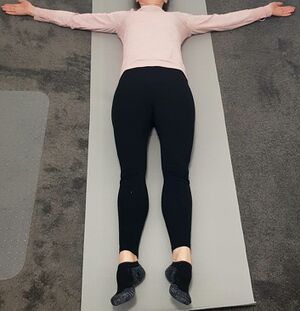
Patient position: supine, shoulder girdle depressed, glenohumeral joint extended, abducted, and laterally rotated, elbow in extension, forearm in supination, wrist, fingers, and thumb in extension. This position was held and then neural mobilisation performed, with "slow, rhythmic oscillations of wrist flexion and extension."
Twenty oscillations were performed each minute for 3 minutes; this process was repeated three times in one session, with a 1 minute gap between each attempt.[2]
Self-applied vibration to the upper limb
The current classification of vibration is as follows:[12]
Stimulation directly applied to a specific muscle or tendon
Indirect vibration - i.e. stimulation which is not muscle specific and is delivered through the hands by holding a device
The potential effects of upper limb vibration:[12]
Inhibits H-reflex amplitude
Increases inhibition on pre-synaptic spinal pathways
May provide an effective avenue for targeted rehabilitation during conditions of spasticity
A study by Mirecki et al.[13] found that participants with higher spasticity had decreased spasticity after focal upper extremity vibration. There was, however, "no clear effect on grasp, transport and release function"[13]
Passive movement
Joint-by-joint passive range should be performed.
The intensity of passive movement required to achieve therapeutic level is unknown.[14]
According to Harvey et al.,[4] when range of motion is limited, stretching should be done for long periods (from 20 minutes to up to 12 hours). A prolonged stretch can be accomplished with splint use.
"Electrical stimulation applied to individual muscles may produce a short-term decrease in spasticity. There is also some concern that long-term use of electrical stimulation may increase spasticity."[18]
Upper Limb Reconstruction in Tetraplegia
Reconstruction surgeries can improve upper limb function for individuals with upper or lower tetraplegia. The two types of reconstructive procedures are nerve transfers and tendon transfers. The following examples represent an incomplete list of currently available procedures.
Nerve transfers
Nerve transfers complement tendon transfer techniques. A combination of nerve and tendon transfers may be the best solution for some individuals with tetraplegia.[19] The nerve transfer procedure involves cutting and reconnecting a functional nerve from the above injury zone and reconnecting it to a non-functional nerve, which serves a more important function, from below the injury zone.[20]
Thumb and finger flexion reconstruction with brachialis-to-anterior interosseus nerve transfer with an in situ lateral antebrachial cutaneous nerve graft
Active extension of the fingers with supinator-to-posterior interosseous nerve transfer complements brachialis-to-anterior interosseus nerve transfer
Post-operative therapeutic protocol includes immediate elbow, wrist and finger passive range of motion
Weight-bearing activities start two weeks post surgery
Active exercises of the donor muscles start two or three weeks post surgery
When the recipient's muscles start contracting, physiotherapy intervention must focus on co-contraction exercises, motor education, and a strengthening exercise programme[21]
Finger pinch and grasp with musculocutaneous-to-median nerve transfer
Benefits of nerve transfer procedures:
Restore muscle groups without altering their biomechanics
Do not require prolonged immobilisation
Potential reconstructions are available when no tendon transfer options exist
Offer a greater than 1:1 functional exchange: sacrificing one simple function can potentially restore multiple functions
Tendon transfers are the most commonly accepted intervention for restoring hand function in persons with tetraplegia. The procedure includes cutting the distal end of a functional muscle and reattaching it at the insertion site of a non-functional muscle. Tendon transfers are performed to restore grasp and release of the fingers, and thumb and elbow extension in persons with a C5 through C8 spinal cord injury. Reconstruction of finger extension through tendon transfers in patients with tetraplegia remains difficult.
The following are examples of tendon transfer procedures in patients with upper or lower tetraplegia:[23][24]
No elbow extension
Posterior deltoid-to-triceps tendon transfer, or
Biceps-to-triceps tendon transfer
Weak or no grip:
With weak or no wrist extension: brachioradialis-to-extensor carpi radialis brevis tendon transfer. Some patients require an additional posterior deltoid transfer to counteract brachioradialis
With active wrist extension: brachioradialis-to-flexor pollicis longus transfer
↑Fleuren JF, Nederhand MJ, Hermens HJ. Influence of posture and muscle length on stretch reflex activity in poststroke patients with spasticity. Arch Phys Med Rehabil. 2006 Jul;87(7):981-8.
↑Castilho J, Ferreira LAB, Pereira WM, Neto HP, Morelli JGDS, Brandalize D, Kerppers II, Oliveira CS. Analysis of electromyographic activity in spastic biceps brachii muscle following neural mobilization. J Bodyw Mov Ther. 2012 Jul;16(3):364-368.
↑ 13.013.1Mirecki MR, Callahan S, Condon KM, Field-Fote EC. Acceptability and impact on spasticity of a single session of upper extremity vibration in individuals with tetraplegia. Spinal Cord Series and Cases. 2022 Feb 5;8(1):1-6.
↑Dunn J, Wangdell J. Improving upper limb function. Rehabilitation in Spinal Cord Injuries. 2020 Feb 1:372.
↑Li S, Xue S, Li Z, Liu X. Effect of baclofen combined with neural facilitation technique on the reduction of muscular spasm in spinal cord injury. Neural Regeneration Research,2007;2(8):510-512