When refering to evidence in academic writing, you should always try to reference the primary (original) source. That is usually the journal article where the information was first stated. In most cases Physiopedia articles are a secondary source and so should not be used as references. Physiopedia articles are best used to find the original sources of information (see the references list at the bottom of the article).
If you believe that this Physiopedia article is the primary source for the information you are refering to, you can use the button below to access a related citation statement.
Feeding is a vital part of everyday life. Healthy and nutritious foods are essential for brain development, so feeding plays an essential role in the development of motor and cognitive functions.[1] Poor nutritional status is common in children with cerebral palsy because of feeding and swallowing problems. Untreated feeding issues may lead to growth failure, chronic aspiration, oesophagitis, and respiratory infections.[1] They can also impact a child's social, emotional, and cognitive function and significantly increase caregiver stress.[2] This article overviews problems and potential solutions for children with cerebral palsy who experience eating and swallowing difficulties.
Feeding and Swallowing Disorders
Paediatric Feeding Disorder is "an impaired oral intake that is not age-appropriate, and is associated with medical, nutritional, feeding skill, and/or psychosocial dysfunction."[3]
Dysphagia is a swallowing problem that places the child at risk for aspiration with oral feeding. Aspiration may have life-threatening pulmonary consequences.[4]
Mechanics of Feeding and Swallowing
Feeding
The feeding / eating process has four phases:
Phase 1: Opening the mouth
Phase 2: Using utensils and placing the food or liquid in the mouth
Phase 3: Closing the mouth to prevent food or liquid from spilling out
Phase 4: Chewing the food and moving it around to prepare to swallow
Swallowing phases
Swallowing
Swallowing (deglutition) is the process by which food passes from the mouth through the pharynx and into the oesophagus.[5] It must be coordinated with breathing because both processes share the same entrance to the pharynx. Failure of coordination between breathing and swallowing can result in choking or pulmonary aspiration.
Increased muscle tone and involuntary body movements
Unable to close the mouth due to increased or decreased resting tone of the jaw muscles
Unable to open the mouth due to jaw-muscle tension
Uncoordinated, non-graded, or limited movements of the jaw, leading to a lack of jaw rotation movement and a limited, or lack of, ability to chew
Passive lips, lack of lip closure and spoon clearance
Difficulty forming a bolus in the mouth
Food accumulating in the mouth
Poor saliva control
Sensory Challenges
Hypersensitivity to certain textures or stimuli (taste, smell, temperature, visual aspect of food)
Difficulty discriminating tactile sensations (preference for crunchy, chewy foods)
Difficulty in the perception of gustatory (taste) and olfactory (smell) stimuli (preference for sour and spicy food and refusal to eat balanced or mild tastes)
Difficulty accepting new food experiences
Avoiding behaviour towards a primary caregiver
Swallowing Challenges
Lack of stability in the lower jaw, so there isn't an adequate base of support for selective tongue movements in all directions
poor tongue control affects bolus transport, delays the initiation of swallowing, and reduces pharyngeal motility[7]
Clinical Signs of Feeding and Swallowing Problems in Children
A child may display the following signs of feeding and swallowing difficulties:[6]
difficulty breastfeeding or bottle feeding
cries or gets worried, excited or agitated during feeding
does not follow feeding developmental milestones
coughs during or right after eating or drinking
often clears throat
often vomits or shows signs of vomiting while eating
food flows from the mouth or nose during feeding
poor food ration
long duration of feeding
has a wet or gurgly voice during or after eating or drinking
feels like something is stuck in the throat or chest
has difficulty drinking from a cup
has problems with breathing after meals
has difficulty gaining weight or is experiencing weight loss
behavioural challenges
Factors Influencing a Child's Feeding and Eating Skills
Environmental factors: Environmental distractions can decrease a child's ability to concentrate on feeding and eating. Distractions include watching television, looking at a computer, bringing toys to mealtime, and having meals in chaotic, crowded environments with people having loud conversations.[8]
Physical difficulties: A child's oral motor difficulties may prevent them from eating independently and increase the time and energy spent on feeding and eating.[6]
Behavioural factors: Caregiver stress and a child's negative mood affect feeding and eating. Caregivers who remain calm / in control emotionally can positively impact a child's behaviour during feeding.[6]
Healthcare Team Responsibilities
Feeding difficulties can impact different areas of a child's life, including medical, nutritional and psychosocial aspects. Thus, an interdisciplinary team is needed to treat children with feeding and eating difficulties.
Speech Language Therapist / Pathologist
A communication, speech and language therapist (pathologist) is responsible for the following:[9]
assessing the function of feeding
helping to determine the diagnosis and aetiology of dysphagia
assessing the protective capacity of the respiratory system
indicating alternative ways of eating
providing direct and indirect interventions, such as strengthening facial muscles, teaching different strategies to develop sucking, chewing, and drinking skills, tasting new food and drink with rich flavours and aromas, and modifying food liquid to improve swallowing[6]
guiding staff and caregivers in better management of feeding difficulties[6]
Occupational Therapist
The occupational therapy assessment of a child with feeding and eating needs should consider their independence and safety, and include the following aspects:[3]
motor and sensory skills assessment
muscle strength assessment
observation of the child's behaviour and environmental factors around mealtimes
The occupational therapy intervention focuses on:[6]
improving oral motor skills
sensory processing
promoting correct posture
selecting adaptive devices and choosing strategies to use them functionally
adjusting and adapting the environment to promote independent eating
working with parents and caregivers on using different feeding methods or techniques
Physiotherapist / Physical Therapist
Physiotherapy interventions are part of oral motor therapy (OMT).[10] OMT can improve a child's functional independence and quality of life.[11] Protocols for OMT vary and may include the following:
strain-counter strain technique may be used to help relax tensed muscles, including the masseter and sternocleidomastoid muscles[13]
Feeding and Eating Management Strategies
Goals and Outcomes
General goal: "to improve the quality of life for both the child and family, through interventions that maximise independence in activities of daily living, mobility, and nutrition".[1]
The outcomes will vary and depend on the following:[1]
type of cerebral palsy: spastic vs nonspastic
location of motor involvement: diplegia, quadriplegia, etc.
the child's functional status, including their ability to walk or sit and the degree of head and trunk control
Treatment Strategies
Establish a feeding routine
Promote correct posture during meal times and beyond (see images below)
use appropriate seating equipment and / or handling techniques to ensure the child's head / trunk are aligned and upright
facilitate chin tuck and elongation of the back of the neck in a midline neutral position
provide adequate postural stability
stable base of support for the trunk, hips, knees and feet
hips symmetrically flexed at around 90°
use a tray to support arms
use a headrest to support the head and the neck
maintain the child's correct posture outside of mealtime
use oral appliances to help stabilise the jaw, improve sucking, tongue coordination, lip control, and chewing[1]
Correct sitting posture in the wheelchair.
Incorrect sitting posture in the wheelchair.
This video suggests various parenting / caregiver strategies to promote correct posture for children during meal time:
↑ 1.01.11.21.31.4Ferluga ED, Archer KR, Sathe NA, Krishnaswami S, Klint A, Lindegren, McPheeters ML. Interventions for Feeding and Nutrition in Cerebral Palsy [Internet]. Rockville (MD): Agency for Healthcare Research and Quality (US); 2013 Mar. (Comparative Effectiveness Reviews, No. 94.) Introduction. Available from https://www.ncbi.nlm.nih.gov/books/NBK132442/ [last access 25.01.2024]
↑Greer AJ, Gulotta CS, Masler EA, Laud RB. Caregiver stress and outcomes of children with pediatric feeding disorders treated in an intensive interdisciplinary program. J Pediatr Psychol. 2008 Jul;33(6):612-20.
↑Special Education Professionals. Best Feeding Position for Children with Feeding Disorders. Available from: https://www.youtube.com/watch?yRrO80gIOTY [last accessed 29/01/2024]


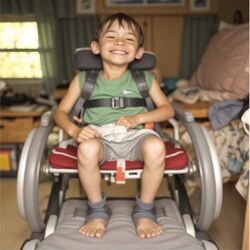 Correct sitting posture in the wheelchair.
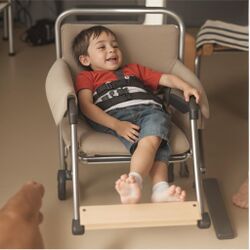 Incorrect sitting posture in the wheelchair.