When refering to evidence in academic writing, you should always try to reference the primary (original) source. That is usually the journal article where the information was first stated. In most cases Physiopedia articles are a secondary source and so should not be used as references. Physiopedia articles are best used to find the original sources of information (see the references list at the bottom of the article).
If you believe that this Physiopedia article is the primary source for the information you are refering to, you can use the button below to access a related citation statement.
Charcot-Marie-Tooth disease (CMT) is known as a hereditary motor and sensory neuropathy (HMSN) and is the most common inherited neuromuscular disease with a prevalence of approximately 1 in every 2,500. [1] CMT involves the degeneration of nerve fibres in the body that results in muscle weakness and wasting along with a decrease in sensation. [2][3] CMT is a slowly progressive disorder and it encompasses a large group of clinically and genetically heterogeneous disorders.
CMT was first described and named after Jean-Martin Charcot, Pierre Marie, and Howard Henry Tooth in 1886. CMT usually emerges during the first two decades of life, characterized by a gradual onset of weakness beginning in the lower extremities and eventually affecting the upper extremities.[4]
The Demyelinating CMT (Type 1) accounts for 70% of cases, primarily caused by mutations in myelin genes: the Peripheral myelin protein 22 (CMT1A, 50% of patients), Myelin protein zero (CMT1B), and Gap junction beta 1 (CMT1X). [6] CMT1A is the most common form of CMT and it is caused by a duplication of the 1.4 Mb region of chromosome 17 containing the peripheral myelin protein 22(PMP22) gene. [1]
The Axonal CMT (Type 2) is caused by mutations in over 10 genes, including mitofusin 2 (MFN2). MFN2 mutations on chromosome 1p36 account for CMT2A, the most common form of CMT2 (approx. 20% of total CMT cases). [7] More information regarding the specifics of the different gene mutations can be found here. [8]
Causes
CMT is caused by genetic mutations with approximately 1000 mutations in 80 genes that are related to the physical presentation of the disease. The diagnosis and classification of CMT is a very complicated process. [2]
Clinical Presentation
The clinical presentation of CMT is extremely variable between different types due to the extensive amount of mutations possible. It is a progressive disease so the symptoms change between earlier and later stages, with most symptoms beginning in the first or second decade of life, starting with weakness in the lower extremities and later affecting the upper extremities. [9]
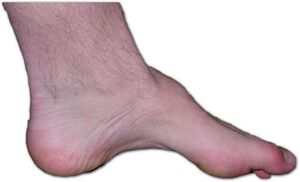
Pes- Cavus, also known as highly arched feet: This can cause foot and ankle instability issues which may result in ankle sprains.
Lower legs are very thin, while the thigh muscles are a normal shape and bulk, or size: This characteristic is known as the inverted champagne bottle
Some sensory loss and numbness in both the arms and legs: This is not usually a major problem for most individuals, but can result in unknown injuries if it is very severe
Pain: About 20% to 30% of patients with CMT complain of musculoskeletal pain rather than neuropathic pain.
Abnormal gait pattern.
Later symptoms
Upper limbs including both the hands and forearms may be affected as the disease progresses
Wasting of hypothenar muscles in patients with long-standing disease due to the weakness of the intrinsic muscles of the hand.
Stork leg deformity: can be caused as a result of atrophy of the lower legs and distal thighs
Loss of fine motor control such as difficulty in buttoning, zipping, and writing
Restless legs syndrome
Loss of dexterity & overall hand strength
Spinal deformities (scoliosis)
Some may exhibit pupillary abnormalities, including tonic pupils, miosis, mydriasis, anisocoria, and impaired pupillary reaction[11]
Additional rare manifestations of Charcot-Marie-Tooth disease include hyperkeratosis, skin hyperlaxity, arthrogryposis, cognitive impairment, learning disabilities, lip or chin myokymia, respiratory insufficiency, tremors, nystagmus, ataxia, fasciculations, cold-induced muscle cramps, hip dysplasia, and features overlapping with Ehlers-Danlos syndrome. [12]
CMT most often affects the distal limbs first, or those limbs further away from the body such as arms and legs. However, the lower limbs are usually affected before the upper limbs. The muscles in the lower part of the leg, ankle, and foot begin to atrophy as the disease progresses. This means the amount of muscle in these areas will decrease. Atrophy in the more proximal parts of the limbs or the parts closer to the body such as the thighs and upper arms is rare and usually only occurs in those more severely affected.
Charcot Marie Tooth - Functional Outcome Measure (CMT-FOM)[15]
Medical Management
There is currently no cure or drug therapy for CMT. The main treatment options are rehabilitation therapy which will involve both a physiotherapist and an occupational therapist, and surgical treatment options[2].
Surgical Treatment
Surgical treatment is used for individuals with CMT with different skeletal deformities most often in their feet. Most individuals start with flexible deformities in which the ankle begins to turn in, known as a cavovarus deformity. However, during the later stages of this disease, the deformity can become fixed. Treatment options are, therefore, soft tissue surgeries, osteotomies or removal of bone, and joint fusions. These can either be performed on their own or as a combination of a few. Research indicating who is appropriate for surgery and when this would be optimal is not yet conclusive as more in-depth long-term studies must be completed. For the upper limbs, tendon transfers may be beneficial to improve the ability to oppose the thumb and assist with wrist extension. In addition, scoliosis, also known as a curvature of the spine, is prevalent in about 15-20% of individuals with CMT and if severe enough, may need surgical intervention. [2]
Physiotherapy Management
Physiotherapy is a key factor in managing CMT. It helps to improve the symptoms of CMT as well as decrease the risk of muscle contractures also known as the shortening of muscles. Physiotherapy management will incorporate various exercises, including stretching, grip strengthening, aerobic conditioning, and resistance training, supplemented by orthotic interventions such as supportive shoes and ankle orthoses to address foot drop and improve ambulation. Physiotherapy along with occupational therapy should be started at the onset of symptoms. Starting physiotherapy early on can be beneficial because muscle weakness and sensory loss will be minimal.[16]
The physiotherapist will also be involved in assessing the need for any additional aids or equipment. Many people with CMT may require high-top shoes or boots to provide more stability to the ankles and prevent injury. Others may need braces known as ankle-foot-orthoses (AFOs) that act similar to a cast but are removable. An AFO is a plastic brace, custom-made for each individual to provide the necessary support and prevent tripping as a result of foot-drop. If individuals have more muscle weakness proximally or higher up the leg, then knee-ankle-foot orthoses are available.
The majority of individuals with CMT do not require to use of a wheelchair, however, in later stages of the disease some may choose to use one when going longer distances to reduce fatigue and the amount of stress on joints. The physiotherapist will work with the occupational therapist and help with referrals to a podiatrist to ensure that all necessary equipment has been provided. [17]
Hydrotherapy
Hydrotherapy is a highly beneficial option as an exercise for individuals with CMT as it helps in improving their quality of life, balance, gait speed, qualitative increase of gait pattern, posture changes, and functional complaint of this patient.[18] Essentially, Hydrotherapy is a structured exercise led by a physiotherapist that takes place in a pool. Hydrotherapy pools are not always easily accessible, but have many benefits, especially for those individuals with CMT. Some of the benefits include reducing the amount of stress on joints due to the buoyancy of the water but still adding some light resistance to exercises to help maintain muscle strength.
Aerobic Exercise
While the concept of "overuse weakness," where exercise potentially exacerbates muscle loss and weakness, remains debated in CMT [19], Aerobic anti-gravity exercise has benefits as it improves balance and walking capacity. [20]Aerobic exercise is important in managing CMT.
As long as that person is comfortable and working at low-moderate intensity, aerobic exercise can help reduce fatigue, improve mood, and increase a person’s endurance. The goal is to help keep the individual as independent as possible for as long as possible. However, it is important to avoid overworking and exhaustion. When carrying out any type of exercise fatigue and weakness should not be caused within 30 minutes of exercises and neither should any form of excessive muscle soreness or cramping. These are things that are strongly discouraged when exercising with CMT. [21]
Stretching
Stretching is also a key part of physiotherapy management for CMT. As noted above, individuals with CMT are at risk for muscle contractures, and stretching assists in maintaining muscle length. When this is done slowly and gently it can provide comfort for individuals and reduce stiffness in the joints. Physiologically. in a disease process such as CMT, where the progression of the condition is due to axonal and demyelinating factors in the peripheral nervous system, the application of Proprioceptive Neuromuscular Facilitation (PNF) techniques with elastic or manual resistance, with low impact on the skeletal and muscular system could demonstrate improvement in the capacity of the muscle, without producing.[21]
Balance and Posture
Balance is an extremely important ability to carry out daily tasks. It involves gathering sensory input from the body and its surroundings in order to accurately orientate itself with gravity and the environment. With CMT, sensation may be altered which will affect a person’s ability to balance and ultimately completely normal activities of daily living. [22]Tai Chi, Yoga, and Pilates are all very useful exercises for improving both balance and posture.
Gait Training
Evaluating gait patterns is essential in CMT patients, as progressive weakness can result in foot drop and an abnormal, high-stepping gait.
Therefore, gait training is important in individuals with CMT as it will help prevent the risk of falls and provide overall improvement in the QoL. The gait pattern associated with CMT presents unique characteristics that differ based on the severity. [23] The factors that influence the abnormal gait patterns in CMT include ankle deformity, somatosensory deficit, and muscle weakness therefore a comprehensive assessment, examination and hierarchical management approach should be employed in gait training of individuals with CMT. [24]
References
↑ 1.01.1Reilly, M., Murphy, S. and Laura, M., 2011. Charcot-Marie-Tooth disease. Journal of the Peripheral Nervous System. vol. 16, pp. 1-14
↑ 2.02.12.22.3Pareyson, D. and Marchesi, C., 2009. Diagnosis, natural history, and management of Charcot-Marie-Tooth disease. Lancet Neural. vol. 8, pp. 654-657.
↑Lafarege, C., Talsania, K., Townshend, J. and Fox, P. 2014. Living with Charcot-Marie-Tooth Disease: a qualitative analysis. British Journal of Neuroscience Nursing. October/November, vol. 10, no. 5, pp. 226-235.
↑Fridman V, Bundy B, Reilly MM, Pareyson D, Bacon C, Burns J, Day J, Feely S, Finkel RS, Grider T, Kirk CA, Herrmann DN, Laurá M, Li J, Lloyd T, Sumner CJ, Muntoni F, Piscosquito G, Ramchandren S, Shy R, Siskind CE, Yum SW, Moroni I, Pagliano E, Zuchner S, Scherer SS, Shy ME; Inherited Neuropathies Consortium. CMT subtypes and disease burden in patients enrolled in the Inherited Neuropathies Consortium natural history study: a cross-sectional analysis. J Neurol Neurosurg Psychiatry 2015; 86(8): 873-8
↑Hoebeke C, Bonello-Palot N, Audic F, Boulay C, Tufod D, Attarian S, Chabrol B. Retrospective study of 75 children with peripheral inherited neuropathy: Genotype-phenotype correlations. Arch Pediatr 2018; 25(8): 452-8.
↑Nagappa M, Sharma S, Taly AB.Nagappa M, Sharma S, Taly AB. Charcot-Marie-Tooth Disease. InStatPearls [Internet] 2024 Jun 22.
↑ 11.011.1Stojkovic T, de Seze J, Dubourg O, Arne-Bes MC, Tardieu S, Hache JC, Vermersch P. Autonomic and respiratory dysfunction in Charcot-Marie-Tooth disease due to Thr124Met mutation in the myelin protein zero gene. Clin Neurophysiol 2003; 114(9): 1609-14.
↑Hattori N, Yamamoto M, Yoshihara T, Koike H, Nakagawa M, Yoshikawa H, Ohnishi A, Hayasaka K, Onodera O, Baba M, Yasuda H, Saito T, Nakashima K, Kira J, Kaji R, Oka N, Sobue G; Study Group for Hereditary Neuropathy in Japan. Demyelinating and axonal features of Charcot-Marie-Tooth disease with mutations of myelin-related proteins (PMP22, MPZ and Cx32): a clinicopathological study of 205 Japanese patients. Brain 2003; 126(1): 134-51
↑McCorquodale D. Pucillo E. Johnson N. Management of Charcot-Marie-Tooth disease: improving long-term care with a multidisciplinary approach. Journal of Multidisciplinary Healthcare. 2016; 9: 7-19.
↑Leite H, Batista AC, Corrêa C. Hydrotherapy associated with kinesiotherapy in a patient with Charcot-Marie-Tooth disease: case report. Rev Neurociencias 2010; 18: 485-90.
↑ 21.021.1Grandis, M. and Shy, M. 2005. Current Therapy for Charcot-Marie-Tooth Disease. Current Treatment Options in Neurology. vol. 7, no. 1, pp. 23-31.
↑Nardone, A., Godi, M., Artuso, A. and Schiepatti, M. 2010. Balance Rehabilitation by Moving Platform and Exercises in Patients with Neuropathy or Vestibular Deficit. Archives of Physical Medicine and Rehabilitation. vol. 91, pp. 1869-1877.
↑Park J, Joo SY, Choi BO, Kim DH, Park JB, Lee JW, Kim DY. Gait pattern in Charcot-Marie-Tooth disease type 1A according to disease severity. J Pers Med 2023; 13: 1473. doi: 10.3390/jpm13101473.
↑Nonnekes J, Hofstad C, Greef-Rotteveel AD, der Wienen HV, van Gelder JH, Plaass C, Altmann V, et al. Management of gait impairments in people with Charcot-Marie-Tooth disease: a treatment algorithm. J Rehabil Med 2021; 53(5). doi: 10.2340/16501977-2831.