When refering to evidence in academic writing, you should always try to reference the primary (original) source. That is usually the journal article where the information was first stated. In most cases Physiopedia articles are a secondary source and so should not be used as references. Physiopedia articles are best used to find the original sources of information (see the references list at the bottom of the article).
If you believe that this Physiopedia article is the primary source for the information you are refering to, you can use the button below to access a related citation statement.
Postural control begins in the brain and ends in the hand or foot. Typically, by the age of seven, a child's postural control should be consolidated and automatic and they should be “writing ready” and “sport ready”.[1] However, some children may not develop this postural control for a number of reasons:[1]
They may be too floppy or bendy - i.e. they have low connective tissue tone with underlying weaknesses, even if they are sporty. This may be caused by conditions such as:
An inability to concentrate on a specific activity
Temperament
Too shy
Too nervous
Gives up easily
Learning difficulties
Learning Through Play
Figure 1. Learning through Play
Childhood development critically depends on play, which promotes physical, emotional, cognitive, and social growth. [2] As is shown in Figure 1, children typically experience by “doing”things. The more “doing”, the more learning. The more “doing”, the stronger their muscles get. Strong muscles and exercise are good for writing, reading, concentrating and exercising. Exercise also has a positive impact on happiness, health and friendships.[1][3][4]
The Building Blocks of Learning
Children develop motor competence in their early years (i.e. up until 5 years old). These fundamental motor skills (FMS) enable children to eventually develop specialised movement and sport skills.[5] Developing FMS is associated with physical activity levels during both childhood and adulthood.[6]
Based on research by Ayres[7] and Stock Kranowitz,[8] early learning can be broken down into four levels (Table 1):[1]
Table 1. Four levels of early learning.
Level
System / Skill
Age
Action
Level One
Primary Sensory Systems
Infant, 0 to 3 months, but starts in the womb
Taking in sound, taste, vision, touch and smell
Level Two
Sensory Motor Skills
Baby to toddler, 3 to 24 months
Developing independent movement
Gaining body awareness and motor planning
Level Three
Perceptual Motor Skills
2 to 4 years
Speech and language
Auditory and visual discrimination
Eye-hand coordination
Purposeful activity
Level Four
Academic and Sport Readiness
5 to 7 years
Specialisation and automation
Organised behaviour
Postural control
Self-esteem and self-control
What if Children Are Not Ready for Learning and Sports?
Some children may not be ready as early as others for sports or academic learning. These children may have the following characteristics:[1]
Poor concentration
Fidgeting
Inactivity/withdrawing from playground activity/sport
Poor pencil grip
Low academic confidence
Physical and muscular coping strategies:
The strong child
The floppy child
Pain
Ensuring that children engage in the cycle of doing, learning and practising can, however, help them to achieve writing and sport readiness:[1]
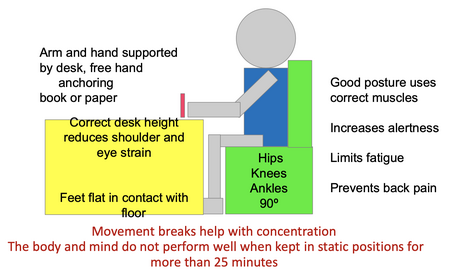
Figure 2. Sit right then write.Sitting should be comfortable
Foot support (i.e. footstool, height-adjustable chair)
If the child is sitting on the floor, consider the sitting position. Look at alignment, midline orientation, focus of attention, static propping versus weight collapsing
Allow Lots of Movement
Do not have children aged 6 to 7 years sitting still for more than 15 to 20 minutes (i.e. in Grades / Years 1 and 2)
Movement plays an important part in sitting: “a school in which movement is supported and encouraged has a positive effect on the learning ability and attentiveness of the children” (Dr Dieter Breitheckerxi)[11]
If a child is not coping, it can be useful to consider how this child sits and breathes while writing. If a child is hunched over a desk, head in arms, it can lead to:
Comments such as:
“I don’t want to do my homework”
“It’s boring”
“I'm tired”
Fidgeting
Slumping
Twisting
Poor attention to a task
Possible solutions to these issues include:
Adjusting the height of the chair
It is possible to purchase height-adjustable chairs or alternatively to use common household items to make adjustments, such as hot water bottles, cushions, books etc
Raising the work surface or using an inclined sloping surface
Feet should be placed flat on floor
Avoid hooking feet around chairs
Consider furniture size (e.g. desk and chair height)[11]
When selecting furniture in schools, the age and height of the child are often not considered, so the furniture is often too big or too small
This can lead to discomfort and restlessness and, thus, affect learning
It is possible to use wedge cushions or footstools to address these issues[1]
Writing slopes
Enable children to keep their hand under the line of writing
The position and height of the desk need to work for the child. Consider in particular the set up for:[1]
Left-handed children
Paper should be positioned to the left of the child's midline
Sitting to the left hand side of other children at their desk
Tall children
Short children
It can be beneficial to invest in a “homework chair” - examples include the: Sit Right, Enzi, Stokke and Ergochair
Sitting for Pre-Schoolers
For preschoolers, it is important to avoid W-sitting. Instead, aim for alignment with wedges and cushions and encourage positions such as:[1]
Kneeling
All fours
Playing in high kneeling
Children should also be encouraged to eat with good alignment - i.e. feet supported and a stable base.[1]
Practical Solutions
See Table 2 for practical solutions to help children become reading and writing ready, to develop good writing skills and to help them to "do".
Table 2. Ideas to help children with writing, reading and "doing".
Good Writing Skills
Cross the midline
Painting
Chalk
Use an upright surface
Stick page down
Use thicker crayons
Reading and Witing Ready
Sand/mud play
Spaghetti/string plan
Playdough
Shaving foam
Blackboards
Cut out cardboard letters
Draw lying on back
Encourage Doing
Find activities that a child can “excel” at and not be the odd one out (children should be grouped according to ability, not age)
Facilitate independence in activities of daily living (doing up buttons, dressing, getting changed for PE, getting school bag ready)
Break down activities into steps and have a 3 step plan for each activity
Give a child extra time (i.e. wake up early)
Provide choice (e.g. let children choose their own school bag)
Encourage children to exercise
Make time for attention (both the parent's and the child's)
Physical Activity
Guidelines for physical activity are discussed in more detail here, but it is recommended that:[13][14]
School-aged children have 60 minutes of physical activity per day
No screen time access for children under the age of 2 years
1 to 2 hours of educational screen time for children aged 2 to 5 years
A maximum of 2 hours screen time for children aged over 6 years
The Importance of Promoting Movement
While questions remain about how physical activity can best be incorporated in schools,[15] it is important to promote movement in children for the following reasons:[1]
To increase muscle strength, which reduces fidgeting[1]
To relieve tight muscles, which results in fewer aches and pains[1]
Movement and standing in the classroom promote concentration/focus and enhance health outcomes[17][18]
To enhance executive control processes and other cognitive tasks/performance [19][20]
NB: Increased Physical Education (PE) during school time (and the associated decrease in academic time) does not cause a decline in academic performance[21]
Practical activities to encourage movement are listed in Table 3.[1]
Table 3. Activities to encourage movement in children.
Leg balance
Running
Stretches, active mobilisation, yoga
Teach the child to ride a bike
Jumping
Hiking
Sensory activities
Teach the child to do handstands/cartwheels
Hopping
Walking
Ball exercises (skills and core work)
Talk about posture
Hopscotch
Leg strengthening
Teach the child to skip
Introduce healthy eating habits
The “I Can” Attitude
"Intrinsic motivation, characterised by an engagement in activities for their own sake, driven by inherent interest and enjoyment, stands at the core of academic success and the broader development of learners."[22]
A child needs a sense of self-efficacy and agency to engage in challenging tasks. Agency is defined as: “being able to make choices and decisions to influence events and have an impact on one’s world.”[23]
It can be beneficial to set SMART goals for the child to enhance a child’s intrinsic motivation.[1] The following strategies can be useful for parents to further encourage intrinsic motivation:[1][22]
Choose praise, reward effort and be specific with praise [24]
Acknowledge/validate and explain discomfort:
“I can see you find sitting still very hard”
“The burning feeling in your legs is a sign that your muscles are getting stronger”
“Being out of breath means that your heart is working very hard and you are getting fitter”
“I can see that this is tricky for you”
Support children to manage themselves independently[25]
↑Severino GR, Cabatic ET, Molina MM. The Role of Play in Children’s Development. The Asian Journal of Education and Human Development (AJEHD). 2024 Dec 31;5(1).
↑ 3.03.1Committee on Physical Activity and Physical Education in the School Environment; Food and Nutrition Board; Institute of Medicine; Kohl HW III, Cook HD, editors. Educating the Student Body: Taking Physical Activity and Physical Education to School. Washington (DC): National Academies Press (US); 2013 Oct 30. 4, Physical Activity, Fitness, and Physical Education: Effects on Academic Performance. Available from: https://www.ncbi.nlm.nih.gov/books/NBK201501/
↑Liu Y, Zhang D, Ke Y, Yan Y, Shen Y, Wang Z. Physical activity and sedentary behavior in children and adolescents: recommendations and health impacts. InPromotion of Physical Activity and Health in the School Setting 2024 Aug 25 (pp. 3-39). Cham: Springer Nature Switzerland.
↑Barnett L, Hnatiuk J, Salmon J, Hesketh K. Modifiable factors which predict children’s gross motor competence: a prospective cohort study. The International Journal of Behavioral Nutrition and Physical Activity. 2019;16(1):129.
↑Kangas J, Ukkonen-Mikkola T, Harju-Luukkainen H. Contextualizing Playful Learning Practices in the Finnish Early Childhood Education and Care. InEarly Childhood Pedagogical Practices Across the World: Selected Case Studies on the Role of Teachers for Learning and Care 2025 Apr 13 (pp. 81-94). Singapore: Springer Nature Singapore.
↑Myer GD, Faigenbaum AD, Edwards NM, Clark JF, Best TM, Sallis RE. Sixty minutes of what? A developing brain perspective for activating children with an integrative exercise approach British Journal of Sports Medicine. 2015;49:1510-1516.
↑Hinckson E, Salmon J, Benden M, Clemes SA, Sudholz B, Barber SE et al. Standing classrooms: research and lessons learned from around the world. Sports Med. 2016;46, 977–87.
↑Finch JE, Saavedra A, Obradović J. Academic motivation and self-regulated classroom behaviors in middle childhood: Moderation by parental education. Journal of Child and Family Studies. 2024 May;33(5):1451-65.
↑Cooper-Kahn J, Dietzel L. Late, lost, and unprepared: A parents’ guide to helping children with executive functioning. Routledge; 2024 Apr 30.