When refering to evidence in academic writing, you should always try to reference the primary (original) source. That is usually the journal article where the information was first stated. In most cases Physiopedia articles are a secondary source and so should not be used as references. Physiopedia articles are best used to find the original sources of information (see the references list at the bottom of the article).
If you believe that this Physiopedia article is the primary source for the information you are refering to, you can use the button below to access a related citation statement.
The physiotherapy assessment for individuals with spinal cord injury (SCI) provides "the vision of the possibilities [the] patient could attain in the perfect situation, and adapt it to the specific person's world".[1]
International Classification of Functioning, Disability and Health Model (ICF)
A description of health can be found in the International Classification of Functioning, Disability and Health (ICF). It offers a standard language to be used among health providers to describe the health-related state.[2] The use of ICF in the spinal cord injury assessment facilitates communication and understanding of team roles within an SCI multidisciplinary team. It challenges clinicians to think holistically.[3][4][5] The following components of health conditions are included in the ICF: body functions and structures, activities, participation, environmental factors, and personal factors. The goal of the assessment is to collect information about disordered movement patterns, underlying impairments, activity restrictions, and societal participation, and to identify the structural or functional mechanisms influencing improvement for the purpose of intervention planning.[6][7][2] The assessment should be ongoing so that clinicians can tailor-make treatment plans based on observed changes in the patient's function and behaviour.
Subjective Assessment
Body Functions and Structures
In this section, the physiotherapist asks questions and reviews the medical record, seeking information on current and past medical history, including:[1]
Mechanism of injury: traumatic vs. non-traumatic
Presence or history of other injuries related to the primary reason for assessment
Medical management and current precautions
Progression of the condition
Pre-morbid medical history
Presence of complications related to the spinal cord injury, including myositis ossificans, syringomyelia, spasticity, pressure sores, autonomic dysreflexia, infections, postural hypotension
Activity
In the ICF model of functioning, difficulty in activity is defined as problems with performing physical actions or tasks. In this section, physiotherapists ask about and observe patients' current and past abilities to perform activities of daily living with or without the assistance of special equipment. Current equipment that the patient uses may facilitate or restrict mobility. Examples of equipment used include nasal gastric (NG) tube, suctioning machine, and ventilator equipment.
Physiotherapists must notice the technology that the patient uses: assistive device, standard or special wheelchair, etc.[1]
Participation
In the ICF, participation limitation is defined as a "limitation in performing socially defined life tasks and roles".[8] It includes socialising (interpersonal interaction and relationship),[9] travelling, working, taking care of one's own health, taking care of the members of the family, taking care of one's own finances, play and leisure.[10][11] Limitations in participation can be due to functional impairments related to a spinal cord injury and / or its secondary complications. The physiotherapist must acknowledge the presence of the multidisciplinary team members who are involved in managing these limitations: speech-language pathologist, nutritionist, dietician, wound care nurse, or psychologist. For this domain, the patient is asked about previous therapy, patient goals and envisaged outcomes.
Environmental Factors
When discussing environmental factors, physiotherapists must include an assessment of the barriers and resources in the community.[1] The following examples represent environmental factors accessibility of the patient's residence (e.g.) mountainous, rural or urban area, sandy), weather conditions (e.g. hot, dry, snowy, windy), distance from healthcare services, and access to specialised services or technology.
Personal Factors
Understanding a patient's personal factors allow the physiotherapist to determine the individual's level of function and to design patient-specific interventions. Examples of personal factors include: degree of functioning; socio-economic status; mental well-being including forgetfulness, beliefs, and attitude; lack of knowledge about healthcare and prevention; lifestyle choices and practising prevention care; self-awareness, stress management, and help-seeking behaviour;[12] and household (e.g. amenities, access, support structures).[1]
You can read more about the spinal cord injury subjective assessment here.
Objective Assessment
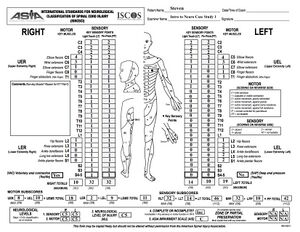
The SCI objective assessment includes observing and analysing a patient's attempts at completing a movement or activity to determine which part of the task the patient is having difficulty with. This assessment guides treatment and it provides an objective way to monitor improvement over time.[13] The timing of the assessment and communication among team members are key to the objective assessment. An objective assessment should begin with the International Standards for Neurological Classification of SCI-ASIA, and this must be completed within 4 to 72 hours after the injury.
The Modified Ashworth Scale for elbow and / or knee flexors and extensors: the instrumented stretch-reflex test is performed by the clinician. The therapist moves the forearm or lower leg slowly through elbow flexion or knee flexion, and then rapidly through extension to stretch the elbow flexors or the knee flexors.[14] Spasticity is rated as indicated by Bohannon and Smith:[15]
0: No increase in tone
1: Slight increase in tone, manifested by a catch / release, when the limb is moved into flexion or extension
1+: Slight increase in muscle tone, manifested by a catch with minimal resistance throughout the remaining range of motion (this should be less than half the total range)
2: More noticeable increase in tone through most of the range of motion, but the limbs are still easily moved
3: Significant increase in tone and passive movement is difficult
4: The limb is rigid in flexion or extension
The Wartenberg pendulum test can be used for an assessment of knee tone: the patient is sitting with their legs hanging freely over the edge of a plinth and torso reclined to approximately 30°. The therapist slowly raises the lower leg to passive full extension and holds the leg in a horizontal position until the patient is completely relaxed. The patient's lower leg is released and allowed to oscillate until coming to rest.[14]
Pain level to determine whether the pain is neurogenic or nociceptive.[1]
Cognitive function can affect participation in socially defined life tasks and roles. Current research suggests that individuals with SCI should be evaluated for cognitive impairment as there are reports that there is a high incidence of impaired cognitive functions in individuals with SCI.[16] 30% of tetraplegics have associated head trauma or hyponatremia which can lead to impaired cognition.[1] In addition, the following factors can contribute to this problem including but not limited to concomitant brain injury, psychological or somatic comorbidities, or decentralised cardiovascular control.[16]
To evaluate participation, clinicians must understand the specific needs and problems of an individual with an SCI. In the literature, it is referred to as a person–perceived participation or handicap.[17] The following measures of participation are currently available:
Craig Handicap Assessment and Reporting Technique (CHART)[18] is based on 6 domains: physical independence, cognitive independence, mobility, occupation, social integration, and economic self–sufficiency. Collects information about if and how the respondent fulfils the roles typically expected from people without disabilities. The score range from the minimum (0) to the maximum (100) where 100 corresponds to a role fulfilment at the level of the person without a disability.
You can read more about this tool and you can download the worksheet here.
The Assessment of Life Habits (LIFE–H)[19] is a self-reported assessment of life habits across 12 domains from activities of daily living to social participation. Life habits are referred to as "regular activities (eating, communication, moving around, etc) and social roles (working, studying, practising leisure activities, etc) [17]
The Impact on Participation and Autonomy Questionnaire (IPAQ) is a self-administered questionnaire that measures perceived participation and the experience of problems for each aspect of participation.[20]
You can read more about this tool and you can download the worksheet here.
You can find more information on the participation after spinal cord injury here
You can read more about spinal cord injury objective assessment here
Outcome Measures
The physiotherapist has access to a number of accurate and sensitive outcome measures in an SCI assessment.[2] No single outcome measure exists that monitors all changes and is applicable for the assessment of all individuals with spinal cord injury. It is important to choose the most appropriate ones, and to consider which ones correspond with the stage, level of the patient and the patient's goals. When assessing the patient at different stages of rehabilitation, the physiotherapist may need to use alternative outcome measures.[1][21]
When using outcome measures, the physiotherapist must remember that "outcome measurement tools do not take into account how a functional improvement was achieved ".[2] This statement gives an important message about the compensatory mechanisms that can develop over the course of rehabilitation and which can alter the true effect of a therapeutic intervention.
Upper Extremity Outcome Measures
The Nine-Hole Peg Test is used to measure finger dexterity in patients with various neurological diagnoses
The Action Research Arm Test (ARAT) or the modified Action Research Arm Test (mARAT) assesses upper limb function based on the ability to complete functional tasks[24]
Lower extremity motor score (LEMS) is a measure of the voluntary muscle strength of 10 key leg muscles, 5 on the left and 5 on the right side. Each muscle is assessed on a scale from 0 to 5, where 5 is normal. The patient can receive a maximum combined score of 50 points (5 x 10 muscles)
Ambulatory outcome measures are available when gait speed, endurance, turns and position changes from sitting/standing to walking need to be quantified. Other variables can be assessed during the performance of these tests, but it depends on their complexity.[31] For example, safety while crossing the street at a crosswalk can be evaluated. It has been established that walkers need to have a walking speed of 0.6 m/s to safely cross. However, the evaluator must also consider the region where the task will be performed (rural vs city), as the demand for speed may vary. Another example is general walking speed. Walking above 1.0 m/s for elderly people correlates with independent living.[32]
The following are examples of the ambulatory outcome measures:
Timed up and go test (TUG) looks at the time required for an individual to stand up from a chair, walk 3m, turn around, walk back to the chair and sit down
Two-minute walk test (2mWT) is a variation of the 6mWT and assesses the distance covered during a 2 minute walk. This assessment IS NOT well-established in SCI
Instrumented walkways are portable devices that offer gait analysis, including speed, step length, stance time, swing time, single support time and base of support[35]
Information on the strength and limitations of the lower extremity outcome measures can be found here.
Functional Performance Outcome Measures
Spinal Cord Independence Measure III (SCIM III) assesses the ability of a person with SCI to perform activities of daily living and is used for a comprehensive assessment of functional recovery[37]
You can read more about spinal cord injury outcome measures here.
Team Communication / Team Roles
The interdisciplinary team in a SCI unit typically consists of rehabilitation physicians, residents, rehabilitation nurses, physiotherapists, occupational therapists, leisure therapists (recreational therapists), social workers, and psychologists, but the number and speciality of the team members can vary depending on the country, medical systems, socioeconomic status, etc. The staff should be available 5-7 days a week and should be supported by other healthcare professionals including pharmacists, dietitians, speech-language pathologists, respiratory therapists, orthopaedic surgeons, or infection control specialists.
You can find information on the interdisciplinary management of spinal cord injury here.
Goal Setting
Good assessment and choosing the most appropriate goals can lead to more functional outcomes; i.e. the patient would have a better chance to return to their home environment with the appropriate equipment and skills to re-integrate back into society and perform the roles they want to fulfil safely and effectively.[1] When goal setting in SCI rehabilitation reflects only physical functioning goals, the individual with an SCI will not be adequately prepared for everyday life and emotional issues. Healthcare providers should address psychosocial components such as family issues and change of roles and include goals relevant to the person with the SCI and their everyday life.[42]
One common method of goal setting is derived from the SMART Goal approach, which originated in the field of project management.[43] The acronym SMART stands for specific, measurable, attainable or assignable, realistic, and time-related.
↑Sykes C. Health Classifications 1 - An Introduction to the ICF. WCPT Keynotes. World Confederation for Physical Therapy. 2006.
↑Rauch A, Cieza A, Stucki G. How to Apply the International Classification of Functioning, Disability and Health (ICF) for Rehabilitation Management in Clinical Practice. Eur J Phys Rehabil. 2008;44(3):329-42.
↑Ryerson S. Neurological Assessment: The Basis of Clinical Decision Making. In: Lennon S, Stokes M, editors. Pocketbook of Neurological Physiotherapy. Elsevier Health Sciences; 2008 Oct 10.
↑Bernhardt J, Hill K. We Only Treat What It Occurs to us to Assess: The Importance of Knowledge-based Assessment. Science-based Rehabilitation: Theories into Practice. 2005:15-48.
↑Jette AM, Haley SM, Kooyoomjian JT. Are the ICF Activity and Participation dimensions distinct? J Rehabil Med. 2003 May;35(3):145-9.
↑Kumari R, Joshi R, Vijay P. Cross-cultural adaptation and validation of the “impact on participation and autonomy”(IPA) questionnaire in Indian population with spinal cord injury. Spinal Cord Series and Cases. 2025 Jan 20;11(1):2.
↑Wuolle KS, Van Doren CL, Thrope GB, Keith MW, Peckham PH. Development of a quantitative hand grasp and release test for patients with tetraplegia using a hand neuroprosthesis. J Hand Surg 1994; 19: 209–218.
↑Andrews AW, Vallabhajosula S, Ramsey C, Smith M, Lane MH. Reliability and normative values of the Wheelchair Propulsion Test: A preliminary investigation. NeuroRehabilitation. 2019;45(2):229-237.
↑van Hedel HJA, EMSCI Study Group. Gait speed in relation to categories of functional ambulation after spinal cord injury. Neurorehabil Neural Repair. 2009;23:343–50.
↑Zörner B, Blanckenhorn WU, Dietz V, Curt A. Clinical algorithm for improved prediction of ambulation and patient stratification after incomplete spinal cord injury. J Neurotrauma. 2010;27:241–52.
↑Barbeau H, Elashoff R, Deforge D, Ditunno J, Saulino M, Dobkin BH. Comparison of speeds used for the 15.2-meter and 6-minute walks over the year after an incomplete spinal cord injury: The SCILT Trial. Neurorehabil Neural Repair. 2007;21:302–6.
↑Dobkin BH. Short-distance walking speed and timed walking distance: Redundant measures for clinical trials? Neurology. 2006;66:584–6.
↑Nair PM, Hornby TG, Behrman AL. Minimal detectable change for spatial and temporal measurements of gait after incomplete spinal cord injury. Top Spinal Cord Inj Rehabil. 2012;18:273–81.
↑Gresham GE, Labi ML, Dittmar SS, Hicks JT, Joyce SZ, Stehlik MA. The Quadriplegia Index of Function (QIF): sensitivity and reliability demonstrated in a study of thirty quadriplegic patients. Paraplegia. 1986 Feb;24(1):38-44.