When refering to evidence in academic writing, you should always try to reference the primary (original) source. That is usually the journal article where the information was first stated. In most cases Physiopedia articles are a secondary source and so should not be used as references. Physiopedia articles are best used to find the original sources of information (see the references list at the bottom of the article).
If you believe that this Physiopedia article is the primary source for the information you are refering to, you can use the button below to access a related citation statement.
Running for health has led to a growing running shoe market worldwide. Over the past 50 years running shoe designs have changed significantly. The purchase of a running shoe can be overwhelming for a runner as the market is full of shoes of different weights, designs, features, materials and prices. Often the consumer is dependent on the advice of a salesperson to select the correct shoe. Marketing claims, such as those promoting "gait-matched" footwear, can significantly bias a runner's subjective perception of shoe comfort and performance. [1]
The challenge for clinicians treating runners is to stay informed about the continuous changes and updates in footwear, as well as the forever changing scientific landscape of shoe benefits and risks to help runners make informed decisions.[2]
Finding the Right Fit
Physiotherapists working with runners need to be knowledgeable about running shoes. They also need to be accurate and thorough when fitting running shoes. Furthermore, it is important to provide runners with sound advice about their running shoes.[3] For a quick review, read this page: Basic Anatomy of a Running Shoe
Physiotherapists can provide advice on shoes based on[3]:
The foot size of the runner
What distance do they run/ mileage?
Running mechanics
History of previous injuries or current injuries
The goal is to be able to guide runners to a type of shoe that suits their abilities and needs.[3] To be able to do that, it is important to:
The runner needs one pair of shoes that can be versatile
e.g. running on road and trail
Different shoes are necessary
The shoe selection may change over time as the runner's aims and goals change, for example:
Beginner runner wanting to do longer distances
Road runner wanting to do more trail running
Trail runner wanting to run on more challenging and technical trails
Understanding your runner and their goals are important if you are to provide advice on shoe selection. The subjective and objective assessment of the runner is important and valuable as this determines factors that will impact shoe selection. These factors can include[3]:
Type of running (road; trail; track)
Running distance/mileage
Running terrain
Runner’s aims
Preferences for multi-terrain shoe vs road running shoe vs trail shoe vs track shoe
Assessment of a Runner’s Shoes
Ask the runner to bring their old and worn running shoes to the physiotherapy consultation/session
It is always better to analyse a runner’s older shoes than brand new ones
Common Issues in Running Shoes That Are Not Always the Product's Fault
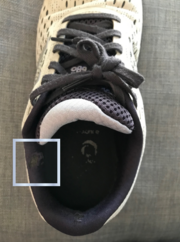
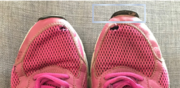
Running shoe upper - Toe lift
Some common issues found in running shoes are not always due to the product. Issues to be aware of include[4]:
Toe lift
Running shoe upper with holes near the big toe
Contributing factors:
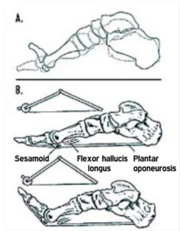
Windlass MechanismWindlass mechanism of the foot[5] – tightness of the plantar fascia (and possibly Achilles tendon and calf muscles) causes the big toe to lift and, thus, make contact with the upper of the shoe.
Shape of shoe
Volume of upper around the toe box
Flexibility of the shoe
Combination of shoe materials
Ankle and foot mobilisation, myofascial release of the plantar fascia and surrounding areas could reduce toe lift incidences
Narrow base of running gait due to weakness or lack of range of motion in hips and glutes – this means that the opposite foot may strike the upper collar causing excessive wearing. Shoelaces that are not tied properly can compound this issue as the collar will be more open and exposed.
Runners with low flat arches or wider feet may also experience this scuffing around the heel collar.
Splitting sides
Contributing factors:
Shoe too wide
Shoe too narrow
Incorrect shoe type, for example, neutral runner running in a stability shoe
Lack of cleaning or incorrect cleaning of shoes – especially trail shoes (dirt between mesh layers can act like sandpaper and damage the upper of the shoe)
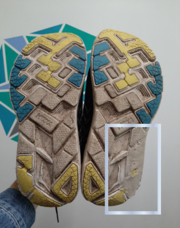
Signs of heel drag on sole of left shoeHeel drag
Excessive wear will be visible on the outside of the heel of the shoe's sole
This is often caused by the gluteal muscles not firing properly, leg length discrepancies, pelvic tilt or scoliosis
The image on the right shows signs of heel drag on the left shoe of a runner who had a hamstring injury
Inner heel wearInternal heel wear
Contributing factors:
Shoelaces not tied correctly
Runner with a Haglund’s deformity
Shape of the conforming heel cup to the shape of the heel – if this does not match excessive wear is possible
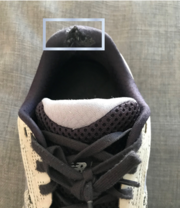
Toe bumper coming loose
Contributing factors:
Incorrect shoe care (washing machine, tumble dryer)
Stress or trauma to the area – trail running in tricky terrain
Washing and Maintaining Shoes
Toe bumper of shoe coming looseNever wash shoes in a washing machine
Never artificially dry shoes
Do not leave shoes in the car in the heat – this softens the foam and influences the life span of the shoe[4]
Do not leave shoes in the sun to dry
Be careful with common cleaning solvents
Assessing a Runner’s Shoe
Some factors to consider with a runner's shoes at the assessment[3]:
Shoe mileage (how many kilometres has the runner run in the shoes)
The type of shoe (road running; trail running; neutral shoe; stability shoe)
Apps are available that can provide relevant information on the specific shoe such as the stack height and heel to toe drop (e.g. RunRepeat)
When assessing the runner's shoe, focus on the following[3]:
Assess the wear on the shoe
Always compare left to right
Be methodical i.e. start from the front, laces, different angles, side view and back view
Assess the wear on the upper and sole of the shoe
Older more worn running shoes will provide more information
Running Shoes for Specific Injuries
Keep in mind that the individual response to different shoes remains variable and unpredictable. Furthermore, the evidence is lacking on injured runners and the selection of shoes for specific injuries. Remember that shoe selection is just a part of your management plan and that educating the runner about their injury, load management, training at the appropriate level and exercise prescription to address any possible deficits such as strength or control remains crucial.[7]
Footwear recommendations primarily prioritise comfort and injury prevention, with cushioning highly regarded for both. Opinions on the importance of pronation control are inconsistent across disciplines.[9]
Assess the area of pain on Achilles Tendon - sometimes the pressure from the heel collar irritates the tendon
Consider reducing the load and stretch on the Achilles tendon by suggesting a running shoe with a higher heel to toe drop and with more cushioning
A shoe with a higher heel to toe drop may be favourable for management of injuries such as Achilles tendinopathy as the maximum range of ankle dorsiflexion is decreased. The muscle-tendon unit length of the gastrocnemius is also reduced. One systematic review by Rabusin et al.[10] reported that heel lifts can affect these specific biomechanical parameters.[10]A randomised trial investigated the efficacy of heel lifts versus calf muscle eccentric exercise for mid-portion Achilles tendinopathy and found that heel lifts were more effective than calf muscle eccentric exercise in reducing pain.[11] Furthermore there was an improvement in function at 12 weeks.[11] However, further research is necessary to determine if these differences are clinically relevant, but is is noted that clinicians can consider the use of heel lifts as a first line treatment for adults with mid-portion Achilles tendinopathy.[11]
Impact injury - can recommend to runner to start training on a firm grass field, to reduce impact
A shoe with adequate cushioning may absorb the impact of the foot hitting the ground when running
A systematic review concluded that shoes with low levels of cushioning can increase the risk of shin and calf injuries[12]
Minimalist running shoes ( <7‐mm heel‐to‐forefoot drop, <200‐g weight, and little to no cushioning) may offer biomechanical benefits. To prevent injury, sudden changes to footwear or technique should be avoided, and gradual, individualised adjustments is recommended.[13]
Metatarsalgia
Metatarsalgia is a general term for pain in the area of the metatarsophalangeal joints. Pain on the ball of the foot.
Investigate the toe box of the shoe - is it too narrow, causing compression?
Restriction of the natural foot deformation and mid-forefoot widening has been shown to influence the load distribution and forces in the foot and can cause running-related repetitive loading disorders such as metatarsalgia, interdigital neuromas, bunions and painful toenails. [2]
Pain developed shortly after a change in running shoes
Feels as if there is no power to lift foot while running
Advice on shoe selection:
Assess the weight of the shoe and if there is a difference between current and previous running shoes
The activation of tibialis anterior is affected by the mass of a shoe in runners and heavy running shoes used for running over a period of time may cause injury related to tibialis anterior muscle fatigue[15]
Note: Runners can develop chronic exertional compartment syndrome in all of the compartments of the lower leg.[16] Specifically in the anterior compartment of the lower leg, the following structures may be involved: tibialis anterior, extensor digitorum longus, extensor hallucis longus, peroneus tertius, deep peroneal nerve, and the anterior tibial artery and vein. The runner may report a dull, achy, cramping pain or feeling in the involved limb and may be accompanied by numbness, paresthesia and/or muscle weakness. These symptoms often worsen as the intensity and/or duration of the activity increases. Symptoms usually subside 15 to 20 minutes after the activity has stopped.[17]
Acute compartment syndrome occurs when an injury to a limb is a result of a significant increase in intracompartmental pressure. This increase in pressure results in decreased perfusion pressure, subsequent ischaemia to muscles and nerves and this may result in tissue necrosis and complications. In acute compartment syndrome, pain is typically out of proportion to the examination. Other symptoms that can arise as the intracompartmental pressure increases are the 6 "Ps" (passive pain (disproportionate to the injury), paresthesia, pallor, paralysis, pulselessness and poikilothermia (difference in temperature between limbs, the involved or affected limb is usually cooler than the other side).[18]
Clinicians should be aware of the differences between chronic exertional compartment syndrome and acute compartment syndrome as the latter requires emergent and invasive treatment.
Changing Shoes
If a runner has a specific brand of shoe that is working well - don't change it
Try and adapt to a similar shoe within the same brand
If a drastic change is needed - introduce the change gradually[3]
↑ 4.04.1Bryant G. It's Not Always a Shoe Fault.[Internet]. 2020 [cited 07 December 2021].
↑Welte L, Kelly LA, Kessler SE, Lieberman DE, D'Andrea SE, Lichtwark GA, Rainbow MJ. The extensibility of the plantar fascia influences the windlass mechanism during human running. Proceedings of the Royal Society B. 2021 Jan 27;288(1943):20202095.
↑Docpods. Windlass mechanism and how it relates to foot pain and heel pain. Available fromhttps://www.youtube.com/watch?v=_UVbR7uD0Og (last accessed 7 December 2021)
↑Halldin Lindorsson S, Rennerfelt K. Compartment Syndromes of the Lower Leg. In Sports Injuries: Prevention, Diagnosis, Treatment and Rehabilitation 2025 May 3 (pp. 677-694). Cham: Springer Nature Switzerland.
↑Vajapey S, Miller TL. Evaluation, diagnosis, and treatment of chronic exertional compartment syndrome: a review of current literature. The Physician and sportsmedicine. 2017 Oct 2;45(4):391-8.
↑Farah O, Farah G, Mumuni S, Volchenko E, Hutchinson MR. Acute Compartment Syndrome in the Athlete. Clinics in Sports Medicine. 2023 Apr 6.