When refering to evidence in academic writing, you should always try to reference the primary (original) source. That is usually the journal article where the information was first stated. In most cases Physiopedia articles are a secondary source and so should not be used as references. Physiopedia articles are best used to find the original sources of information (see the references list at the bottom of the article).
If you believe that this Physiopedia article is the primary source for the information you are refering to, you can use the button below to access a related citation statement.
There is a considerable range of running shoes available on the market. There are multiple brands, styles and colours, as well as various shoes for specific types of running (e.g. road, trail, or track). With runners striving to increase performance and reduce the risk of injuries, the footwear market has bloomed and along with it the technological advancement of running shoes.[1] It is vital to understand the makeup of a running shoe and the specific needs of the runner - what would best suit them for their training and racing? Runners may even need more than one shoe if they train on both trail and road or require different types of trail shoes for different terrains.
Not only is there a large selection of shoes to choose from, there has been an enormous change in shoe design over the past 100 years.
Research on Running Shoes
Trail running shoe outer sole
Running shoes are engineered specifically for their intended purpose. They are described using terms such as support, cushioning, lightweight, minimalist and barefoot.[2] A basic understanding of their structure is necessary to effectively assess, treat and recommend shoes to runners.[3]
Running shoes play a vital role in the biomechanics and physiological efficiency of the runners.[4]
Vercruyssen et al.[5] found that calf pain increased significantly in trail runners who wore a minimalist shoe compared with trail runners who wore a traditional shoe.
Motion control (supported or anti-pronation) shoes should be considered when choosing/selecting a shoe for a runner.[6]
One study[7] found that the plantar force over the medial foot structures increased as running mileage/distance increased in recreational runners wearing neutral shoes, but not in those wearing motion control shoes. Runners in this study had 6 or more degrees of foot pronation.
Altering the material hardness of the midsole can affect muscle activation in response to the loading rate of the impact forces at heel-strike.[8]
The weight of the running shoe can affect biomechanics.
Wang et al.[9] showed that the peak vertical ground reaction force increased significantly as shoe mass increased, which may heighten injury risk.
Based on the systematic review, Kettner et al.[10] concluded, that thicker soles are primarily associated with extended stance duration and reduced ground reaction force loading rates.
While every individual has their own running strategy, the running shoe's mass may cause an alteration in strike pattern and the coordination of the running strategy.[9]
Two paradigms have been proposed by Nigg et al.[2]
Preferred movement path - an individual athlete's skeleton attempts to stay in the same movement path for a given task (e.g. heel-toe running)
Comfort filter - the comfort level of the shoe which the runner selects is due to the runner’s own comfort filter. This comfort filter automatically reduces the risk of injury and may explain why there is no clear trend in the number of running injuries over time.[2]
Comparison of three different styles of shoes (minimalist; cushioned and large heel-toe drop)[11]:
Large adaptations in muscle activation are needed when running conditions are drastically different – for example, changing from a minimalist to a cushioned or extreme heel-toe drop.
The movement path can be maintained with small changes in muscle activation when running conditions are similar, including using similar shoes.
Research, therefore, shows the importance of knowing your running shoe to fit your runner and the impact that shoes can have on muscle activation. It also highlights that the comfort level of a shoe may have a significant influence on injury risk.
Importance of Shoe Anatomy
Variety and significance
Be specific for each runner
Understand the goals of the runner
What are their aims and what do they want to achieve?
These factors will play an integral role in determining what type of shoe should be recommended.
Pre-existing or previous conditions – certain shoes may assist in supporting certain structures and prevent the irritation of other conditions
Shoes must fit correctly
To prevent blisters
To maintain good circulation
To prevent tightness especially as feet swell
To prevent pins and needles (paraesthesia)
To ensure shoes are comfortable to wear
It is important to know what type of surface the runner is predominantly running on: road, trail, or track? Does the runner need one versatile shoe for both road and trail? Is your runner wanting to have different pairs of shoes for road running and trail running? Also, consider the affordability of this.
Fit the Shoe Correctly
These are guidelines, but they need to be adapted for each individual runner.
Ideally fit a shoe at the end of the day.
Put the shoe on, then test while standing to see that there is a finger space in the front to allow room for the toes.
Walk in the shoe and determine comfort.
Ensure that the heel doesn’t slide up.
Check the lacing - lace the shoe as normal to get an accurate feel of the shoe.
Proper fitting of the shoe may prevent blisters.
The running shoe must not be too tight – allow for feet to swell. This is especially important for ultra runners who spend a long period in their shoes.
Some trail runners, in particular, prefer a more snug fit, especially for technical terrain. This comes down to what has worked for the runner and their personal preference.
If the shoe is too tight it could possibly cause circulation problems or even pins and needles (paraesthesia).
The way the shoe is laced may also have an impact on the above, even if a correct size shoe is worn.
These guidelines will help you fit the shoe well, understand the shoe and be able to have the knowledge to guide runners into which shoe may be the best for them.[3]
Road Running Shoes versus Trail Running Shoes
Trail running shoes with lugs on the outer sole
Road running shoes and trail running shoes look different. The main difference is the outer soles: trail running shoes have lugs (deep indentations in a pattern designed to provide good footing) and road running shoes are smooth. There are many different types of road and trail shoes. Trail shoes can have varied lugs:
Large and spaced out lugs
Smaller lugs - with more lugs on the outer sole
Large, deep lugs that are fairly dense
Different lugs have different functions. Shoes with deeper lugs are suitable for muddy terrain - they help to prevent mud from getting stuck between lugs. Because they have a larger surface area, these shoes are better able to grip. Shoes with a smaller and greater number of lugs are used for more technical trails. They are more likely to be more comfortable over longer distances.
Road running shoes
The road running shoe is flat underneath with no lugs as grip is not really needed. However, road running shoes vary in cushioning depending on the function or the runner's preference.
If a runner prefers to have just one shoe for trail and road, it is best to recommend a trail shoe with smaller lugs. Be aware that the lugs will most likely wear out quicker with road running than with trail running and this should be taken into consideration.
The upper part of the shoe is also specifically designed for road or trail. The uppers of trail shoes vary, but tend to be firmer to sustain the harsh terrain without ripping. However, they still need to be breathable. Trail shoes will often have a firmer part at the front of the shoe.
The cushioning of a shoe decreases the impact on a runner's feet between the shoe and the surface area (road/ trail). It is recommended to have more cushioning for longer runs, so that the feet are more comfortable and cushioned. The midsole thickness can change how and for how long the runner contacts the ground. Furthermore, the distribution of sole thickness from under the heel and toe affects running motion.[13][14]
Heel to toe drop refers to the difference in height between the heel and the toe of the shoe. There is usually a drop of between 0 and 11mm:
0mm is a minimalist heel drop
5mm is a middle heel drop
11mm is the maximal heel drop
It is possible to have a shoe with a large cushioning, but a minimalistic (0mm) heel drop. In other words, the shoe is flat (similar to being barefoot), but it is cushioned. You can also get a cushioned shoe with a heel-toe drop of 5 or 10mm.
There are also shoes with minimal cushioning and low heel-toe drop - which is a minimalistic shoe (i.e. barefoot running) - or shoes with minimal cushioning that have a high heel drop of 5 to 10mm.
According to Renninger and Beck,[16] "a lower heel-toe drop elicits the best running economy" due to allowing the medial gastrocnemius to work at longer, more economical lengths, and throught the reduction of knee extension moments.
Two ways to easily test the flexibility of running shoes are:
Flex the toe part of the shoe upwards to test the flexibility of the sole – mimicking toe-off.
Torsional test - check how easy it is to twist the shoe. Is there any resistance offered? How much does the shoe twist?
By testing flexibility, it is possible to see what kind of support the shoe may offer. If there is a large play, or movement, in either or both movements, the shoe is probably not going to be very supportive. However, if there is a bit of resistance and less movement, more support will be available.
Supported shoes are also known as anti-pronation shoes [19] although this name is becoming less popular. A firmer base is made on the inner part (medial side) of the shoe to provide the additional support to prevent the over-pronation movement.[20] Pronation is defined as the inward rotation of the rear foot about the subtalar joint axis. Supination is the outward rotation of the rear foot about the subtalar joint axis.[21] If the runner has a supported shoe and it works for them, keep it. If, when they changed to a supported shoe they started to develop an injury, this may be a possible cause to keep in mind.[3]
If the runner has not got a supported shoe and some additional support may be needed, opt for a neutral shoe and consult/refer to an orthotist/podiatrist to create the necessary Introduction to Orthotics i.e. the amount to build up, as well as the exact area of support.[3]
Difference Between Running Shoes
Neutral shoes
Running shoes that are generally lightweight and flexible, with no specific features to address overpronation[22]
Stability or supported shoes
These shoes are designed to support the arch of the foot. There is greater support through the midsole and this support may extend into the heel. Shoes are slightly stiffer and heavier than a neutral shoe.[22]
Motion control shoes
These shoes provide arch support in the midsole, but usually also have additional heel cup support and other features to stop the foot from rolling during each step. Shoes are stiffer and heavier than neural or stability shoes. These shoes are often designed for runners with flat feet or those with severe overpronation.[22]
Always compare the runner’s shoes, the left with the right and especially the old shoes.
Heel collar
Assess if there is any asymmetry - if the collar bends inwards, it may indicate pronation
Using video analysis can help to identify if the runner has forefoot or rearfoot pronation or a combination.
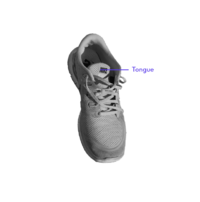
Tongue of the shoeIdentify the tongue of the shoe
Upper
What is it made of? For example, mesh and how dense?
Trail shoes have a toe bumper - i.e. a solid part to protect the toes from being hit by rocks.
What is the wear on the upper? This might indicate where a runner scuffs one leg on the other.
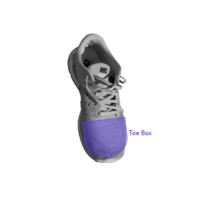
Toe boxToe box
This is an important aspect of the shoe
There are different sizes available in the same make shoe, so it is necessary to check that the runner has what they need.
Are their toes bulging out the sides or is the toe box loose with too much space?
How wide or narrow is the toe box and does it fit well?
Lacing
Note how the runner laces their shoe. This may have an influence on possible niggles or injuries developing.
The shoe can be laced differently to accommodate areas that need either more or less support.
Lock laces are also an option, but depend on personal preference. The lock lace is great in that once it is in place, you won’t have to stop and tie a shoelace!
Lacing techniques
Read more about lacing techniques in this blog post by RunRepeat: The top 12 shoe lacing techniques. The image below is a useful guide to these 12 lacing techniques. The videos below also show how to perform the different lacing techniques.
There are a variety of brands and within each brand, there are different types of shoes. Trail, road, track, and a combination of these. It is important to note if the runner, in particular road runners, likes to use a racing shoe and a training shoe. In general, the racing shoe is lighter – so the overall weight of the shoe is less. Its material, particularly the cushioning, is made of extremely good material, but it may not last long due to impact, so these shoes have a shorter run life. Training shoes may be more cushioned and possibly more stable – longer time in the shoe for comfort and longevity.[3]
Different Brands
Different brands may be known for specific aspects of a shoe. Some may have a narrower fit while other brands may offer different toe box sizes. Ultimately, if the runner comes with a specific brand and it works for them, don’t change it unless necessary. Look at An Introduction to Understanding Your Runner and Subjective Assessment of a Runner for more information on how to be specific in analysing the runner and their needs.
Vary Shoes
If possible, it is recommended that a runner has two pairs of shoes that they can swap between while training. It can even be the same make, worn at different times. This allows the runner's feet to experience a different feel and adapt to this, rather than being in the same shoe all the time. Malisoux et al.[40] showed that runners who use more than one pair of running shoes at the same time had a lower risk of running-related injuries. It is hypothesised that alternating between running shoes induces a variation in the physical load applied to the musculoskeletal system.[40]
Ensure that you recommend the shoe that suits the runner's needs, abilities and terrain, and NOT the looks!
↑Andreyo E, Unverzagt C, Schoenfeld BJ. Influence of Minimalist Footwear on Running Performance and Injury. Strength and Conditioning Journal. 2022 Jun 26;44(3):107-16.
↑Running Physio. Are motion control shoes the answer for pronation related injuries? Available from https://www.youtube.com/watch?v=IKfHtVbkgLk. (last accessed 13 October 2021)
↑ 40.040.1Malisoux L, Ramesh J, Mann R, Seil R, Urhausen A, Theisen D. Can parallel use of different running shoes decrease running‐related injury risk?. Scandinavian journal of medicine & science in sports. 2015 Feb;25(1):110-5.