
Objective Assessment of the Shoulder
Top Contributors - Carin Hunter, Jess Bell, Kim Jackson, Tarina van der Stockt and Vidya Acharya
Introduction
Shoulder pain is the third most common musculoskeletal presentation in primary care, and it is often persistent.[1][2] The subjective examination should establish a working list of differential diagnoses; the focus of the objective examination is to narrow these down and enable more effective management and treatment. This page outlines the key clinical frameworks and assessment procedures for the objective examination of the shoulder. For a more detailed guide to shoulder assessment techniques, see Overview of Shoulder Assessment.
Causes of Pain
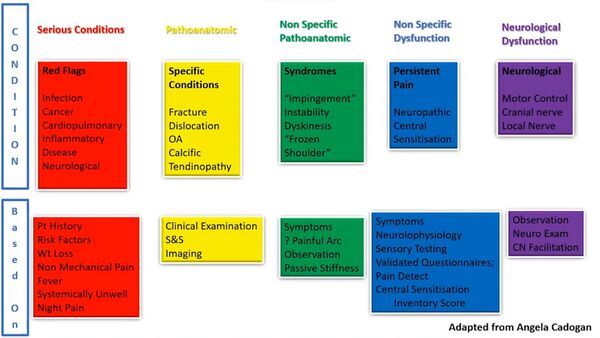
The following is not an exclusive list, but provides a framework for considering the possible causes of shoulder pain. This classification is adapted from Angela Cadogan.
Serious Conditions
- Infection
- Cancer/malignancy
- Cardiopulmonary
- Inflammatory disease
- Neurological problems

Pathoanatomic
- Fracture around the shoulder
- Dislocation
- Osteoarthrosis
- Calcific tendinopathy
Non-specific Pathoanatomic
- Impingement syndrome
- Instability
- Dyskinesis
- Adhesive capsulitis (frozen shoulder)
Non-specific Dysfunction
- Persistent pain
- Neuropathic pain
- Central sensitisation
Neurological Dysfunction
- Motor control
- Cranial nerve
- Local nerve
Objective Assessment
First, exclude the cervical spine as a source of symptoms using tests such as:
Once the cervical spine has been excluded, the assessment can proceed with a structured classification framework.
STAR Assessment
The STAR (Staged Approach for Rehabilitation Classification) shoulder assessment proposes that rehabilitation diagnoses are made based on the assessment findings. This system defines three levels of irritability, with corresponding strategies guiding treatment intensity based on the physical stress theory.[3][4]

Please read this article if you would like further information: Staged Approach for Rehabilitation Classification: Shoulder Disorders (STAR-Shoulder)
SIN
SIN refers to the Severity, Irritability, and Nature of the patient's condition. It is important to assess SIN before conducting the objective examination, as it guides the intensity of the assessment. If SIN is not considered, the patient's symptoms may be aggravated early in the assessment and, as a result, the examination may need to be stopped before the differential diagnosis can be confirmed or excluded.[5][6]
Severity can be measured using the Visual Analogue Scale. Irritability is determined by how easily symptoms are provoked, the severity of those symptoms, and how long they take to settle once aggravated.[7][8] A useful prompt is: "WHAT activity, after HOW LONG, brings on HOW MUCH pain? And HOW LONG does it take to subside?" Nature refers to whether the condition is inflammatory, traumatic, degenerative, or mechanical.
SIN can be classified as high (greater than seven out of ten, tends to disturb sleep), moderate (four to six out of ten, may include intermittent pain at night), or low (no pain at rest).[2]
Meaningful Task Analysis
When conducting an assessment, cardinal movements such as flexion, abduction, and rotation are commonly assessed. However, Linda-Joy Lee and Diane Lee[9] describe the importance of a meaningful task analysis — identifying the specific movement that brings on the patient's pain, such as taking off a jumper, fastening a bra, or putting on a seatbelt. The meaningful task should be used as the basis for reassessment, both in the clinic and in the patient's activities of daily living.[2]
Range of Motion
While the meaningful task is the primary focus of reassessment, the clinician will also assess general range of motion as part of the objective examination. It is important to consider the patient's background when interpreting findings, as normative ranges vary between populations — for example, range of motion values differ between the dominant and non-dominant shoulders of tennis players, and between males and females.
Active movement should be assessed before passive movement, so that the pain-free range is established first. The following movements should be assessed:
- flexion
- extension
- abduction
- adduction
- internal rotation
- external rotation
- horizontal flexion
- horizontal extension
Special Tests
Research suggests that individual special tests have limited diagnostic accuracy for shoulder pathology, and no single test is sufficient to make a specific structural diagnosis.[10][11] However, they can still contribute to the clinical picture when interpreted alongside other findings.[2]
- Crank Test
- Hawkins-Kennedy Test
- Posterior Instability
- Anterior Instability
- Posterior Impingement
- O'Brien's test
Shoulder Symptom Modification Procedure
The Shoulder Symptom Modification Procedure (SSMP),[12] developed by Jeremy Lewis in 2009, is a reliable systematic approach to assessing patients with rotator cuff-related and subacromial pathology.[13] It includes four sequential mechanical techniques. Each technique is applied while the patient performs a provocative movement. The goal of SSMP is to identify techniques that reduce symptoms and/or improve movement and function.[14] Rather than attempting to diagnose a specific pathology or determine the exact source of pain, the SSMP focuses on identifying factors that may be contributing to provocative movements, which then informs treatment.

The four stages of the SSMP are as follows.[15]
Altering the thoracic kyphosis: the clinician first assesses whether increasing or decreasing the thoracic kyphosis influences the patient's symptoms. If this fully resolves symptoms, treatment focuses on postural education, exercise (including motor control training during provocative activities) and manual therapy.[15][16]
Scapular repositioning: when thoracic modifications only partially improve or don't change symptoms, the clinician assesses how changing scapular position impacts symptoms.
Humeral head positioning procedures: if scapular procedures don't fully resolve symptoms, the clinician evaluates the effect of humeral head techniques (e.g., depression, elevation, anterior and posterior glides) on symptoms.
Neuromodulation: if the preceding three stages do not sufficiently improve or alter symptoms, the clinician applies manual techniques — such as soft tissue and joint mobilisation across the cervical, thoracic and shoulder regions — to assess their impact on pain.
If you would like to read more, please see:
- Rotator Cuff Tendinopathy: Navigating the Diagnosis Management Conundrum[17]
- SSMP Tool
- SSMP summary by Eleanor Richardson & Jeremy Lewis
Strength Definitions and Force Assessment
Strength is the ability of a muscle or muscle group to develop maximal contractile force in a single contraction against resistance.[2]
Endurance is the ability of a muscle or a muscle group to repeatedly exert a submaximal force.[2]
Explosive power is the ability to produce the maximum amount of force in a minimal amount of time.[2]
Rate of force development is a measure of the speed of force production.[2]
Electromechanical delay is the delay between the onset of electrical activity and the measurable onset of muscle force. An electromechanical delay can result in micro instability.[2]
Measuring Force
Force can be measured isometrically using a digital dynamometer, such as the Activforce 2, which connects to a smartphone app and provides a direct force value. Each test position should be held for three seconds, and the clinician should note whether the patient experiences any pain, as this will inhibit muscle power.
Positions for isometric assessment include abduction, external rotation, and external rotation and internal rotation at 90 degrees of abduction. Internal rotation at 90 degrees can also be used to assess middle and lower trapezius force. When using a long lever, patients may find it difficult to produce force; applying the dynamometer at the posterior aspect of the acromion may be a practical alternative. Assessment should progress into functional positions relevant to the patient.
Assessing Serratus Anterior Function
The most common way of assessing serratus anterior is in protraction, but it is also important to assess its role as an upward rotator. The following break test assesses this:
- Position the patient's arm in approximately 130 degrees of flexion
- Place one hand over the patient's wrist and the other over the inferior angle of the scapula, resting it in the webspace between the thumb and first finger.
- Apply a downward force with the hand by the wrist
- Assess what moves first:
- Humerus first: the arm drops down, followed by the scapula downwardly rotating
- Scapula first: the scapula downwardly rotates before the arm drops. This indicates a deficiency of serratus anterior as a scapular upward rotator.
Proprioception
Proprioception is an important consideration for the shoulder due to the inherent instability of the joint — sometimes described as a ball and saucer rather than a ball and socket. Neural processing is critical in keeping the humeral head stable.[2]
Joint position sense — our ability to understand joint position in space[18] — is one of the most commonly used measures of shoulder sensory function. It can be assessed through active joint position sense, passive joint position sense, and active path of joint motion replication. Kinaesthesia is our ability to appreciate and interpret joint movement.[18] There are many ways to assess proprioception around the shoulder, but currently, there is no standardised method.[2]
Summary
When assessing active movement, quality is as important as range — movement should look effortless, without compensatory patterns. Pain behaviour and the effect of repetition should be noted, and all findings should be related back to the meaningful task. The shoulder should be considered as a whole, including the sternoclavicular and acromioclavicular joints, and the kinetic chain should not be overlooked.
References
- ↑ Lucas J, van Doorn P, Hegedus E, Lewis J, van der Windt D. A systematic review of the global prevalence and incidence of shoulder pain. BMC Musculoskelet Disord. 2022 Dec 8;23(1):1073.
- ↑ 2.00 2.01 2.02 2.03 2.04 2.05 2.06 2.07 2.08 2.09 2.10 Horsley I. Objective Examination of the Shoulder Course. Physiopedia Plus, 2021.
- ↑ McClure PW, Michener LA. Staged Approach for Rehabilitation Classification: Shoulder Disorders (STAR-Shoulder). Phys Ther. 2015 May;95(5):791-800. doi: 10.2522/ptj.20140156. Epub 2014 Dec 11. PMID: 25504491.
- ↑ Podschun L, Hill C, Kolber MJ, McClure P. Application of the Staged Approach for Rehabilitation Classification System and associated improvements in patient-reported outcomes following rehabilitation for shoulder pain. Phys Ther. 2024 May 1;104(5):pzae029.
- ↑ Petersen EJ, Thurmond SM, Jensen GM. Severity, Irritability, Nature, Stage, and Stability (SINSS): A clinical perspective. Journal of Manual & Manipulative Therapy. 2021 May 15:1-3.
- ↑ Koury MJ, Scarpelli E. A manual therapy approach to evaluation and treatment of a patient with a chronic lumbar nerve root irritation. Physical therapy. 1994 Jun 1;74(6):548-60.
- ↑ Sayres LR. Defining irritability: the measure of easily aggravated symptoms. British Journal of Therapy and Rehabilitation. 1997 Jan;4(1):18-37.
- ↑ Barakatt, E. T., Romano, P. S., Riddle, D. L., Beckett, L. A., & Kravitz, R. (2009). An Exploration of Maitland's Concept of Pain Irritability in Patients with Low Back Pain. The Journal of manual & manipulative therapy, 17(4), 196–205. https://doi.org/10.1179/106698109791352175
- ↑ Lee DG. Biomechanics of the thorax - research evidence and clinical expertise. J Man Manip Ther. 2015 Jul;23(3):128-38.
- ↑ Lee GT, Himler P, Flis J. therapist use of special tests for rotator cuff–related shoulder pain: a retrospective chart review of 125 medical records]. JOSPT Open 2025 3:4, 458-461.
- ↑ Lee GT, Forte RE. Exploring the clinical utility of shoulder special tests included in National Physical Therapy Examination study materials: a critical review. Physical Therapy Reviews. 2025;30(1):28-33.
- ↑ Lewis, J. S. (2009) Rotator cuff tendinopathy/subacromial impingement syndrome: is it time for a new method of assessment? British Journal of Sports Medicine, Vol 43, pp. 259-264
- ↑ Lewis JS, McCreesh K, Barratt E, Hegedus EJ, Sim J. Inter-rater Reliability of the Shoulder Symptom Modification Procedure in People with Shoulder Pain. BMJ Open Sport & Exercise Medicine. 2016 Nov 1;2(1):e000181
- ↑ Eleanor Richardson & Jeremy Lewis. The Shoulder Symptom Modification Procedure (SSMP). https://www.shoulderdoc.co.uk/article/1478
- ↑ 15.0 15.1 Lewis J, Mccreesh K, Roy JS, Ginn K. Rotator Cuff Tendinopathy: Navigating The Diagnosis-Management Conundrum. Journal Of Orthopaedic & Sports Physical Therapy. 2015 N
- ↑ Requejo-Salinas N, Fernández-Matías R, Cadogan A, Chester R, Roy JS, Struyf F, Bateman M, et al. Neck or shoulder? Establishing consensus for spine screening in patients with shoulder pain: an international modified Delphi study. Phys Ther. 2025 Feb 6;105(2):pzae133.
- ↑ Lewis J, McCreesh K, Roy JS, Ginn K. Rotator cuff tendinopathy: navigating the diagnosis-management conundrum. Journal of orthopaedic & sports physical therapy. 2015 Nov;45(11):923-37.
- ↑ 18.0 18.1 Fox JA, Luther L, Epner E, LeClere L. Shoulder proprioception: a review. J Clin Med. 2024 Apr 3;13(7):2077.