When refering to evidence in academic writing, you should always try to reference the primary (original) source. That is usually the journal article where the information was first stated. In most cases Physiopedia articles are a secondary source and so should not be used as references. Physiopedia articles are best used to find the original sources of information (see the references list at the bottom of the article).
If you believe that this Physiopedia article is the primary source for the information you are refering to, you can use the button below to access a related citation statement.
For clinicians to design an effective rehabilitation programme, they need to understand what the specific performance needs of the athlete are. What are the athlete's goals, but also what is their current status? Identifying an athlete's current status will also identify the athlete's current constraints. Most often, these constraints relate to tissue injury. Implementation of a rehabilitation programme can only start if these factors are understood.
The rehabilitation plan consists of a loading plan with a clear set of intervention intents. The aim of this is to achieve adaptations that progress the athlete from their current status to their performance goals. Important considerations include monitoring and reviewing the interventions and monitoring against the intended outcome.[1]
Performance Backward Thinking
Conducting a performance needs analysis with the athlete[2]
What is the athlete's performance goal or end goal?
What is required to reach this goal?
What physical qualities underpin these?
What are the current capabilities?
What are the barriers and facilitators?
Components of a Performance Needs Analysis
Consider the following in an activity-specific needs analysis[2]:
Components of Activity Specific Performance Needs Analysis[2]
Sport, role, position
What is the athlete’s role within the activity or sport?
Performance duration
What is the total duration of the athlete’s whole performance?
What is the duration and frequency of training sessions?
Activity duration
Is it a continuous activity or does it require bursts of varying intensity and duration?
Activities
What is involved?
Jumping, landing, sprinting, change of direction, kicking, throwing, lifting, carrying?
Impact sport/Collision sport/Contact sport
Distances covered and directions moved in
Endurance and capacity-based requirements
Strength requirements
Predominant muscle groups
Predominant muscle actions
Flexibility and range of movement demands
Motor skill requirements
A Paradigm for Needs Analysis and Rehabilitation
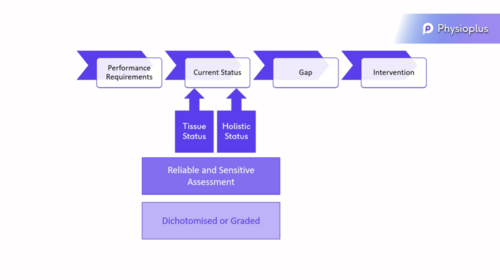
Performance requirements can include level of strength, level of mobility, level of endurance, and coordination tasks
With an injury, the current status of the injured tissue and the athlete’s holistic status need to be assessed.Needs Analysis Paradigm[1]
Reliable and sensitive assessments are necessary to assess the current tissue status
What can the injured tissue tolerate at this moment in time?
What can the individual do in relation to the injured tissue at this time with this injury?
Consider dichotomised versus graded assessment approaches
Dichotomised assessment:
"Specific structure is painful, therefore it is injured"
Simple test with a yes or no answer: yes the structure is injured; or no, the structure is not injured
Graded assessment
Graded exposure of the tissue to load to see how much load the injured tissue can tolerate
The assumption is often that an acute muscle/ligament/tendon injury will have zero load tolerance when the structure is injured. However, these injured structures can often still tolerate a level of load, even if it is very little.
The level of load an injured tissue can tolerate needs to be clearly identified[1]
Note that significant muscle atrophy can occur within 5 -14 days of inactivity.[3] It is, therefore, crucial to determine the minimum activity an injured athlete can perform to reduce the occurrence of atrophy due to underactivity.
Principles of Rehabilitation
Where to Start?
Identify the start point
Establish a stable baseline
Identifying the gaps and a starting point for loading can be seen as establishing a stable baseline. The starting point is not always at zero (i.e. no strength or no flexibility); therefore, a graded approach in assessing the tissue tolerance level is key.
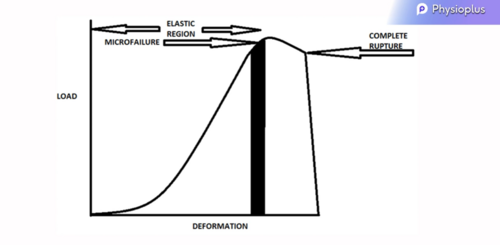
Load Deformation Curve[2]Consider the load deformation curve:
A certain amount of micro failure is allowed when loading the tissue as this brings on physiological changes. This leads to tissue adaptation, which strengthens the tissue.
If we consider the load-deformation curve, sub-optimally loading tissue (i.e. loading before the left side to the micro failure zone) will lead to tissue atrophy and the tissue will weaken to the level of the loads applied.
Similarly, overloading the tissue (i.e. loading to the right side of the micro failure zone) can lead to irreparable damage
Therefore, it is imperative to apply the maximum load the specific tissue can tolerate.
Underpinning Theories
Mechanotransduction = shifting of mechanical energy into physiological energy.
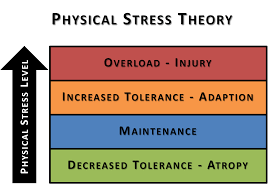
Biological tissues adapt to changes in the levels of applied stress
Maintaining tissue tolerance is essential to prevent atrophy, whereas overloading results in hypertrophy
Excessively high levels of stress lead to tissue injury and potential permanent damage
The magnitude, time, and direction of stress application determine the overall level of exposure to physical stress
Injury may occur due to a high-magnitude stress applied for a brief period, a low-magnitude stress applied for a long duration, and/or a moderate-magnitude stress applied to the tissue many times
Principle of Specificity = the body adapts to the loads which are applied to it
Specific velocities of muscle contraction (Olympic sprinter vs older person walking to the shops)
Key Issues when Reloading Injured Tissues
Key issues to remember when reloading injured tissues include:[1]
Understand what the stable baseline load is and at what level loading should start
What forces stress the injured structure?
What forces and loads do not stress the injured structure?
Ligaments - the direction and magnitude of the injurious force need to be defined
Muscle and tendon - nature of contraction load, force velocity and length-tension relationship implications should be defined
Articular surface - define the direction and magnitude of injurious forces and the impact of malalignment
Monitoring Impact of Load
It is important to know when to proceed with gradual stress and when to take a step back. There are multiple indicators of excess or less load:[2]
Increased swelling of the training muscles indicates inflammation-overload.
Circumferential measures: to be taken after the activity, in the morning and in the evening.
Ideally swelling should not increase between days. If it was increased after training it should decrease by the evening. If it is still swollen by the next morning, the training load should be decreased.
Pain
Visual Analogue Scale (VAS) 0-10, rate the score to a specific movement or exercise.
Any change of score >1 the day after training, that does not reduce by the evening may indicate overload.
Stiffness: especially in the morning, is a good mark of inflammation.
Link the stiffness to a specific task or movement. For example, simply ask the patient if they have difficulty doing a simple full squat in the morning.
Muscle contractility or inhibition is influenced by pain and swelling.
Technological applications and trackers can be helpful in giving a start point to build up a gradual progressive rehabilitation programme without overloading or deloading.
Progressing Load
Progressively expose the athlete / individual to load at a tissue and system level[9][10]
Maximum tolerated loads necessary to generate supraphysiological stress and low level of micro failure to create adaptation[1]
Allow sufficient recovery time to enable adaptation[10]
Application of the appropriate load to drive the required adaptation
Specific Adaptation to Imposed Demand (SAID) principle[11]
Adaptations produced by training are highly specific to the nature of the stimulus or overload applied[7][11]
SAID applies to all the systems of the body
Adaptations are specific to strength, power, endurance, functional activity, joint angle, sequence of muscle activations, energy systems and virtually all other variables present
Key Rehabilitation Areas
Regaining Maximum Force and Force Generation
Maximum force
Overcome muscle inhibition
Use muscle stimulation at the same time as contracting the muscle to try to superimpose the contraction[12]
Use crosstalk or effort from the other limb to generate neural activity in the injured limb[13]
Whole body or local vibration
Relieve pain
Work in mid-range initially to generate strongest contraction
Repetition maximums
The repetition continuum or strength-endurance continuum is usually used to prescribe specific loading recommendations[7]
For muscle strength, use low repetitions with heavy loads: 1 - 5 repetitions per set with 80% - 100% of 1 -repetition max (1RM)
For muscle hypertrophy, use moderate repetitions with moderate loads: 8 - 12 repetitions per set with 60% - 80% of 1RM
For muscle endurance, use high repetitions with light loads: 15 + repetitions per set with loads below 60% of 1RM
Force velocity - slow contraction vs rapid generation of force
Regaining Movement Skill
Teaching a movement involves moving through various stages of learning[2][14][15]:
Acquisition/Cognitive stage: deconstructing the function into simple movements with repetitions.
Retention/Associative stage: recalling and delivering the task after a period of not practising the task.
Transfer/ Autonomous stage: the ability to carry out a task without paying attention to tactics. Ideally, we want our patients to reach a stage where they can perform a similar, but different task than was originally learned in the acquisition stage.
How we instruct patients depends on their stage of learning. In the first stage, closed skills are used to eliminate all external influences and to drive the focus internally (i.e. intrinsic focused cues). This can be achieved by asking patient to reflect on the purpose and the mechanism of a simple movement e.g. single leg squat. Repetition during this stage aids cognition and acquisition.
In the Retention and Transfer stages, training should be external or goal focused. For example, asking a patient to move towards a certain target, or doing a task while keeping their trunk ahead of their knees. The ultimate aim of motor skill learning is to transfer the skill to performance in sport or activities of daily living. The patient needs to move from closed skill tasks (same movement tasks in stable predictable environments) to open skill tasks where tasks/movements are unplanned.
Intrinsic feedback - seen as "the knowledge of performance"[2]
Extrinsic (augmented) feedback can be from visual demonstrations, using a mirror, verbal instructions or guidance through touching
It is important to provide specific and constructive feedback
Feedback is informational, but can also have motivational properties[17]
Timing of feedback is important:
Constant feedback won't allow the athlete to reflect and learn
"Less is more" - occasional feedback on positive performance is better than constant feedback on every task attempt[17]
The rehabilitation programme should then develop complexity to mimic the reality of the athlete's performance requirements.
Random skill training can be acquired in this stage by training the athlete to deliver function on various surfaces, with different external loads and to react to external stimuli.[2]
Key Take Home Messages
Understand the performance requirements
Identify what load the tissue (and individual) can currently tolerate
Fill the gap in performance deficits
Clearly define the purpose of an exercise
Measure the exercise's impact against that purpose
Always apply the maximum loads the tissue (and individual) can tolerate
Assess the impact of loading at all stages
References
↑ 1.01.11.21.31.41.51.61.71.8Herrington, L. General Principles of Exercise Rehabilitation Course. Plus. 2022.
↑ 2.02.12.22.32.42.52.62.72.8Herrington, L, Spencer, S. Principles of Exercise Rehabilitation. In Barnard K, Ryder D, editors. Petty's Principles of musculoskeletal treatment and management: a handbook for therapists. Fourth edition. Elsevier Health Sciences; 2024
↑Wall BT, Dirks ML, Van Loon LJ. Skeletal muscle atrophy during short-term disuse: implications for age-related sarcopenia. Ageing research reviews. 2013 Sep 1;12(4):898-906.
↑Taberner M, Allen T, Cohen DD. Progressing rehabilitation after injury: consider the ‘control-chaos continuum’. British journal of sports medicine. 2019 Sep 1;53(18):1132-6.
↑ 10.010.1Gabbett TJ, Oetter E. From tissue to system: what constitutes an appropriate response to loading?. Sports Medicine. 2025 Jan;55(1):17-35.
↑Spiering BA, Clark BC, Schoenfeld BJ, Foulis SA, Pasiakos SM. Maximizing strength: The stimuli and mediators of strength gains and their application to training and rehabilitation. The Journal of Strength & Conditioning Research. 2023 Apr 1;37(4):919-29.
↑Charlton JM, Eng JJ, Li LC, Hunt MA. Learning Gait Modifications for Musculoskeletal Rehabilitation: Applying Motor Learning Principles to Improve Research and Clinical Implementation. Physical Therapy. 2021 Feb;101(2):pzaa207.
↑ 17.017.1Cools AM, Maenhout AG, Vanderstukken F, Declève P, Johansson FR, Borms D. The challenge of the sporting shoulder: From injury prevention through sport-specific rehabilitation toward return to play. Annals of Physical and Rehabilitation Medicine. 2021 Jul 1;64(4):101384.