When refering to evidence in academic writing, you should always try to reference the primary (original) source. That is usually the journal article where the information was first stated. In most cases Physiopedia articles are a secondary source and so should not be used as references. Physiopedia articles are best used to find the original sources of information (see the references list at the bottom of the article).
If you believe that this Physiopedia article is the primary source for the information you are refering to, you can use the button below to access a related citation statement.
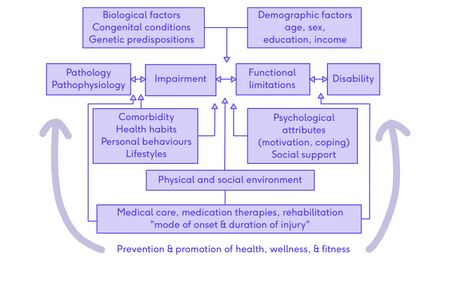
Disablement models are conceptual models which provide a framework for clinical practice and research.[1] These models are tools that are used to define impairment and more recently functioning and are utilised by governments and society to device strategies and policies for meeting the needs of people who have a loss in function as a result of health conditions, disease or injury. These models are used in healthcare as a way to organise clinical practice decisions. It creates a common language among healthcare professionals and facilitates patient-centred and whole-person healthcare.[1] Disablement models are an important piece of evidence-based practice. Evidence-based practice entails clinician expertise, research evidence and patient preferences and values. It is key to incorporate research evidence and the values of patients into their care model. A disablement model facilitates this incorporation.[1]
Disablement modelThe disablement model starting point may be pathology or pathophysiology (such as an injury)
This may lead to an impairment (such as pain or loss of range of motion) and because of that there is a functional limitation (i.e. the inability to do some activity or having difficulty performing the activity).
This leads to the determination of disability (i.e. the individual's perception of how specific functional limitations affect their activities of daily living (ADL), instrumental activities of daily living (IADL), work ability, participation in recreational activities or sport).
Other components that play a role are:
Biological factors
Congenital factors
Genetic predisposition
Demographic factors such as age, sex, education, income
Comorbidities
Health habits
Personal behaviours
Lifestyle
Psychological attributes (motivation, coping)
Social support
Physical and social environment
Medical care, medication therapies, rehabilitation and mode of onset and duration of injury
From a sports perspective, prevention and promotion of health, wellness and fitness help mediate the development of pathology or the outcome.[2]
A good understanding of anatomy and biomechanics is critical in sports medicine. It adds value and understanding to mechanisms of injury, prevention of injury and also the treatment of the specific structure and any collateral damage elsewhere in the kinetic chain. A relevant definition of biomechanics for sports medicine clinicians is[3]:
"The application of mechanical principles in the study of living organisms."[3]
An understanding of the basic principles of the body's response to an exercise stimulus is vital for the performance and rehabilitation of athletes. This knowledge guides sports clinicians in terms of exercise prescription, rehabilitation and prevention of injury.
The different tissues in the body will respond differently under different levels of stress. Biological tissues show characteristic responses to physical stress and each response will occur within a defined range along the continuum of mechanical stress. The responses include:
The general physical rehabilitation pyramid includes five tiers. The bottom tier can be considered the first and most important. Individuals should be evaluated for the components of each tier and the clinician needs to be satisfied that progression to the next tier will not hinder the healing and rehabilitation process.[7]
General Physical Rehabilitation Pyramid
General physical rehabilitation pyramid tiers (Tier 1 (bottom tier) to Tier 5 (top tier))
Static proprioception and cognitive facilitation; correction of faulty mechanics and tissue lengthening
Cardiovascular conditioning and dynamic proprioception training
Progressing stabiliser conditioning
Mobiliser conditioning
ADL conditioning (or in sports medicine: sport-specific conditioning)
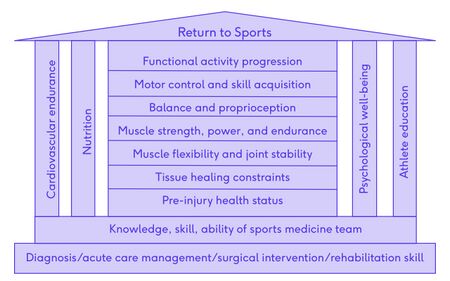
Sports Rehabilitation Pyramid
Return to sport or physical activity is the goal and important to athletes recovering from injury. This return to sport goal is supported by multiple components such as:
Building blocks of rehabilitation considerations such as:
Pre-injury health status
Tissue healing constraints
Muscle flexibility and joint stability
Muscle strength, power and endurance
Balance and proprioception
Motor control and skill acquisition
Functional activity progression
All of the components and considerations mentioned above are supported by a sports medicine team consisting of professionals who have the relevant knowledge, skills and abilities.
Underpinning all of the above are:
Skills to diagnose accurately
Acute care management skills
Relevance and influence of surgical intervention
Excellent rehabilitative skills and competencies
Responsibilities of the Sports Physiotherapist
Prevention
Educate and instruct
Gledhill et al.[8] recommend three strategies for clinicians to empower athletes during their return to sport. These are:
Monsonis et al.[9] investigated perspectives about sports injury prevention from various stakeholders (athletes, coaches, managers and healthcare professionals). It was evident that education, communication, knowledge, and empowerment were all fundamental role players in injury prevention.
Ensure proper instruction on how to perform the exercise
Check that equipment is safe to use
Sanitation
Continuing physical activity or exercise may prolong or aggravate infectious diseases[12]
Infection control measures should be followed. These include hand washing, cleaning of facilities, preventing shared use of personal items (i.e. water bottles)[12]
Early diagnosis can reduce transmission risk, reduce time loss from play and prevent larger breakouts[12]
Sports medicine professionals "need to spend time pitchside."[14] "Sport-specific knowledge and team internal group dynamics are integral part of excellent communication and collaboration that are essential for us to serve athletes very well."[14]
↑Stark TW. Introduction of a pyramid guiding process for general musculoskeletal physical rehabilitation. Chiropractic & Osteopathy. 2006 Dec;14(1):1-6.
↑ 8.08.1Gledhill A, Forsdyke D, Goom T, Podlog LW. Educate, involve and collaborate: three strategies for clinicians to empower athletes during return to sport. British Journal of Sports Medicine. 2022 Mar 1;56(5):241-2.
↑McDermott ER, Tennent DJ, Patzkowski JC. On-field Emergencies and Emergency Action Plans. Sports Medicine and Arthroscopy Review. 2021 Dec 3;29(4):e51-6.