When refering to evidence in academic writing, you should always try to reference the primary (original) source. That is usually the journal article where the information was first stated. In most cases Physiopedia articles are a secondary source and so should not be used as references. Physiopedia articles are best used to find the original sources of information (see the references list at the bottom of the article).
If you believe that this Physiopedia article is the primary source for the information you are refering to, you can use the button below to access a related citation statement.
Providing care to the child and adolescent athlete brings unique ethical dilemmas.[1] When facing these issues, the sports clinician needs to consider a wide range of factors such as autonomy, informed consent, competency and the maturity of the young athlete, as well as the involvement of other stakeholders such as parents and coaches. The clinician's ethical framework will help guide decision-making when managing the child and adolescent athlete.
No single approach will provide the solution to every ethical concern. However, in sports medicine, these approaches are useful to provide a framework to help with decision-making and ethical practice.[2]
Virtue ethics places importance on the medical professional's/clinician's character (or moral agent)
"Virtuous practice argues that morality stems from an individual's character or identity, rather than being a reflection of the actions of the individual"[2]
The five virtues that apply to a medical professional are[3]:
Trustworthiness
Integrity
Discernment
Compassion
Conscientiousness
Another valuable virtue is discipline
Good judgement comes from good character
In virtuous practice, the motivation of the clinician is paramount
Ethical decision making is based on the character of the clinician
The virtuous sports medicine clinician's role is first and foremost the welfare of the athlete
Virtuous ethics allows for the adaptation of choices in specific scenarios and the people involved
This flexibility encourages creative thinking and problem-solving
"A virtuous person perceives a situation, judges what is right, and then wants to act accordingly because it is their disposition to act well"[4]
Deontology
The Deontology approach can be summarised as follows[2]:
Duty-based ethics
Do the right thing because it is the right thing to do
When deciding what you should do in certain situations ask yourself: "Would it be acceptable if everyone took this type of action?"
The principle of utilitarianism promotes consequentialism
The rightness or wrongness of a decision or action is judged by its consequences[2]
The concept of putting the team before the individual athlete is at the forefront of this approach: "There is no 'I' in team"
The goal is to create the greatest happiness for the greatest amount of individuals (in a sports context this will imply the team)
The action or decision can be justified if the benefits outweigh the actual or potential harm (for example sporting organisations want to do what is right for the sporting organisation)
The issue with this approach is that it disparages the interest and welfare of the individual athlete in favour of the team's success
This can never be the approach of a team clinician/medical professional
There are certain team environment scenarios where a utilitarian approach may be appropriate
Touring team scenario - an athlete on tour is injured
The athlete requires focus, time and resources from the team clinician for treatment and rehabilitation that are so demanding that it can potentially negatively affect the rest of the team and the medical services available for the rest of the team
In this scenario, a decision may be made to rather send the athlete home for further treatment and rehabilitation
A fundamental ethical principle is respect for an individual's autonomy[2]
Autonomy is the capacity of a competent individual to make an informed, uncoerced decision[4]
Knowledge is an imperative part of autonomy and is central to informed consent[9]
In sports medicine, an athlete with an injury who needs to make a decision on treatment choices needs to understand the injury, comprehend the risks and benefits of all treatment options and be aware of the future prognosis[2][9]
Even though the decision will not only influence the athlete, but perhaps the team as well, the team clinician's primary obligation remains with the individual athlete!
Other factors that can influence decision-making are[4]:
The meniscal tear is repairable, but the athlete has two options:
Option A: Arthroscopic meniscectomy and a fast return to play
Option B: Meniscal repair and potentially out for the rest of the season
Both options have short and long-term consequences:
Short term consequences: With option A a quicker return to play, whereas with option B a lengthier rehabilitation period and potentially misses out on the entire season
Long-term consequences: With option A there is an increased risk of developing degeneration in the knee later on, whereas with option B there is a reduced risk of long-term risks and degeneration to the knee
In the principle of autonomy, the athlete needs to be aware of all these options in their entirety, understand the injury, the risks and benefits of all treatment options and the future prognosis. This is the only way an athlete will be able to make an informed, uncoerced decision.[9]
In sport, athletes are aware that injury and harm is a risk, but it remains the sports medical professional's role to minimise further harm and try to limit risk as much as possible[2]
Athlete requesting an injection of local anaesthetic from the team doctor to allow the athlete to continue playing or to compete again
Option A: The doctor provides the injection and the athlete can continue (short-term gain) but potentially risk further injury and/or long-term risk and damage
Option B: The doctor does not provide the injection and the athlete cannot continue play, but this allows for a more thorough assessment of the injury. The athlete will however lose out on possible sporting success and the team may also be impacted.
World Rugby has an anaesthetics guideline clarifying that "a player may not receive local anaesthetics on match day unless it is for the suturing of bleeding wounds or for dental treatment administered by an appropriately qualified medical or dental practitioner."
Beneficence vs Non-maleficence
Athletes may sometimes show risky behaviours towards their own career and welfare and this can cause difficult situations. As already stated, athletes are aware of the risk and the sports clinician's role is to minimise further harm and try to limit risk. The athlete is not obliged to follow the advice or recommended plan suggested by the clinician, but athletes should be aware of the risk and consequences of the decisions that they make. The sports clinician should also respect an athlete's decision even if it is not aligned with the clinician's opinion. Sporting organisations can help with this by providing guidelines on controversial treatment.[2]
Justice
The fourth pillar of Principles ethics is justice and includes the following:[2]
Justice = to act fairly when the interest of different individuals are in competition with each other
Three categories of obligations of justice:
Distributive justice - the fair distribution of scant resources
Scarce resources should be distributed equally based on need and not on the basis of star players getting preferential treatment
Rights-based justice - respect for people's rights
Clinicians should respect each athlete's right to treatment and may not fail to treat because of bias or contrary beliefs
Legal justice - respect for morally acceptable laws
Clinicians should wilfully do no harm to any athlete in their care
The International Federation of Sports Physical Therapists (IFSPT) also has a Code of Ethics based on the International Federation of Sports Medicine (FIMS) Code of Ethics and the WCPTs ethical principles. You can read the IFSPT Code of Ethics here.
Uniqueness of Sports Medicine
Some of the unique challenges clinicians face when managing athletes include[11]:
Pressure from coaching staff, team management and athletes themselves to return to sport as early as physically possible
Athletes experience pressure to earn their teammates' respect, as well as financial implications if injured
Inaccurate reporting of an injury and the severity thereof by athletes out of fear of missing training or match time
Maintaining confidentiality of information in the clinician-patient relationship is often a clinician-patient-coach triad with third parties involved such as a coach or team manager
Athletes are forever striving to improve their performance.[12] Certain tools that athletes will use to achieve this may include[12]:
Dietary supplements
Medication such as mismanagement or overuse of analgesics
Doping with prohibited substances and performance-enhancing drugs
Find the Word Anti-Doping Code International Standard Prohibited List 2022 here
Excessive training by athletes that increases risk
The health and safety of the individual athlete are paramount
Athletes must have the right to make their own informed decision
Keep in mind that in a highly charged game environment informed consent is trickier
The responsibility lies with the clinician to determine if continued training or participation by the athlete is appropriate
Maintain a degree of professional distance from the management team
Clinician first, team clinician second
Never abdicate your responsibility to the individual player
Approaching Ethical Dilemmas
Ethical approaches and principles are a framework, used as a reference for decision making
Clinical decision-making is centred around the clinician's professional judgement
Professional judgment always seeks balance - the balance between ethical principles such as patient autonomy, avoiding doing harm, generating well-being and assessing risks and benefits - while at the same time trying to satisfy the needs and interests of other parties such as coaches, the team management and the team
The Principles Approach in the Child and Adolescent Athlete
Applying the principles approach to a child is dependent on competence.[13] Competence forms part of autonomy.
Autonomy
The three concepts that drive the application of autonomy in the child and adolescent athlete are[14]:
Competence
The ability to understand the information needed to make a decision
Dependent on the legal system of a country
Confidentiality
A competent person's right to restrict the divulging of information without their consent
Informed Consent
A competent person's right to make decisions based on information
Three components are necessary for informed consent:
Decision-making capacity, thus competent
Full discussion about risks, benefits, outcomes and prognosis of all treatment options
Sufficient understanding - consider the language used, amount of information and maturity of the athlete
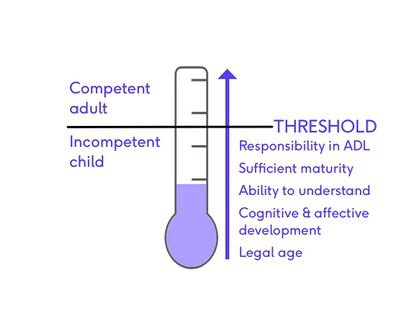
Developing AutonomyThe assessment and development of Autonomy in the child and adolescent athlete is dependent on a few factors. These include[14]:
Legal age
Cognitive and affective developmental stage of child or adolescent
Ability to understand and decide
Sufficient maturity and intelligence
Responsibility in activities of daily living (ADL)[15]
Deciding where the threshold is that separates the incompetent child from the competent adult is difficult. One should accept a competent person's decision even if others believe that the choice is wrong. Children need time to develop these abilities. Responsibility and decision-making should be encouraged in the child and adolescent and, as clinicians, it is crucial that we encourage the development of autonomy in children, protect this developing autonomy and also respect the child's future autonomy.[4]
Beneficence and non-maleficence considerations[13]
Competent adults make decisions on what they think will make their lives go well. but incompetent children cannot make such decisions
What is the best interest of the child or adolescent and who decides what the standards are to which decisions should be made?
If the best interest standard is too demanding, should the focus then rather be on not acting against the child or adolescent's interest?
Consider the child or adolescent's overall needs and not just medical best interests
Parental authority should be in the interest of the child
It should not extend to causing the child long-lasting harm
Parent's autonomy should also be respected, but there are limits to parental authority
The focus should always be on the protection of the whole child and their overall interests
Clinical Case Study
Each case clinicians encounter is different and unique and there is no uniform outcome in all cases. For this reason, it is crucial to consider a shared decision-making process between the child or adolescent athlete, the parents or family and the clinicians involved.[16][17] Clinicians should provide all information and current knowledge on risks and benefits, possible outcomes and prognosis.[16][18]
"Eleven-year-old Martin is a promising football academy player with an acute anterior cruciate ligament (ACL) tear. There are no other knee structures involved, nor does he have any dynamic instability. Generally, Martin is well. He can run, change direction, kick and jump with no problem."[19]
Two scenarios in the management of Martin's injury:
A clinical case study presented by Ardern et al[19]
Scenario 1
Scenario 2
Medical team advise ACL reconstruction, parents do not consent to surgery
Medical team rationale:
High knee-demand sport
High-level athlete
Possible conflict of interest:
Medical team works closely with the club
Pressure from club administrators
Parent's reasons for not wanting surgery:
Martin is too young
Previous experience of complications from surgery with another sibling
Medical team advocating for conservative management (advise against ACL reconstruction), parents keen for surgery to go ahead and want the club to pay for the surgery
Medical team rationale:
Isolated ACL tear with no dynamic instability
Want to try rehabilitation first
Parents want surgery and may be invested in Martin's future financial potential
Unknown if a club will offer a professional contract to someone who has sustained a serious injury, whether conservatively or surgically managed
Decision-Making in Clinical Case Study
Two approaches available in the literature will be applied and combined to illustrate the steps to take in deciding on Martin's (case study) care.[4]
Approach as set out by Ardern et al.[19] in applying ethical standards to guide shared decision-making with youth athletes:
Fact 1: Unknown if youth athletes with an ACL injury, with or without ACL reconstruction, can have a successful professional/elite sporting career
Fact 2: Acceptable treatments for youth athletes with ACL injury include both high-quality rehabilitation alone or in combination with ACL reconstruction[20]
What are the uncertainties?
Uncertainty 1: What are Martin's chances of reaching the highest level in his sport with non-surgical management?
Uncertainty 2: Can Martin cope through the next few years and onto professional sport with an ACL-deficient knee if surgery is delayed
Uncertainty 3: Will the club keep Martin in the football academy if he undergoes an ACL reconstruction?
The second approach is applying a deliberative approach as outlined by Michaud et al.[14] This approach poses six questions to guide the clinician in the ethical decision-making process.
Deliberative Approach as outlined by Michaud et al.[14]
What? Who?
What is the main ethical issue?
Who are the stakeholders?
Competent
Can the child/adolescent be considered competent?
Legal standing
Differs country by country
Age of consent?
Age for informing parents?
Age for the right to confidentiality
Medical and psychological consequences of each treatment?
Short- and long-term consequences
Involving other stakeholders?
Involving other stakeholders such as parents, coaches, the team
Balancing the pros and cons of a decision
Bearing in mind the ethical pillars
Best interests of the child/adolescent
Considering autonomy
Considering the possible vulnerabilities
In the table below, the deliberative approach is applied to the specific case study of Martin with the ACL injury.
Applying a deliberative approach to Martin's case study[4]
What? Who?
The main issue is to determine the best management for Martin
A reconstruction now or conservative rehabilitation and a possibility of delayed surgery?
Martin, Martin's parents and the academy, the management team and the coach
Competent?
Martin is only eleven, but what we don't know is:
Does he have sufficient maturity?
What are his responsibilities in ADLs?
Does he possess the ability to understand?
What are his cognitive and affective development like?
Legal standing
Legal age of consent?
Medical and psychological consequences of each treatment
Scenario 1: Do the reconstruction immediately
Low risk of medical harm?
Possible growth disruption?
Absence from football - loses out on 9 - 12 months
Will he be allowed to stay in the academy?
Improve chances of adult athletic success and possible future injuries?
Evidence lacking to be confident in this benefit
Involving other stakeholders
Parents and club management, coach, team
Balancing the pros and cons of a decision
Child and parent autonomy
Facts and vulnerabilities
What is in Martin's best overall interest?
ACCEPT PARENTAL DISCRETION
Conservative management now; delayed surgery
Approaching Ethical Dilemmas in the Child and Adolescent Athlete
A summary of the approach clinicians should take in the management of the child and adolescent athlete[4]:
Approaching Ethical Dilemmas in the Child and Adolescent Athlete
Clinicians use ethical principles as a framework for decision-making
Seek balance between the needs and interests of the child and adolescent and the needs and interests of other stakeholders, particularly parents
Special consideration should be given to developing autonomy in the child, respecting concepts such as competence, informed consent and confidentiality
Clinicians should be advocates for developing safeguards to protect children and adolescents in sport[21] and oppose any sport or physical activity that is not appropriate for the stage of growth, the development, the general condition and health, and the level of training of children and adolescents[22]
Clinicians should always act in the best overall interest of the child and adolescent athlete and give consideration to parental authority and discretion, especially in the welfare of the incompetent child[22]
↑Vannatta CN. Surveying the Moral Landscape: How Ethical Frameworks Influence the Structure of Return-to-Sport Decision Making. Journal of Orthopaedic & Sports Physical Therapy. 2024 Apr;54(4):230-3.
↑Varkey B. Principles of clinical ethics and their application to practice. Medical Principles and Practice. 2021;30(1):17-28.
↑ 9.09.19.2Grossi J, Garber L, Klein B, Bartlett L, Bitterman AD, Cohn RM, Sgaglione NA. Multidisciplinary Team Discussions and the Inclusion of Individualized Patient Factors May Improve Informed Consent in Sports Medicine. Arthroscopy, Sports Medicine, and Rehabilitation. 2025 Feb 1;7(1):101007.
↑ 13.013.113.2Baines P. Medical ethics for children: applying the four principles to paediatrics. Journal of medical ethics. 2008 Mar 1;34(3):141-5.
↑ 14.014.114.214.3Michaud PA, Berg-Kelly K, Macfarlane A, Benaroyo L. Ethics and adolescent care: an international perspective. Current opinion in pediatrics. 2010 Aug 1;22(4):418-22.
↑Ross LF, Hester DM, Malone JR. Teenage Development and Parental Authority: applying consensus recommendations to adolescent care. Perspectives in Biology and Medicine. 2024;67(2):227-43.
↑ 19.019.119.219.3Ardern CL, Grindem H, Ekås GR, Seil R, McNamee M. Applying ethical standards to guide shared decision-making with youth athletes. British Journal of Sports Medicine. 2018 Oct 1;52(20):1289-90.