
Cushions
Original Editor - Daniele Barrilla and Vidya Acharya as part of the Wheelchair Service Provision Content Development Project
Top Contributors - Naomi O'Reilly, Jess Bell, Stacy Schiurring, Tarina van der Stockt, Kim Jackson, Rucha Gadgil, Tony Lowe, Olajumoke Ogunleye and Ewa Jaraczewska
Introduction
A wheelchair cushion is a clinical intervention, not simply a comfort accessory. For many wheelchair users, the cushion is the most consequential component of the seating system, affecting pressure injury risk, pelvic stability, and long-term postural health. An inadequate cushion is the component most likely to cause serious injury or premature death in individuals at high risk of pressure injuries.[1][2]
Why the Cushion Matters: Starting with the Pelvis
The pelvis is the foundation of the seated posture: its alignment determines spinal alignment, trunk control, pressure distribution, and upper extremity function. Every cushion decision should be considered in terms of what it does for pelvic positioning.
Posterior pelvic tilt, anterior pelvic tilt, and pelvic obliquity each create distinct pressure and alignment consequences. The cushion must either support a neutral pelvis where possible, or accommodate a fixed deformity while minimising associated risks.[3]
| Pelvic position | Postural consequences | Pressure concerns |
|---|---|---|
| Posterior tilt |
|
Increased sacral and coccygeal loading |
| Anterior tilt |
|
Uneven ischial and anterior thigh loading |
| Obliquity |
|
|
| Rotation |
|
|
Beyond the pelvis, clinicians should think about the entire seating footprint (i.e. the total surface area through which body weight is distributed). The ischial tuberosities, greater trochanters, and sacrum are primary loading sites, but the thighs, lower legs, feet, forearms, and even the occiput (with a head support) all contribute to the surface area. Maximising this footprint by ensuring all support surfaces are properly adjusted is a core principle of pressure management.[3]
Primary Clinical Functions of a Cushion
A well-selected cushion addresses multiple, sometimes competing, clinical priorities simultaneously.[5]
- Pressure redistribution. Reducing peak pressure under bony prominences, particularly the ischial tuberosities, sacrum, and coccyx.
- Postural stability. Providing a stable base for the pelvis to support trunk alignment and function.
- Comfort. Enabling extended wheelchair use without pain or fatigue.
- Microclimate management. Managing heat and moisture at the skin–cushion interface, which directly influences tissue integrity.
- Transfer and mobility support. Supporting safe, efficient transfers and propulsion mechanics.
However, no single cushion type optimises all of these properties simultaneously. This is why individualised assessment is essential, and why cushion selection is never a one-time decision, requiring clinical review as the user's needs change over time.
Cushion Materials: Categories and Clinical Considerations
Foam

Foam remains the most widely available cushion material and the common baseline for comparison with other technologies. It is available in a range of densities: high-density foam provides a firmer, more stable base, while lower-density and memory foams allow greater immersion (the body sinks into the material) and envelopment (the material wraps around bony prominences).[5][6]
Clinical advantages. Lightweight; relatively low cost; good postural stability; can be cut or contoured to accommodate pelvic asymmetries; superior moisture and temperature management compared to most fluid or air alternatives.
Clinical limitations. Compresses and loses its pressure-redistributing properties over time; requires regular assessment and replacement as clinically indicated (manufacturer warranty periods vary); difficult to clean thoroughly if soiled, so continence management must be carefully considered at prescription.
Primary clinical indications. Basic to moderate pressure risk; postural support needs; temporary or general mobility equipment (GME) use; cost-constrained settings. Not sufficient as a sole intervention for individuals with high or very high pressure risk.
Elastomers

Elastomers are flexible polymer materials that offer greater durability and resilience than standard foam. They tend to maintain their shape over a longer period, are easier to clean, and can be manufactured in varying densities to target specific areas of support.[5][7]
Clinical advantages. Durable; easy to clean; stability-focused; good for individuals with incontinence or hygiene concerns. Some elastomers (e.g. honeycomb/stimulite-style materials) provide a firm, stable surface. These may particularly suit users who require a high degree of pelvic stability, including some individuals with spinal cord injury who find air cushions insufficiently stable.
Clinical limitations. Less widely known and available than foam or air cushions; may have higher upfront cost; evidence base is less extensive than for foam or air cushions.
Primary clinical indications. Moderate pressure risk with stability as a priority; incontinence; users transitioning away from air systems due to stability needs.
Gel and Fluid
Foam and gel are frequently confused, but they behave differently and should be understood separately.[5][6][8]
Gel cushions or inserts use a semi-solid polymer. Full gel cushions exist, but are rarely prescribed in isolation due to their weight and the tendency of gel to migrate. Once displaced, gel may not return to its original position when the user transfers off the cushion. Gel is more commonly encountered as inserts or pads within a foam base, targeting specific high-pressure areas such as the ischial tuberosities.
Fluid systems use liquid-filled compartments designed for dynamic pressure redistribution. Fluid is self-levelling and allows for both immersion and envelopment. Fluid cushions are more dynamic than gel and respond to movement, which can support skin health during in-seat activity.
Primary clinical indications for fluid cushions: Moderate to high pressure risk; skin integrity concerns; users who benefit from dynamic displacement and require immersion and envelopment properties.
-
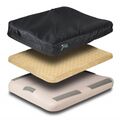 Hybrid gel cushion
 -
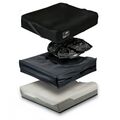 Hydrid fluid cushion


| Property | Gel | Fluid |
|---|---|---|
| Consistency | Semi-solid | Liquid |
| Migration | Yes — may not return to position | Self-levelling |
| Immersion/envelopment | Moderate | High |
| Stability | Moderate | Can feel less stable |
| Weight | Heavy | Moderate to heavy |
| Maintenance | Low | Requires positioning and monitoring |
| Common form | Inserts/packs within foam base | Complete fluid compartment |
Air

Air cushions use interconnected or independent air cells that can be inflated or deflated to adjust the level of immersion and support. The technology is well established; air cell cushions have been available for over 50 years, and the evidence base for their pressure redistribution properties is strong.[6][8][9]
Air cushions allow for both immersion and envelopment when correctly inflated. The key clinical variable is proper set-up: over-inflation reduces immersion and increases interface pressure; under-inflation may reduce stability. Different brands vary significantly in the size, configuration, and adjustability of their air cells, and clinicians should be familiar with the specific systems available to them.[10]
Clinical advantages. Superior pressure redistribution when correctly set up; adjustable; well-suited for individuals with high skin integrity risk and limited sensation.
Clinical limitations. Risk of deflation or cell puncture; requires regular monitoring and inflation checks; some users report feeling less stable on air surfaces, which may affect propulsion, transfers, and overall function. Users should carry a repair kit and know how to check inflation. Skin temperature may be higher than foam-gel alternatives. One systematic review and meta-analysis found that foam-gel cushions produced significantly lower interface temperatures than air cushions.[5]
Primary clinical indications. High pressure risk; impaired or absent skin sensation; history of pressure injuries.
Alternating Pressure Systems

Alternating pressure cushions are a newer development, in clinical use for less than a decade. These systems use motorised bladders that cycle inflation automatically, redistributing load and reducing the duration of pressure at any single point without requiring the user to perform pressure relief manoeuvres.[10][11][12]
Clinical advantages. Provides dynamic pressure relief passively; potentially valuable for users who are unable to perform adequate independent pressure relief.
Clinical limitations. The power pack adds weight and requires charging; systems are more complex and costly; less established evidence base than static air or foam cushions; less commonly prescribed for active wheelchair users due to weight and power requirements.
Primary clinical indication. Very high pressure risk; users with existing or recurrent pressure injuries; clients unable to independently perform pressure relief manoeuvres.
Hybrid Systems and Customisation
Many commercially available cushions combine materials (e.g. a foam base with a fluid or air insert over the ischial tuberosities). Hybrid systems aim to balance the structural stability of foam with the pressure redistribution properties of air, fluid, or gel. This is a clinically common and practical approach, particularly for users who need postural stability but also carry significant pressure risk.[3]
Manufacturers also offer customisation options for off-the-shelf cushions: additional foam build-ups under specific areas, modified ischial tuberosity wells, or separate air cell chambers adjusted independently for pelvic obliquity management. These options allow meaningful individualisation without the commitment to a fully custom-moulded system and should be explored before assuming that a standard product is insufficient.
Custom-Moulded Cushions
Custom-moulded seating uses simulation technology or direct moulding to create a cushion contoured precisely to an individual's anatomy. It offers the highest level of postural support and pressure management for users with complex presentations that cannot be adequately managed with off-the-shelf or hybrid products.[3][13]
Important clinical considerations:
- Custom moulding is a 'picture in time'; it captures the user's body at the point of assessment. If body composition, spasticity, or deformity changes significantly, the mould may no longer be appropriate.
- There is very little margin for adjustment once moulded; changes may require remoulding.
- It requires specialist assessment by a clinician trained in simulation or moulding techniques, and specific expertise varies between manufacturers. Clinicians should access appropriate training before prescribing.
Primary clinical indication. Severe or fixed pelvic and trunk deformity; complex neuromuscular presentations; high postural support and pressure management needs that cannot be met by configurable systems.
| Material | Pressure redistribution | Postural stability | Maintenance | Relative cost | Primary indications |
|---|---|---|---|---|---|
| Foam | Low–moderate | Good | Low (soiling risk) | Low |
|
| Elastomer | Moderate | Good | Very low | Moderate |
|
| Gel (inserts) | Moderate | Moderate | Low | Moderate |
|
| Fluid | High | Moderate-low | Moderate | Moderate-high |
|
| Air | High | Lower (if over-inflated) | Moderate (inflation monitoring) | Moderate-high |
|
| Alternating pressure | Very high (dynamic) | Variable | Higher (power required) | High |
|
| Hybrid | Moderate-high | Moderate-good | Variable | Moderate | Balanced stability and pressure needs |
| Custom-moulded | High | Very high | Specialist review required | Highest |
|
Cushion Covers
Covers are a clinically significant component that is frequently overlooked. A cushion and its cover are designed together by the manufacturer and should always be prescribed and used as a matched pair. Substituting a different cover is not clinically appropriate and may alter pressure distribution, friction, and moisture management properties.[3]
Clinicians should assess covers for the following:
- Stretchability. A non-stretch cover can prevent immersion into the cushion material, negating its pressure redistribution properties.
- Moisture management. Dual-layer covers or moisture-wicking fabrics help manage the microclimate at the skin–cushion interface.
- Antimicrobial properties. Relevant for users with recurrent skin concerns.
- Incontinence covers. An outer waterproof cover or incontinence liner may be necessary; ensure it does not create folds or shear at the skin surface.
- Transfer properties. Some covers include a low-friction layer to assist lateral transfers; others are designed to prevent sliding.
Cushion covers should be washable and replaced when damaged. A torn or poorly fitting cover can increase pressure injury risk directly.[3]
Clinical Pearl: Several principles cut across all cushion decisions
Pressure relief manoeuvres remain essential regardless of cushion type. Research demonstrates that forward and lateral lean manoeuvres produce significant reductions in interface pressure and improvements in tissue blood flow. They should be taught to all wheelchair users and their caregivers, regardless of whether they are able to physically perform them.[7] The cushion reduces risk; it does not eliminate the need for active pressure management. Providing education on pressure relief empowers all users to advocate for themselves and their needs.
Environmental conditions affect material performance. Foam stiffens significantly in cold environments; air cushion pressure changes with temperature and altitude (relevant for air travel). Clinicians should account for the user's climate and travel habits when selecting materials.[3]
Warranty periods matter. All cushion materials degrade over time. Reviewing manufacturer warranty information and establishing a clinical review schedule is part of responsible prescription.[3]
When in doubt, trial. No assessment tool replaces direct trial of a cushion with the individual user, ideally using pressure mapping where available.[14] Multiple trials may be required before arriving at the optimal solution. It should be noted that some customisations and custom molded options are likely not possible to trial exact replicas due to their unique method of fabrication.
References
- ↑ World Health Organization. Wheelchair provision guidelines. World Health Organization; 2023 Jun 2.
- ↑ European Pressure Ulcer Advisory Panel, National Pressure Injury Advisory Panel and Pan Pacific Pressure Injury Alliance. International Pressure Ulcer/Injury Guideline (2019 edition). Available from: https://epuap.org/pu-guidelines/ (accessed 30 May 2026).
- ↑ 3.0 3.1 3.2 3.3 3.4 3.5 3.6 3.7 3.8 Kiger, A. Foundations of Wheelchair Provision Programme. Foundations and Principles of Seating and Positioning Systems. Physioplus. 2026.
- ↑ Owens J, Davis D. Seating And Wheelchair Evaluation [Internet]. 2023 [cited 25 May 2026]. Available from:https://www.ncbi.nlm.nih.gov/books/NBK559231/
- ↑ 5.0 5.1 5.2 5.3 5.4 Couzens L, Peterson B, Innes E, Stevens CJ. The effect of wheelchair cushion properties on the microclimate at the cushion‐user interface: A systematic review and meta‐analysis. Australian occupational therapy journal. 2024 Aug;71(4):612-26.
- ↑ 6.0 6.1 6.2 Damiao J, Gentry T. A systematic review of the effectiveness of pressure relieving cushions in reducing pressure injury. Assistive Technology. 2024 Sep 2;36(5):373-7.
- ↑ 7.0 7.1 Sprigle S, Deshpande Y. Procedure to categorize wheelchair cushion performance using compliant buttock models. Frontiers in Bioengineering and Biotechnology. 2022 Sep 30;10:1006767.
- ↑ 8.0 8.1 He C, Shi P. Interface pressure reduction effects of wheelchair cushions in individuals with spinal cord injury: a rapid review. Disability and rehabilitation. 2022 Mar 13;44(6):826-33.
- ↑ Sonenblum SE, McDonald A, Maurer CL, Bass A, Watson M, Zellner H. Reducing pressure with the goal of improving outcomes: a retrospective chart review of cushion evaluations and recommendations at one seating clinic. Disability and Rehabilitation: Assistive Technology. 2024 May 18;19(4):1552-60.
- ↑ 10.0 10.1 Corral-López I, Marco-Ahulló A, Rubio-Belmonte C, Segura-Navarro X, Pozo-Alegre JM, Montesinos-Magraner L. Comparative analysis of sitting pressures in individuals with spinal cord injury: static vs. dynamic air cushions. Frontiers in Public Health. 2025 Dec 15;13:1637106.
- ↑ Nasirian A, Erel V, Nuthi P, Gu Y, Allman M, Meza F, Sikka S, Wijesundara MB. Smart seat cushion feasibility pilot study: automated interface pressure modulation of individuals with spinal cord Injury. Disability and Rehabilitation: Assistive Technology. 2024 Nov 16;19(8):3100-9.
- ↑ Arias-Guzman S, Call K, Laskin JJ, Oberg C, Jellum S, Russon M, Call E. Effects on tissue oxygenation in the gluteal region with a smart pressure redistribution wheelchair cushion compared to a pressure relief manoeuvre. Disability and Rehabilitation: Assistive Technology. 2025 Feb 17;20(2):468-75.
- ↑ Hosking J. The clinical effectiveness of custom-contoured seating for wheelchair users with neuromuscular disorders: a scoping review. Assistive Technology. 2025 Jan 2;37(1):41-53.
- ↑ Sonenblum SE, McDonald A, Maurer CL, Bass A, Watson M, Zellner H. Reducing pressure with the goal of improving outcomes: a retrospective chart review of cushion evaluations and recommendations at one seating clinic. Disability and Rehabilitation: Assistive Technology. 2024 May 18;19(4):1552-60.