When refering to evidence in academic writing, you should always try to reference the primary (original) source. That is usually the journal article where the information was first stated. In most cases Physiopedia articles are a secondary source and so should not be used as references. Physiopedia articles are best used to find the original sources of information (see the references list at the bottom of the article).
If you believe that this Physiopedia article is the primary source for the information you are refering to, you can use the button below to access a related citation statement.
During the newborn period infants are adapting to the new social and physical environment. The sensorimotor abilities they acquired while in the buoyant fluid intrauterine environment are harnessed and adapted to the new constraints on movement imposed by gravity and the surfaces they encounter. The limbs have weight and movement of the limbs produces reactive forces as well as momentum which need to be factored into the control of their movements.[1]
Newborns are born with an innate capacity to interact with their environment.[2] Instinctive cognitive and sensorimotor behaviour contribute to survival and social bonding.[3] Infants naturally find ways to use touch, manage arousal levels, self-soothe and adapt to their new physical environment. In addition to adaptation, they signal their needs with different cries.[2]
Adapting to the Environment
skin-to-skin contact
The infant’s first challenge after birth is to regulate their breathing, temperature, and the rest of their autonomic system, which needs to be functioning properly before infants can concentrate on other developmental tasks. [2]
One of the most effective ways for an infant to adapt to their environment is through skin-to-skin (SSC) contact. [4] The baby dressed in a diaper is placed on the mother’s bare chest so that frontal body contact is skin-to-skin. (baby on their mother’s chest).[5] UNICEF outlines the many benefits for mother-infant skin-to-skin contact:[6]
Calms and relaxes both mother and infant
Regulates the infant’s heart rate and breathing, helping them to better adapt to life outside the womb
Stimulates digestion and interest in feeding
Regulates temperature
Enables colonisation of the infant’s skin with the mother’s friendly bacteria, thus providing protection against infection
Stimulates the release of hormones to support breastfeeding and mothering[6]
Research shows skin-to-skin contact may have secondary benefits for the mother in terms of her long-term mental health, in addition to its positive impact on infant development. [7][8]
Newborn Sensorimotor Synergies
The newborn infant arrives in the extra-uterine world with numerous movement behaviours that support their survival, interaction with the environment and ability to learn from experience.[1] Movement behaviours present at birth are organised as sensorimotor synergies which can be adapted to changing circumstances and events in the environment. The newborn has three survival behaviours: rooting, the suck-swallow-breathe synergy, and turning the head to free the airway.[2]
These movement behaviours are organised as perceptual-motor synergies (also referred to as motor patterns) which can be adapted to changing circumstances and events in the environment.[2] Previously these synergies were described as reflexes, but more recent studies have shown that these synergies involve complex patterns of movements adapted to ongoing changes in the environment. [3][2]
1. Rooting
Rooting refers to the infant's tendency to turn their head towards a touch stimulus, applied to the area around the mouth which facilitates turning towards and latching onto the nipple for feeding.
Traditionally rooting was considered to be a stereotypical response to a specific stimulus in other words, it was thought to be a simple reflex. But research has shown that the rooting response adapts to circumstances, for instance, rooting is not elicited when babies or infants touch themselves. [2]
The motion of the infant's head and mouth occurs simultaneously with whole-body movements suggesting rooting is more than a reflex.[3][9]
2. Sucking
Sucking
Sucking is another newborn behaviour that involves a complex interaction of muscle contractions that are adaptable to the environment. Babies adjust sucking pressure based on the flow of milk by sensing the upcoming flow. “Craig and Lee (1999) found that neonates adjusted their sucking action in a precise and prospective way indicating that they anticipated the upcoming flow of milk.” [3]
Sucking adaptation can also be seen when newborns suck for comfort instead of food.[10]
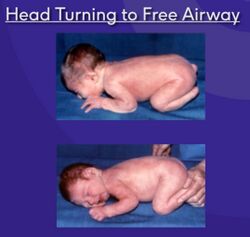
3. Head turning to keep airway clear
The ability to lift and turn head to keep airway clear is another perceptual-motor synergy present from birth. [2]
When placed face-down on a supporting surface newborn infants will lift and turn their heads to clear the airway. [2]
Lifting and turning the head involves not only the neck muscles but also requires some adjustments in the upper extremities and trunk muscles to provide some stability to support the neck movements.[1]
Neonatal Behavioural Assessment Scale
The Neonatal Behavioural Assessment Scale (NBAS) helps clinicians, researchers, and caregivers gain a clearer understanding of a newborn's behaviour and neurological functioning during the early days and months of life.[11] Pam Versfeld refers to this assessment scale throughout her course on Newborn Infant Behaviour.
Dr T Berry Brazelton along with colleagues at Harvard University has studied infant behaviour over many decades and developed the widely used Neonatal Behavioral Assessment Scale (NBAS).[12]
You can read more about it here by following these links:
Or you can watch these short videos to get a better understanding. The third video shows the full NBAS exam. It is in French, but even if you do not understand French, the demonstration gives you a good overview of the full exam.
"Arousal refers to the global state of activation of an organism, which determines its readiness to sense, feel, act."[16]
Throughout the day, an infant will cycle through several stages of arousal, some quick, others slow. American paediatrician Dr T.B. Brazelton described six states of arousal in newborn infants (behavioural states). [12]
There are 2 sleep states, one intermediate state and 3 awake states:[12]
Sleep states:
Quiet Sleep - In this protected state the infant is able to cut out disturbing stimuli like noise from the environment.[2]
Active Sleep / Rapid Eye Movement (REM) - The infant’s breathing is shallower and irregular with sucking and writhing movements occurring periodically. Outside influences might disturb the infant more in this state. When roused the infant will either waken sleepily and fuss or struggles to sink back into a deep sleep.[2]
Intermediate state:
A state between alertness and sleepiness.[17] This short-lived state occurs frequently when the infant rouses or returns to sleep. The infant squirms and moves jerkily, opens and closes the eyes again, and may whimper or cry out. The infant appears disorganised as they try to fall back to sleep or wake up.[2] Light stimulation, such as rocking them, can help ease them into sleep or slowly wake them up.[17]
Awake states:
When awake infants shift between 3 different states which affect the organisation of their spontaneous movements and looking and listening behavior[2]
Alert but quiet state - movement is minimal. Often associated with visual attention to the infant's own hand or the face of a social partner and other interesting visual stimuli in the environment.[2] Ideal time for learning. They are happy, peaceful, and focused. Ready for stimulation and interaction.[17]
Alert and active state - infants engage in bouts of vigorous spontaneous movements of the limbs.[2] Stretching, kicking, and rotating arms.
Awake and distressed state - the infant's movements are ongoing and very vigorous. Jitters and trembling may be present in the limbs. Parents and caregivers will usually move in to calm the infant.[2]
During the first three months of life, approximately 20% to 30% of infants experience infant colic (IC), which is characterised by prolonged crying and unsettled behaviour.[19] IC was previously blamed on indigestion pain, however all healthy, young babies cry and fuss–sometimes inconsolably, and frequently without any obvious cause, particularly in the late afternoon and evening.
Babies tend to cry a lot during the first 6 weeks after birth [20], and the amount of crying during the first three months is associated with tiredness and fatigue in new mothers.[21] Crying is a normal discharge of an overloaded nervous system after a busy day, meaning the infant may simply need to fuss; picking the infant up every 10–15 minutes, soothing them, and then putting them down again is a good way to deal with this crying.[12]
Infant Distress Cues
Parents and caregivers need to learn to recognise their infant’s particular behavioural cues. At the same time, they are learning how to respond in a way that satisfies the infant’s needs. These different ways of responding are dictated by the infant’s temperament.
There are at least six different cries -- hunger, pain, boredom, fatigue, discomfort and attention seeking -- each with unique characteristics. Parents will usually learn to differentiate between the different cries and learn how to respond in an appropriate manner.[22]
Infant Temperament
Newborn temperament describes the way in which babies respond and react to stimulation. Their emotions and reactions are a result of nature (innate personality) and nurture (parenting style). [23] Researchers Thomas and Chess reported that when a child's personality is well suited to their environment, they will do better than children whose personalities and environments fit together poorly.[24] Temperament in infancy is generally defined as constitutionally based biological individual differences in attentional, motor, and emotional reactivity and self-regulation that are exhibited in different contexts in response to stimulation.[25]
Temperament traits can be grouped into the following nine categories:[26]
Activity level: how active the infant is
Rhythmicity: how regular the infant’s sleep/wake and feeding routines are
Distractibility: how easily the infant can be distracted from something they are doing
Approach/withdrawal: how the infant responds to new experiences
Adaptability: how the infant adapts to new situations
Attention span/persistence: how persistent the infant is when faced with challenges
Intensity of reaction: how intense the infant’s responses and emotions are
Sensitivity: how sensitive the infant is to flavours, textures, and noises
Quality of mood: whether the infant has a happy, positive mood most of the time or an unpleasant, negative mood most of the time [26]
Some children are born with a more cautious temperament, they respond with wariness to new people and situations. They are slow to warm to new situations, easily distressed and when upset take longer to recover. [27]
Highly sensitive, cautious/fearful infants may be fussy, and react strongly to any changes such as being undressed. They can be difficult to calm and may react strongly to strangers or unfamiliar situations. [27]
↑Cleveland L, Hill CM, Pulse WS, DiCioccio HC, Field T, White-Traut R. Systematic review of skin-to-skin care for full-term, healthy newborns. Journal of Obstetric, Gynecologic & Neonatal Nursing. 2017 Nov 1;46(6):857-69.
↑Rochat P, Hespos SJ. Differential rooting response by neonates: Evidence for an early sense of self. Infant and Child Development. 1997 Sep 1;6(3‐4):105-12.
↑Les petits princes de l'éveil .Elisebenazet. Petit aperçu d'une échelle de Brazelton - Elise Bénazet. Available from: https://youtu.be/9GnUt1XJ0vs [last accessed 13/05/2022]
↑Kurth E, Kennedy HP, Spichiger E, Hösli I, Stutz EZ. Crying babies, tired mothers: what do we know? A systematic review. Midwifery. 2011 Apr 1;27(2):187-94.