
Prosthetics for Individuals with Hip Disarticulation and Hemipelvectomy Amputations
Original Editor - Tarina van der Stockt
Top Contributors - Martina Lukin, Wanda van Niekerk, Jess Bell, Kim Jackson, Tarina van der Stockt, Stacy Schiurring and Simisola Ajeyalemi
Introduction
Hip disarticulation (HD) and hemipelvectomy (HP) are the most proximal amputations of the lower extremity. They are relatively uncommon, accounting for less than 1% of all amputations.[1][2] Although the two amputation levels are similar in appearance, they feature important anatomical differences: an HD is performed directly through the hip joint, while an HP includes removal of the entire hip joint along with a section of the pelvis on the same side.[3] Both HD and HP significantly affect functional mobility (including walking, rising and sitting down, and climbing stairs) and independence,[3] and are associated with an increased likelihood of chronic pain and skin complications.[1][4]
HD and HP are most commonly performed to remove malignant tumours, following severe trauma, vascular disease (e.g. vascular insufficiency), and infection.[3][5]
A Note on Terminology
There are two surgical classifications of hemipelvectomy: internal and external. An internal hemipelvectomy is a limb-sparing procedure in which part or all of the affected hemipelvis (innominate bone) is resected, but the leg itself is preserved; it is generally reserved for tumours confined to a resectable portion of the pelvis and does not result in a lower-limb amputation. An external hemipelvectomy (also known as a hindquarter amputation) involves removal of the affected hemipelvis along with the entire ipsilateral leg. It is performed when limb preservation is not feasible.[6]
Unless otherwise specified, references to "hemipelvectomy" and "HP" throughout this article refer to the external hemipelvectomy, as this is the amputation level relevant to lower-limb prosthetic rehabilitation. Individuals who have undergone an internal hemipelvectomy retain their limb and are not candidates for the type of prostheses discussed here, though they may require other forms of pelvic reconstruction.
Prosthetic design continues to advance. Components, including those designed specifically for HD and HP, have become lighter and more functional. Socket designs have also evolved to incorporate materials such as silicone that conform more closely to the individual's anatomy, improving fit and comfort. These developments can support a higher level of functional mobility and benefit a wider range of people with these amputations.[7]
Requirements for Successful Prosthetic Function
Active Pelvic Lordosis
Due to the type of amputation, there is no residual limb left and thus no lever to control the prosthesis during gait. Instead, the user drives the prosthesis through active movement of the trunk and pelvis against the socket. Pelvic lordosis is used to initiate prosthetic hip flexion and advance the limb into swing. To ensure successful prosthetic fitting, the prosthetic user must be able to achieve good lordotic range of motion through active use of the lower back and abdominal musculature.[2]
Single Leg Balance
Single leg balance on the intact limb is essential for donning and doffing the prosthesis independently.[2] Good balance may also allow the person to ambulate without using additional gait aids, such as crutches.
The images below are shared with permission from Engstrom et al. in Therapy for Amputees.[10]
-
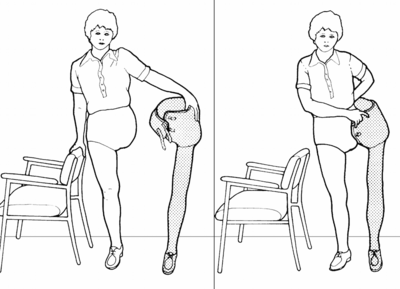 The ability to balance on the intact leg allows the user to easily don and doff the prosthesis.
 -
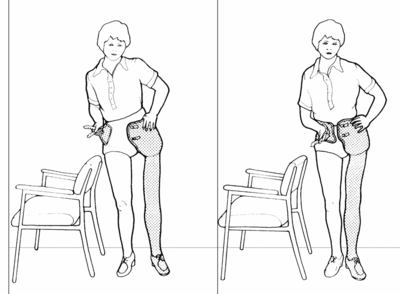


Ability to Contain Abdominal Soft Tissue
The socket must fit firmly and contain the soft tissue of the abdominal region, so that forces transfer more effectively during gait, stability is increased, and lordosis is captured.[2] Muscle tone is not a prerequisite for fitting, but individuals with firmer tone tend to achieve better prosthetic outcomes at this level.[2]
Prosthetic Design and Components for Hip Disarticulation and Hemipelvectomy
The same families of prosthetic components (hip joints, knees and feet) are used at both levels, and the overall design principles are shared. The socket differs, however, because of the anatomy removed: the ischial tuberosity is preserved in an HD but resected in an external HP, so the available weight-bearing surfaces are not the same at the two levels.

The current standard is based on the Canadian hip disarticulation prosthesis, a design originally pioneered in the 1950s by McLaurin.[11][2][4] This type of prosthesis features a prosthetic hip joint mounted anteriorly on the socket, and below the level of the anatomical hip joint. This joint positioning is in contrast to older designs which mounted the hip joint laterally and in line with the anatomical hip position of the intact side.
A major challenge at these levels is to ensure adequate safety and stability while still enabling functionality (i.e. knee and hip flexion during swing and stance phase). Thus, the key advantage of the Canadian hip disarticulation prosthesis is that overall stability can be influenced by the prosthetic alignment (i.e. the relationship between the position of the hip, knee, and foot components).[2] Placing the hip joint anteriorly on the socket means that the load line passes in front of the knee. This provides passive stability at the hip and knee during weight bearing and standing.[4]
The prosthesis is often built approximately 1cm shorter than the contralateral limb to improve toe clearance during swing phase. Depending on the components used, this compensation may not always be necessary.[4] [12]
Prosthetic Socket and Suspension
The prosthetic socket must achieve the following four functional goals.
Define anatomical surfaces and provide the mechanism for weight transfer from the trunk to the prosthetic limb. A total embracing socket is made by taking a plaster cast of the person's pelvis and iliac crests.[10] The cast is then modified to ensure that the socket interface conforms closely to the person's anatomy and that all major weight-bearing surfaces are captured accurately.[2][12] Weight-bearing within the socket occurs at the ischial tuberosity and gluteals of the intact limb for HP, and the ischium and gluteals of the amputated side for HD.
Provide mediolateral stability. This is achieved by ensuring the socket conforms closely to the person and fits firmly over the iliac crests and, on the contralateral side, over the greater trochanter.[2] A firmly fitting socket also feels lighter and requires less effort during walking. [12]
Provide suspension during the swing phase of gait. The socket extends proximally over the iliac crests and locks in tightly above them. This provides the main suspension mechanism of the prosthesis. Padding or relief is added in the bony crest region to ensure comfort while still enabling the socket to be tightened firmly.[2]
Capture biomechanical movements. Abdominal flexion and pelvic lordosis are the key trunk movements that enable prosthetic function.[2]
In addition to these functional goals, the socket should be comfortable for the user. It has been reported that socket comfort significantly improves user acceptance and increases prosthesis wear times.[12] Comfort can be improved by providing pressure relief inside the socket for the pubic bone, the femoral head on the intact limb, as well as any other sensitive areas identified during the initial assessment.[2] Pressure relief is added during socket fabrication by leaving a small space inside the socket on or around sensitive areas or incorporating softer padding materials.
Socket Casting and Fabrication
There are two main ways of taking a plaster impression for an HP/HD socket: using forming blocks, where the individual is required to simulate the final weight-bearing position[12] or by the total suspension casting method.
Socket casting using forming blocks. Two forming blocks are placed facing each other on a weight-bearing platform or standing frame, spaced far enough apart to allow the person to rest the amputated side in between them. The inner sides of the blocks are angled at 45 degrees and help to shape the anterior and posterior surfaces of the socket.
The posterior block is placed underneath the gluteus. The anterior block forms the flat surface that is used to attach the hip connector. It is positioned according to the required placement of the hip joint.
![Casting blocks HP prosthesis[13]](/File:Casting_blocks_HP_prosthesis.jpg)
![Forming blocks positioning[14]](/File:Forming_blocks_positioning_Stark.png)
Forming blocks work well for individuals with good muscle tone and less soft tissue in the abdominal and pelvic areas. If there is excessive soft tissue, forming blocks push this tissue sideways. This expands the medio-lateral width of the socket and requires additional modification during socket fabrication.[2]

Total suspension casting. Total suspension casting is the method of choice for individuals with more soft tissue and less muscle tone. Although soft tissue is contained more effectively within the suspension mechanism, there is still a tendency for the soft tissues to bulge anteriorly. This can make hip joint positioning more challenging later in the socket fabrication process.[2]
In some cases, it is desirable to use both total suspension and forming blocks in combination. This can help contain the soft tissue and define the anterior and posterior surfaces of the socket.[2][12]
Regardless of the chosen casting method, care should be taken to:
- Define and accentuate the iliac crests to ensure adequate suspension.[2][12]
- Ensure a close and accurate impression of the thoracolumbar region. This will help prevent any unwanted shifting and pistoning movements inside the socket during walking.[2]
- Reduce the overall volume of the cast. As the final step in the casting process, the anterior panel of the cast is cut open, the individual reclines back, and the cast opening is then re-tightened as firmly as possible. This step is optional, but it can help produce a firmer-fitting socket.
Socket Design and Closure
Beyond material choice, HP and HD sockets vary in how they are shaped, opened, and secured around the body. There are various socket designs currently in use, but the most common features an anterior opening with adjustable Velcro straps. These straps allow the socket to be tightened to accommodate volume changes, provide mediolateral support, and prevent anteroposterior migration of the socket during gait.[2] A shoulder strap can be added where additional suspension is required.[10]
Socket Materials
The socket can be made from a range of different materials, most commonly thermoformable (thermoplastic) plastics or laminated composites. Thermoplastics offer a greater variety of options and are easier to fabricate. However, they generally result in a thicker, heavier socket that is less durable.[2] Laminated sockets, by contrast, are stronger for a given wall thickness and can be built with varying degrees of stiffness to suit the user's anatomy and stability requirements.[12] There is also a growing trend toward incorporating softer, more flexible materials into the socket interface, such as flexible copolymer plastic sleeves or silicone, to improve user comfort.[12]
A more recent development is the Bikini Socket design (by Martin Bionics), which uses a compliant iliac crest stabiliser in place of the traditional rigid or semi-rigid frame. The developer reports that this reduces socket bulk and weight compared with conventional total-contact designs and better accommodates weight fluctuations, while still maintaining suspension and stability.[16] At present, the supporting evidence is limited to case-level clinical experience, plus manufacturer and clinic descriptions, so these claims should be treated as preliminary rather than an established evidence base. Clinicians considering this option for a patient may wish to weigh it accordingly and watch for further published outcomes as the design sees wider use.
Osseointegration
For people who struggle to tolerate a conventional socket-mounted prosthesis, transpelvic osseointegration has emerged as an alternative fixation method. This involves surgically anchoring a metal implant directly into the residual pelvic bone, to which the prosthetic limb is then attached transcutaneously, which bypasses the need for a socket entirely. The first reported case of pelvic osseointegration for unilateral hip disarticulation described a patient who, at 24 months post-surgery, wore his prosthesis during all waking hours, walked without assistive devices, and reported no complications.[18] These outcomes compared favourably with typical socket-based prosthetic use at this level, but they describe a single patient and should not be generalised.
Prosthesis Components/Joints
Hip Joints
Prosthetic hip joints have to solve two problems in the absence of a residual limb: providing stability during stance without buckling, and permitting controlled flexion during swing so the leg can advance. Because there is no residual limb to power the joint directly, all of the mechanisms below rely on the user generating movement through pelvic lordosis and trunk control, with the joint itself either limiting, assisting, or damping that movement.
Hip Limiter
Mechanism: The hip limiter is mounted anteriorly on the socket and acts as an adjustable stop, or limiter, for hip flexion during the swing phase of gait. In its more advanced form, sometimes called a hip flexion bias system, a coil spring stores energy during stance and releases it at toe-off. This thrusts the prosthetic thigh forward to assist swing initiation.[12] The degree of permitted movement, and therefore step length, can be adjusted as the individual's activity level increases, and an optional manual lock can be added for extra stability.[4][12]
Advantages: Lightweight and mechanically simple. Step length can be adjusted to suit the individual's activity level. The spring-assisted version improves ground clearance and produces a more natural-looking gait than a purely passive limiter, and may reduce the need to build the prosthesis shorter than the intact limb.[12]
Disadvantages: The spring mechanism can develop an audible squeak with use. More significantly, the loaded spring generates a strong knee flexion moment during early-to-mid stance. If this is not resisted by a stance-control or polycentric knee, the user is at risk of the knee buckling and falling.[12] As with all passive hip joints, movement still depends on the user actively generating pelvic and lumbar movement, since there is no residual limb to power flexion directly.[4]
Endoskeletal or Modular (Free-Motion) Hip Joint
Mechanism: This design uses double anterior and posterior free-motion hinges, providing hip extension by means of rubber bands, together with an optional manual hip lock. It is typically built as part of a lightweight, modular (endoskeletal) prosthesis.
Advantages: Simple, robust, and lightweight; the modular construction makes alignment and component changes straightforward.
Disadvantages: Because the joint has a single, fixed axis with no inherent shortening mechanism, the prosthesis usually needs to be built approximately 1 cm shorter than the intact side to achieve adequate toe clearance during swing. Sitting can also be difficult due to the distal joint components.[12]
Four-Bar or Polycentric Joint
Mechanism: A four-bar knee mechanism mounted upside down is a popular option for the hip joint at these levels.[4] As with a polycentric knee, the shifting instant centre of rotation allows the linkage to "shorten" during swing phase. This improves toe clearance without necessarily needing to shorten the whole prosthesis. It also offers adjustable swing- and stance-phase resistance, greater stability at heel-strike, and a low profile during sitting.[12]
Advantages: Increased toe clearance through inherent shortening during swing; greater stability at heel-strike than a simple hinge joint; a lower, more comfortable profile when sitting.[12]
Disadvantages: Heavier and mechanically more complex than a simple limiter or free-motion hinge joint, with more components requiring servicing.
Hydraulic Hip
Mechanism: The polycentric hydraulic hip joint provides three-dimensional motion during stance and swing phase with hydraulic damping and shock absorption. This produces a more natural gait pattern than a single-axis joint. It functions more effectively when paired with a microprocessor knee.[19] Powered hip joints, both anteriorly and laterally mounted, have been developed and tested as research prototypes, but are not yet available for clinical fitting.[19][20]
Knee Joints
At the HD/HP level, the knee sits even further from voluntary control than in a standard transfemoral amputation. Because there is no residual limb to influence its behaviour, knee performance depends entirely on prosthetic alignment and on the person's pelvic and lumbar movement. The general principles of knee selection are the same as for people with transfemoral amputations (see Prosthetic Knees for a full comparison of mechanisms), but some options are more or less suited to HD/HP amputations, as outlined below.
Single-Axis Knee Joint
A single-axis knee joint is a simple hinge-type knee. It rotates around a single fixed axis, with an internal, adjustable friction control mechanism providing resistance during swing phase.[2][12] Single-axis knees are lightweight, durable, relatively inexpensive, and are straightforward to align and service, making them a good choice for HD/HP prostheses.[2][12] However, they provide no inherent stance-phase stability, so the user must rely on prosthetic alignment and their own control to prevent buckling. They are best suited to those who walk at a single, consistent speed rather than a variable pace.[2]
Stance Control Knee Joint
Stance control knees (also known as "safety knees") use a weight-activated friction brake: as weight is taken through the prosthesis, the brake engages and prevents the knee from buckling. They therefore offer a high level of stability. They are generally not recommended for HD/HP, as they may prevent knee flexion and, thus, impede normal gait motion.[2] They may, however, be considered for people new to prosthetic use, particularly when they are learning to transition from swing to stance phase, as the knee will not buckle even when it is not in full extension.[12] The user must fully unweight the leg before it will bend, so the prosthetic side cannot be used to assist sitting down. Stance control knees should not be used for people with bilateral amputations.[12]
Four-Bar or Polycentric Joint
Four-bar or polycentric knees use multiple pivot points rather than a single hinge axis. Although slightly heavier than a single-axis joint, polycentric knees are a good choice at these levels as they provide stability during the stance phase coupled with shortening of the limb during the swing phase.[2][12] This inherent shortening during swing allows the length of the prosthesis to be made in accordance with the contralateral limb. Polycentric knees are recommended for higher-activity users and are often preferred for people with bilateral amputations. However, the greater number of components means more servicing is required.[2][12]
Hydraulic Knee Joint
In hydraulic knee joints, a fluid-controlled mechanism regulates the speed of knee flexion and extension during the swing phase of gait. Hydraulic knees can significantly improve range of motion at the hip and knee joints and allow for faster walking speeds. They may also help initiate hip flexion during swing.[12] Their increased weight is the main reason they are used less often in this population.[12]
Microprocessor Controlled Knee Joint
A microprocessor adjusts knee resistance in real time based on sensor feedback, matching the knee's behaviour to the individual's walking speed and terrain. This offers improved functionality and smoother walking patterns over a range of different terrains and walking speeds. Even applying a microprocessor knee on its own, without other changes, has been found to reduce energy expenditure during gait.[21][19] These units are, however, heavier and more expensive than mechanical alternatives. They require regular servicing and battery charging, and there is a steeper initial learning curve when compared with mechanical options.[21]
Hybrid Knee Joint
Hybrid knees incorporate pneumatic swing-phase control within a polycentric knee unit. They combine the stance-phase stability of a polycentric design with swing-phase damping. This supports a wider variety of walking speeds and activity levels than either feature alone.[12] However, they are more mechanically complex than a standalone polycentric or single-axis knee, which typically means added weight, cost, and maintenance relative to the simpler designs.[12]
Prosthetic Feet
Different prosthetic feet can be used for HD/HP prostheses and should be chosen based on the requirements of the individual user. Important considerations when selecting the prosthetic foot include:
- The weight of the foot. It is desirable to keep the weight as low as possible to reduce energy expenditure and ease of walking.
- The cost of the foot. More modern and complex designs tend to be more expensive and may not necessarily add functionality.
- How the foot interacts with the remaining components, particularly with the knee joint, to either enhance or reduce stability. Feet with a softer forefoot used in combination with a polycentric or four-bar knee joint will enhance knee stability, while those with a harder forefoot will reduce knee stability during the late stance phase of gait.[12]
SACH (Solid Ankle Cushion Heel) Foot
Traditionally, the SACH is the recommended foot for the Canadian hip disarticulation prosthesis design. SACH feet have an internal keel, a softer heel than other types of feet, and no moving parts. They are stable, relatively durable and inexpensive.[12]
Dynamic Response Foot
Dynamic response feet are often used for people with higher activity levels. They incorporate a carbon fibre keel designed to mimic the natural feeling of push-off, storing energy under load during stance and releasing it at push-off, which allows for faster walking speeds. However, they are heavier and more expensive than a SACH foot.[12]
To read more, please see: Prosthetic Feet.
Additional Components
Rotation adapters are attached below the knee mechanism to enable rotation of the leg section. This allows for a more comfortable and natural sitting position, particularly for cross-legged sitting. It is also useful for easy donning and doffing of shoes while still wearing the prosthesis.
Torque absorbers are used to reduce the rotational forces transferred from the socket to the prosthesis during the stance phase of gait. They also reduce impact during the initial stance phase or heel strike.
Challenges of Hip Disarticulation and Hemipelvectomy Prosthesis
It has been well documented that HD/HP prosthetic users are able to achieve a high level of activity and participation despite the complexities associated with prosthetic design, fitting and the rehabilitation process.[3][7] Nevertheless, there are several challenges that may arise, generally due to the prosthesis itself or issues associated with the amputation.
Overall Prosthesis Use
A five-year review of factors affecting successful prosthetic use identified socket comfort, balance, and independent ambulation as key predictors of long-term wear.[24] Of these, lack of comfort at the socket is the most common reason for low rates of use.[4][25] Functional independence also predicts use: people who can don the prosthesis independently and walk without walking aids are more likely to become active users.[2][4][25]
Prosthesis Rejection
People with HD and HP amputations may discontinue prosthetic use because of the high energy expenditure associated with prosthetic ambulation at these levels.[26] Low rates of prosthetic use have also been linked to age. Younger people with HD/HP amputations tend to wear their prosthesis for longer periods throughout the day, while older people may find the weight of the prosthesis, coupled with increased energy requirements for ambulation, more problematic. Cause of amputation has also been associated with prosthetic use, with better outcomes reported after amputation for tumour than after amputation for vascular disease.[3][7][27]
Overloading the Upper Extremities
Individuals using crutches and a prosthesis may have a tendency to overload their upper limbs. This can be addressed with proper gait training and ensuring a well-fitting socket that enables effective weight transfer to the lower limb.[3]
Skin Problems
As vascular disease is a less common indication at these levels than at more distal amputation levels, skin problems primarily occur due to a poorly fitted socket or overuse.[3] Modern componentry, socket materials and more dynamic designs have addressed this to some extent,[2] but wear schedules should be individualised and built up gradually under the guidance of the prosthetic and rehabilitation team. A systematic review and meta-analysis found that average prosthesis wear time after HD/HP was 6 hours.[28] This is, however, an observed average rather than a prescribed limit. Regular skin checks remain important throughout the break-in period and beyond, and the person should be taught to monitor their own skin.
Phantom Limb Pain
Phantom limb pain is common following amputation and is distinct from the socket-related skin and comfort issues discussed above.[29] It can significantly affect rehabilitation participation, prosthetic tolerance, and quality of life. It should therefore be assessed and managed as part of the broader rehabilitation programme rather than treated as an expected but untreated consequence of high-level amputation.
To learn more about phantom limb pain, please see this page.
Psychosocial Considerations
Beyond the physical demands of prosthetic use, people with HD and HP amputations face psychosocial challenges that can significantly influence rehabilitation outcomes and prosthetic acceptance. These include altered body image, effects on sitting posture and clothing fit, and the impact of visible limb loss on self-perception and social participation. Because amputation at this level is rare, individuals may also feel isolated from broader peer communities where transtibial and transfemoral experiences dominate. There may also be less information available about the prosthesis and the challenges that may arise. Peer support groups and individual mentors can therefore be valuable sources of information for both the person and their family, and can help in setting realistic rehabilitation goals and expectations. Clinicians should screen for these concerns as part of holistic rehabilitation planning, not only physical function.
Outcome Measures
Given the rarity of HD and HP amputations, outcome measurement in this population often draws on broader amputation-rehabilitation tools rather than level-specific instruments. The Sickness Impact Profile (SIP) has been used in HD/HP-specific research to capture participation restrictions, particularly around walking, rising/sitting, and stair climbing.[3] Clinicians may also consider general lower-limb prosthetic mobility tools such as the Locomotor Capabilities Index or the Amputee Mobility Predictor, while being mindful that these were not developed or validated specifically for HD/HP users and should be interpreted with that caveat.
References
- ↑ 1.0 1.1 Huffman A, Schneeberger S, Goodyear E, West JM, O'Brien AL, Scharschmidt TJ, Mayerson JL, Schulz SA, Moore AM. Evaluating hip disarticulation outcomes in a 51-patient series. Journal of Orthopaedics. 2022 May 1;31:117-20.
- ↑ 2.00 2.01 2.02 2.03 2.04 2.05 2.06 2.07 2.08 2.09 2.10 2.11 2.12 2.13 2.14 2.15 2.16 2.17 2.18 2.19 2.20 2.21 2.22 2.23 2.24 2.25 2.26 Stark G. Overview of hip disarticulation prostheses. JPO: Journal of Prosthetics and Orthotics. 2001 Jun 1;13(2):50-3.
- ↑ 3.0 3.1 3.2 3.3 3.4 3.5 3.6 3.7 Yari P, Dijkstra PU, Geertzen JH. Functional outcome of hip disarticulation and hemipelvectomy: a cross-sectional national descriptive study in the Netherlands. Clinical Rehabilitation. 2008 Dec;22(12):1127-33
- ↑ 4.0 4.1 4.2 4.3 4.4 4.5 4.6 4.7 4.8 Gholizadeh H, Baddour N, Botros M, Brannen K, Golshan F, Lemaire ED. Hip disarticulation and hemipelvectomy prostheses: A review of the literature. Prosthetics and Orthotics International. 2021 Oct 1;45(5):434-9
- ↑ Chernov D, Frappa N, Alben MG, Listopadzki T, Dillon M, Kovacs A, Riley R, Dyskin E. Hip disarticulation and external hemipelvectomy for infectious indications: a systematic review. Eur J Orthop Surg Traumatol. 2026 Jun 15;36(1):241.
- ↑ Malawer MM, Sugarbaker PH, editors. Musculoskeletal cancer surgery: treatment of sarcomas and allied diseases. Springer Science & Business Media; 2006 Feb 24.
- ↑ 7.0 7.1 7.2 Kralovec ME, Houdek MT, Andrews KL, Shives TC, Rose PS, Sim FH. Prosthetic rehabilitation after hip disarticulation or hemipelvectomy. American Journal of Physical Medicine & Rehabilitation. 2015 Dec 1;94(12):1035-40
- ↑ Chandler Balkman. Hip disarticulation prosthetic gait demonstration 2022. Available from: https://www.youtube.com/watch?v=bSq-tirpTIM [last accessed 9/7/2022]
- ↑ prostheticsinmotion. Hip Disarticulation Amputee Excels with the Otto Bock Helix Hip Joint. Available from: https://www.youtube.com/watch?v=U77D-J46cnU [last accessed 9/7/2022]
- ↑ 10.0 10.1 10.2 Engstrom B, Van de Ven C, editors. Therapy for amputees. Elsevier Health Sciences; 1999
- ↑ Solomonidis SE, Loughran AJ, Taylor J, Paul JP. Biomechanics of the hip disarticulation prosthesis. Prosthetics and Orthotics International. 1977 Apr;1(1):13-8.
- ↑ 12.00 12.01 12.02 12.03 12.04 12.05 12.06 12.07 12.08 12.09 12.10 12.11 12.12 12.13 12.14 12.15 12.16 12.17 12.18 12.19 12.20 12.21 12.22 12.23 12.24 12.25 12.26 12.27 12.28 Van der Waarde T, Michael J. Hip Disarticulation and Transpelvic Amputation: Prosthetic Management. Atlas of Limb Prosthetics: Surgical, Prosthetic, and Rehabilitation Principles. 2002.
- ↑ Stark G. Overview of hip disarticulation prostheses. JPO: Journal of Prosthetics and Orthotics. 2001 Jun 1;13(2):50-3.
- ↑ Stark G. Overview of hip disarticulation prostheses. JPO: Journal of Prosthetics and Orthotics. 2001 Jun 1;13(2):50-3.
- ↑ Cale Konetchy. Ottobock Hip Casting Video. Available from: https://youtu.be/rRRXhef_0iM [last accessed 9/7/2022]
- ↑ Holding L, Moore T. 'Silicone Bikini Socket' Hip Disarticulation: A Case Study [conference presentation]. British Association of Prosthetists and Orthotists (BAPO).
- ↑ Martin Bionics. Bikini of Hip Sockets Hammock Casting Stand Explained. Available from: https://youtu.be/rFIs9BOU2bU [last accessed 9/7/2022]
- ↑ Hoellwarth JS, Tetsworth K, Al-Maawi Q, Tarbosh AM, Roberts C, Al Muderis M. Pelvic osseointegration for unilateral hip disarticulation: a case report. JBJS Case Connect. 2021 May 10;11(2).
- ↑ 19.0 19.1 19.2 Mroz S, Baddour N, Dumond P, Lemaire ED. Design and prototype validation of a laterally mounted powered hip joint prothesis. J Rehabil Assist Technol Eng. 2024 Apr 30;11:20556683241248584.
- ↑ Brannen K, Baddour N, Cho L, Langlois D, Dumond P, Lemaire ED. Development and evaluation of an anteriorly mounted microprocessor-controlled powered hip joint prosthesis. Canadian Prosthetics & Orthotics Journal. 2025 Feb 7;7(2):44494.
- ↑ 21.0 21.1 Chin T, Sawamura S, Shiba R, Oyabu H, Nagakura Y, Nakagawa A. Energy expenditure during walking in amputees after disarticulation of the hip: a microprocessor-controlled swing-phase control knee versus a mechanical-controlled stance-phase control knee. The Journal of Bone & Joint Surgery British Volume. 2005 Jan 1;87(1):117-9.
- ↑ Chandler Balkman. Helix Hip. Available from: https://youtu.be/668uiI0arN0
- ↑ POACFL. NPS Prosthesis for Hip Disarticulate / Hemipelvectomy Amputees. Crystal's prosthesis for hip disarticulation. Available from: https://youtu.be/soAB8qHl890
- ↑ Saif A, Francis R, Sullivan J, Sedki I. Factors affecting successful prosthetic use after hemipelvectomy and hip disarticulation amputations: Five-year experience from a tertiary prosthetic rehabilitation center. Prosthetics and Orthotics International. 2024 Jan 1;48(1):20-4.
- ↑ 25.0 25.1 Fernandez A, Formigo J. Are Canadian prostheses used? A long-term experience. Prosthetics and orthotics international. 2005 Aug;29(2):177-81.
- ↑ Madhavaram AR, Khan F, Cash CA, Simman R. Understanding functional and hemodynamic outcomes across lower extremity amputation levels. Plast Reconstr Surg Glob Open. 2025 Oct 3;13(10):e7183.
- ↑ Denes Z, Till A. Rehabilitation of patients after hip disarticulation. Archives of orthopaedic and trauma surgery. 1997 Oct;116(8):498-9.
- ↑ Paquette R, Highsmith MJ, Carnaby G, Reistetter T, Phillips S, Hill O. Duration, frequency, and factors related to lower extremity prosthesis use: systematic review and meta-analysis. Disabil Rehabil. 2024 Oct;46(20):4567-4585.
- ↑ Limakatso K, Bedwell GJ, Madden VJ, Parker R. The prevalence and risk factors for phantom limb pain in people with amputations: A systematic review and meta-analysis. PLoS One. 2020 Oct 14;15(10):e0240431.