When refering to evidence in academic writing, you should always try to reference the primary (original) source. That is usually the journal article where the information was first stated. In most cases Physiopedia articles are a secondary source and so should not be used as references. Physiopedia articles are best used to find the original sources of information (see the references list at the bottom of the article).
If you believe that this Physiopedia article is the primary source for the information you are refering to, you can use the button below to access a related citation statement.
The prevalence of peripheral arterial disease (PAD) is increasing worldwide, with recent global estimates exceeding 200 million people. Advanced PAD leads to a decline in ambulatory function and diminished quality of life. In its most severe form, critical limb ischemia, rest pain, and tissue necrosis are associated with high rates of limb loss, morbidity, and mortality. Revascularization of the limb plays a central role in the management of symptomatic PAD. when lifestyle changes and medicines do not work. With advances during the last 20 years, there has been an ongoing evolution of revascularization options. These include:
Ecdarterectomy: direct removal of obstructive plaque.
Endovascular surgery: Angioplasty/Stenting When lifestyle changes and medicines do not work, then the doctor may go on to conduit Angioplasty to widen the blocked artery and ensure more blood flow. The surgeon may place a stent, or small mesh tube, in there to keep it open.
Surgery (Bypass with vein or graft): Bypass surgery can also be performed to give blood a different path around the blocked artery.
Patient-specific factors are critical in selecting the most efficacious and durable outcome, with particular importance placed on comorbid conditions, estimated life expectancy, functional status, pattern of disease, and availability of conduit.[2]
Endarterectomy
Endarterectomy is the direct removal of obstructive plaque from an arterial segment and it is best applied for focal lesions in large caliber vessels, particularly at bifurcations (eg, carotid, aortoiliac, common femoralarteries)
Advantages: autogenous nature without need for conduit.
Limitations: relate to adequate securing of the end points, thrombogenicity of the resulting surface in low flow environments, and the subsequent healing response of the artery (intimal hyperplasia), which may lead to recurrent stenosis[2].
Image: CarotidEndarterectomy
Angioplasty and Stenting
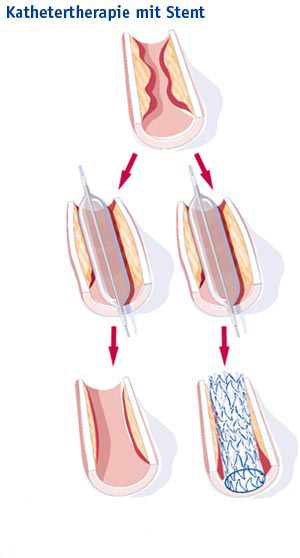
Angioplasty is a procedure to open narrowed or blocked blood vessels. Angioplasty uses a medical "balloon" to widen blocked arteries. The balloon presses against the inside wall of the artery to open the space and improve blood flow. A metal stent is often placed across the artery wall to keep the artery from narrowing again[3].
A stent is a small tube that keeps the artery open. Stents are made of either metal or plastic. Stent grafts are larger stents used for larger arteries. They may be made of a specialized fabric. Stents can also be coated with medication to help keep a blocked artery from closing[4].
Image: PAD therapy with stenting
Bypass
Surgical bypass is a versatile and flexible tool allowing for revascularization across a broad range of disease patterns, from the aorta down to the foot.
Image: 3D Medical Animation still shot depicting the Vascular Bypass Grafting in legs
The large caliber arteries and the high-flow environment of aortoiliac reconstructions favor prosthetic grafts for reconstruction. Both Dacron and PTFE have excellent long-term results. Modern fabrication practices with either collagen or gelatin-impregnated Dacron or PTFE have resulted in synthetic materials that have minimal blood loss through the graft, excellent long-term structural integrity, and ability to incorporate into native tissues.
In contrast, small caliber conduits typically required for infrainguinal bypass (≤6 mm) face a more demanding hemodynamic environment for patency. The ideal bypass conduit is an arterial autograft. For infrainguinal reconstructions, autologous vein is well established as the optimal conduit. The quality of the vein is the single greatest determinant of long-term outcomes of lower extremity bypass.
The limitations of prosthetic conduits in these environments relate to the potential for infection (an infrequent, although highly morbid complication), anastomotic pseudoaneurysms, and thrombosis.
Hybrid Approach
As endovascular interventions evolve, vascular surgeons are increasingly using hybrid approaches, a combination of catheter-based and open techniques to achieve limb revascularization with less invasiveness. eg open common femoral endarterectomy with concomitant angioplasty and stenting of aortoiliac disease.[2]
Physiotherapy
Supervised exercise programs have been recommended as first-line therapy for treatment of claudication and still as important post surgery.
Exercise therapy involves walking until reaching pain tolerance, stopping for a brief rest, and walking again as soon as the pain resolves. These walking sessions should last 30 to 45 minutes, 3 to 4 times per week for at least 12 weeks[5]
Recent evidence demonstrates benefits of exercise training even among those patients with PAD who do not have claudication.
Goals:
Reduce limb symptoms
Improve exercise capacity and prevent or lessen physical disability
Decrease the occurrence of cardiovascular events[6].