When refering to evidence in academic writing, you should always try to reference the primary (original) source. That is usually the journal article where the information was first stated. In most cases Physiopedia articles are a secondary source and so should not be used as references. Physiopedia articles are best used to find the original sources of information (see the references list at the bottom of the article).
If you believe that this Physiopedia article is the primary source for the information you are refering to, you can use the button below to access a related citation statement.
Dysphagia affects an individual's ability to safely and effectively eat and drink. One in six adults report difficulty swallowing, but only half discuss their symptoms with a clinician.[1] Consequences of dysphagia include malnutrition, dehydration, an increased risk of aspiration pneumonia and death from choking. Dysphagia also has a significant impact on social and psychological well-being, as eating and drinking are important social activities.
By understanding dysphagia, healthcare professionals can help to ensure early detection, enhanced management, reduced length of hospital stays, improved rehabilitation outcomes, and decreased morbidity and mortality. This article offers a detailed description of oropharyngeal and oesophageal dysphagia.
General Definition of Dysphagia
Dysphagia is defined as difficulty swallowing liquids, food or medication, which can occur during the oropharyngeal or oesophageal phases of swallowing.[2]
Epidemiology of Dysphagia
20% of the general population have dysphagia. This number increases to 50-66% of people aged over 60 years. More women are affected than men.[3]
Oropharyngeal Dysphagia
"Oropharyngeal dysphagia is characterised by the inability to initiate the swallowing process."[4]
"Oropharyngeal dysphagia is a clinical symptom, defined by the difficulty to move the alimentary bolus from the mouth to the oesophagus."[5]
Oropharyngeal dysphagia (or transfer dysphagia) can lead to:[6]
malnutrition and / or dehydration caused by a decrease in deglutition (or swallowing) efficacy:
dehydration is "a shortage of body water due to insufficient drinking or excess losses, or a combination of both"[7]
serum osmolality ≥300 mOsm/kg, serum sodium concentration ≥150 mmol/L, or blood urea nitrogen (BUN) to creatinine ratio ≥20 indicate a distinct lack of water in the body[8]
pneumonia with associated mortality caused by a reduced ability to swallow safely and the development of airway obstruction with choking:
Banda et al.[9] found that post-stroke dysphagia increases the risk of pneumonia almost 4.5 times
Oropharyngeal dysphagia is associated with structural alterations of the oral cavity and the pharynx.[4] It can also be caused by functional swallowing disorders.[2]
Structural alterations affect bolus progression. Various structural abnormalities can lead to oropharyngeal dysphagia, including:
neck osteophytes
neoplasm
extensive compression through goitre or lymphadenopathy, etc.
While ranges do vary in the literature, Steele et al.[10] found that the normal swallow response in healthy individuals ranges from 0.6–1 seconds. Functional disorders of swallowing affect the oropharyngeal swallow response. These disorders can be caused by:
Symptoms of dysphagia are often ignored by patients or caregivers and not reported to physicians.[2] However, the percentage of individuals with oropharyngeal dysphagia is high. It's important to note that prevalence rates vary depending on the screening method and the population tested. For instance, the highest rates are found on the African continent (64.2%) and the lowest rates in Australia (7.3%).[2]
Rofes et al. report the following prevalence rates for oropharyngeal dysphagia:[11]
over 30% of patients with cerebrovascular accident
91.7% of individuals with community-acquired pneumonia
According to Rajati et al.,[13] there is a high prevalence of oropharyngeal dysphagia in the paediatric population. These high rates might be caused by:[13]
dental issues / abnormalities
large tongue and tonsils
craniofacial abnormalities (i.e. problems with the cranial bones and structures of the mouth and throat that develop prenatally)
prenatal issues with the gastrointestinal tract (e.g. oesophageal atresia)
tracheoesophageal fistula caused by prolonged ventilator support (e.g. in preterm infants)
vocal cord paralysis
tracheostomy surgery
oesophageal stimulation or ulceration caused by gastroesophageal reflux disease
Mechanisms of Oropharyngeal Dysphagia
Velopharyngeal incompetence occurs when "the velum and lateral and posterior pharyngeal walls fail to separate the oral cavity from the nasal cavity during speech and deglutination."[14] It can be caused by:[11]
impairment of the vagus nerve and pharyngeal plexus due to neurological and neurosurgical conditions
brainstem stroke
decompression of the foramen magnum
treatments for head and neck cancer that result in intentional or unintentional "sacrifice" of the nerve supply to the palatal muscles[15]
oropharynx tumours
radiotherapy to the nasopharynx
Absent, inefficient, or infrequent laryngeal elevation occurs when the thyrohyoid and suprahyoid muscles are unable to assist with the anterior and superior movement of the hyolaryngeal complex. Because of this, the cricopharynx does not relax. This pathology can arise from the following neurological and neurosurgical conditions:[15]
posterior circulatory stroke
cerebellopontine angle surgery
high-level spinal cord injuries
tumours
extensive surgery for head and neck cancer
Inappropriate or inefficient laryngeal closure results in "suboptimal laryngeal protection and diversion of the food bolus". It can be caused by:[15]
partial or complete resection of the epiglottis
high vagal injury which involves the superior laryngeal nerves
Inefficient thyropharyngeal contraction leads to the stasis (slowing or stoppage) of a food bolus in the pyriform fossa on the affected side. This can be caused by:[15]
issues with cranial nerves IX, X, and XI (often associated with stroke or neurosurgery)
Cricopharyngeal dysfunction: cricopharyngeus must relax at the correct time to enable a successful swallowing. Cricopharyngeal dysfunction can have primary and secondary causes:[15]
primary: caused by neurological control issues
secondary: occurs when there is a lack of elevation of the larynx
Idiopathic spasm of the cricopharyngeal: there is a simultaneous contraction of the thyropharyngeus and cricopharyngeus muscles. This can cause Zenker’s diverticulum to develop (also known as pharyngeal pouch).[15]
Clinical Presentation of Oropharyngeal Dysphagia
The following signs and symptoms can occur with oropharyngeal dysphagia:[15][4]
nasal regurgitation: often associated with velopharyngeal incompetence and occasionally with cricopharyngeal dysfunction
multiple attempts to swallow: consistent with inefficient laryngeal elevation or cricopharyngeal dysfunction
coughing immediately after swallowing: may indicate unilateral or bilateral laryngeal incompetence
delayed cough: can suggest hypopharyngeal dysfunction
hoarseness, breathing difficulties, and dysarthria
Oesophageal Dysphagia
"Oesophageal dysphagia is characterised by difficulty transporting food down the oesophagus."[4]
Oesophageal dysphagia is associated with mechanical (structural ) problems or motor disorders.Mechanical (structural) disorders occur when there is a barrier that obstructs the flow of a bolus. It can be suspected when an individual has difficulty swallowing solids.[16] Mechanical disorders can be intrinsic or extrinsic.[16]
Motility (motor) disorders result in peristaltic failure.[4] These disorders can lead to problems with both solid and liquid boluses. However, difficulties swallowing solids occur more frequently.[16] Motility disorders can be divided into primary or secondary disorders.[16]
Chagas disease (a disease caused by the protozoan parasite Trypanosoma cruzi[17])
reflux-related dysmotility
systemic sclerosis and other rheumatologic disorders
medications, such as anticholinergics, antiepileptics, benzodiazepines, calcium channel blockers, nitrates, phosphodiesterase inhibitors, opioids, tricyclic antidepressants, serotonin-norepinephrine reuptake inhibitors
Prevalence of Oesophageal Dysphagia
The prevalence of oesophageal dysphagia increases with age and specific comorbidities. For instance, around 30.9% of individuals with gastroesophageal reflux disease, around 8% of individuals with eosinophilic oesophagitis (EOE) and around 4.5% of those with oesophageal stricture experience oesophageal dysphagia.[18] There are also region-specific differences. Australia reports a prevalence of 16%, Argentina 13%, the United States 7.8%, and China only 1.7%.[18]
Clinical Presentation of Oesophageal Dysphagia
Oesophageal dysphagia may have different clinical features depending on the cause of dysphagia.
dysphagia with liquids as the predominant symptom may indicate neuromuscular motility disorders
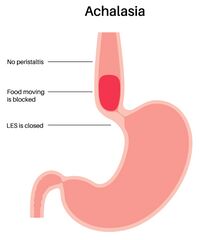
significant, progressive dysphagia with both liquids and solids, which can be relieved by swallowing repeatedly, Valsalva manoeuvres, or positional changes, is associated with achalasia. Additional symptoms include regurgitation of undigested food, particularly at night, coughing, heartburn, weight loss, and aspiration
intermittent, non-progressive dysphagia without weight loss where the patient also reports globus sensation (i.e. the feeling of having a lump in the throat), regurgitation, and heartburn are consistent with a diffuse oesophageal spasm
intermittent non-progressive dysphagia for only solid food indicates that an obstructive lesion may be present, such as an oesophageal ring or web
“steakhouse syndrome” is a term for Schatzki connective tissue B ring symptoms. Symptoms tend to occur after eating bread and meat, especially when the food is eaten quickly. "Meat or food impaction with prolonged inability to pass an ingested bolus (even with ingestion of liquid) is typical of obstructive intrinsic structural lesions."[19]
progressive dysphagia, heartburn, odynophagia (pain when swallowing), food impaction, weight loss, and chest pain imply a narrowing of the oesophageal lumen through inflammation, neoplasm, or fibrosis
oropharyngeal ulcerations, oedema, and erythaema with coughing, crying, vomiting, drooling, and varying degrees of respiratory distress and stridor are associated with thermal or chemical burns to the oesophagus
dysphagia for solids and then liquids that progressively develops over weeks to months often occurs in oesophageal carcinoma
↑ Akizawa C, Gemmell E, Kenworthy J, Speyer R. A Systematic Review of the Prevalence of Oropharyngeal Dysphagia in Stroke, Parkinson's Disease, Alzheimer's Disease, Head Injury, and Pneumonia. Dysphagia. 2016 Jun;31(3):434-41.
↑Lidani KCF, Andrade FA, Bavia L, Damasceno FS, Beltrame MH, Messias-Reason IJ, Sandri TL. Chagas Disease: From Discovery to a Worldwide Health Problem. Front Public Health. 2019 Jul 2;7:166.