When refering to evidence in academic writing, you should always try to reference the primary (original) source. That is usually the journal article where the information was first stated. In most cases Physiopedia articles are a secondary source and so should not be used as references. Physiopedia articles are best used to find the original sources of information (see the references list at the bottom of the article).
If you believe that this Physiopedia article is the primary source for the information you are refering to, you can use the button below to access a related citation statement.
The gracilis may is prone to strain injuries, resulting in adductor tendinopathyeg common in soccer, hockey, football, and basketball athletes[1].
Anatomy
Gracilis muscle (highlighted in green) - anterior view
Origin
The gracilis muscle originates from the inferior ischiopubic ramus, and body of pubis.[2]
Insertion
The gracilis muscle decends almost vertically down the leg and inserts on the medial tibia at the Pes anserinus.[2] The pes anserinus is also the attachment site of the Sartorius and Semitendinosus.
Nerve
The gracilis muscles is innervated by the anterior branch of the obturator nerve (L2-L4). The anterior branch of the obturator nerve also innervates the adductor longus, and sometimes adductor brevis.[2]
There are 5 to 7 muscle fiber bundle compartments in the gracilis muscle, with nerve branches coursing along each compartment, indicating possible independent neuromuscular compartment functioning.[1]
Image: Gracilis muscle (highlighted in green) - anterior view[3]
Function
Due to its attachment on the tibia, the gracilis flexes the knee, adducts the thigh, and medially rotate the tibia on the femur.[4]
Physiotherapy Relevance
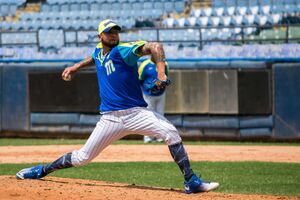
Baseball - potential Gracilis injuryGroin strain/adductor tendinopathy commonly occur in high impact sports that involve ballistic movements or stretching eg soccer, hockey, baseball. Tearing of the muscles usually occur at proximal region near bony attachments at the pelvis[5]
In women, the muscular volume of the medial vastus is greater than in men, while the volume of the gracilis muscle (and the sartorius muscle) is smaller. This predisposes females to ACL injury compared to males.[1]
Surgeons may use the gracilis tendon in reconstruction surgery of the ACL[1]
Pes anserine bursitis is an inflammatory condition of the bursa underlying the conjoined insertion of the sartorius, gracilis and semitendinosus tendons on the proximal anteromedial tibia. Common complaints include pain around the Pes Anserine area, evoked on palpation, climbing stairs, and standing up from sitting. Pes anserine bursitis is commonly seen in patients who are overweight, have osteoarthritis, and female.[1]