When refering to evidence in academic writing, you should always try to reference the primary (original) source. That is usually the journal article where the information was first stated. In most cases Physiopedia articles are a secondary source and so should not be used as references. Physiopedia articles are best used to find the original sources of information (see the references list at the bottom of the article).
If you believe that this Physiopedia article is the primary source for the information you are refering to, you can use the button below to access a related citation statement.
The following fictional case study will include an assessment, treatment and evidence that supports aquatic therapy for a four year old child diagnosed with spastic diplegia cerebral palsy (CP). CP is the most common childhood physical disability[1] and as such it can have significant impacts on a child’s function, participation and inclusion in activity. It is also common for children with CP to present with additional comorbidities that impact overall health and make learning new tasks difficult. Aquatic therapy has been found to improve strength and function for children diagnosed with CP. Therefore, the purpose of this case is to discuss the positive effects of a 10 week aquatic therapy intervention for a four year old child diagnosed with CP. It will also highlight outcome measures that were used to determine a baseline and monitor treatment progress for a child participating in hydrotherapy.
Introduction
Cerebral Palsy (CP) is a movement and postural disorder that appears in early childhood or infancy as a result of brain damage[2]. Though there are several definitions in the literature, CP can generally be classified as any non-progressive central nervous system injury occurring during the first two (some literature says five) years of life[2]. After the age of five, brain damage is classified as an acquired brain injury[2]. In 2011, Statistics Canada found that 0.1% of the Canadian population - or just over 42,000 people - were diagnosed with CP[3]. Globally, population-based studies indicate that the prevalence of CP is said to range from 1.5 to more than 4 per 1,000 live births or children of a determined age range[4]. There is no one test used to diagnose CP, and the presentation of the condition will look very different from one person to another. According to the CP Canada Network[5], general categories include hemiplegia (affecting the ipsilateral arm and leg); diplegia (affecting both legs or both arms); and quadriplegia (affecting both arms and legs, muscles of the trunk, mouth and face). Symptoms that can present with CP depend on which area(s) of the brain are injured. For example, possible symptoms include muscle tightness or spasm, involuntary movements, difficulty with gross motor skills and abnormal perception and sensation[6].
Although there is no cure for CP, the condition can be managed, allowing some people who have CP to go to school, work, get married and participate in society[5]. In fact, over half of the children diagnosed with CP (58%) can walk independently and another 3% can walk using a mobility device[2]. Early intervention with supports such as physiotherapy (PT) can help individuals to achieve this independence. Specifically, PT aims to help people with CP achieve their physical mobility by promoting exercises that emphasize independence[6].
The purpose of this case study is to discuss the effects of a hydrotherapy intervention strategy for a four year old child with spastic diplegic CP. It should be noted that while the primary focus will be on hydrotherapy, the authors will also be prescribing exercises for the parents to work on at home with the patient. Difficulties managing this case predominantly encompassed initial communication and rapport-building between the therapist and patient, as well as the patient’s low confidence when starting to walk without her gait aid. All of these difficulties resolved themselves as the patient became more familiar with the therapist, and confidence in her prescribed exercises improved.
The following cases provide a description of why aquatic therapy was determined to be an appropriate and evidence-based intervention for a child with CP. According to Roostaei, Baharlouei, Azadi and Fragala-Pinkham[7], the buoyancy of aquatic therapy makes it easier for children who have mild to moderate limitations to move compared to exercises out of water. Performing exercises such as walking in water has the potential for better joint alignment in addition to allowing the opportunity to perform movements such as jumping and running that can have a harder impact on joints[7]. In addition, walking in water provides a better opportunity for muscle strengthening due to the increased resistance to movement[7]. However, it is also important to engage the patient and encourage their active participation. Kelly and Darrah[8], noted that the properties of water not only make it easier for children with CP to move but also make exercises more interesting and motivating. According to a literature review by Roostaei et al.[7], three of the 11 studies they found specifically targeted participants who were younger (approximately 2-9 years old), two of which demonstrated significant changes as measured by the Gross Motor Function Classification System (GMFCS). One of the studies (a control trial design) by Lai, Liu, Yang, Chen, Wu & Chan[1], found that the pediatric hydrotherapy group had a greater GMFCS average than the control group, and showed higher scores on the Physical Activity Enjoyment Scale than the control group after treatment. The delivery method of these studies varied from individual sessions to group therapy, however the majority used a 1:1 instructor to child ratio[7]. As such, the current case study will follow a 1:1 ratio of therapist to child. Roostaei et al.[7] also found that the length of sessions may impact improvement as measured by the GMFCS, regardless of intensity of treatment. For example, the authors recommend sessions of 45 minutes or longer, since sessions lasting 30 minutes or less did not show improvement in total GMFCS score. This remained true even when higher intensity exercises were conducted. Therefore, the current case study will also focus on therapy sessions lasting a minimum of 45 minutes. It should be noted that this case study is a fictitious profile created by the authors for educational purposes only.
Client Characteristics
Patient is a four year old female who was diagnosed with spastic diplegia cerebral palsy at birth. She was born prematurely. Patient presents with an abnormal gait pattern and poor trunk control, and has previously had interventions for balance, trunk control and gait aid training. She is currently using a four-wheeled walker with forearm support, and has outgrown her orthotics. In addition to a gait assessment, the authors' intervention objectives will be to update the patient’s current home exercise program and assess appropriateness for hydrotherapy.
The patient has epilepsy (controlled with medication), mild Attention Deficit Hyperactivity Disorder, and wears prescription glasses. She has regular follow-up care with medical staff to monitor her CP and epilepsy.
Examination Findings
Subjective
The patient has had difficulty navigating less accessible environments outside of the home with her walker. Her parents’ current concern is that she is starting kindergarten in the fall. Although she will attend a fully integrated, accessible public school, she would still navigate much more easily without her walker. She will also have assistance from an Education Assistant, as well as an Individualized Education Plan outlining modifications & accommodations in physical education and fine motor control. It is important to the patient that she has better mobility independence in order to play with her classmates; in addition, she has outgrown her current orthotics, and requires new ones. The patient’s parents report she has low walking endurance (must use gait aid for longer distances), trouble toileting (functional incontinence due to limited strength and balance while holding seated position), and mild reflux.
Objective
Observation
Upon observation in quiet standing the patient presented with knee valgus, abnormal trunk and knee flexion, and internally rotated lower limbs. Her gait analysis found a toe-stepping gait, bilateral hip flexion, adduction, and internal rotation, as well as a bilateral decrease in stride length. She had excessive knee flexion and ankle plantarflexion due to hamstring and plantarflexor spasticity and/or contractures, and an overall reduced gait velocity. In the upper extremity her arm swing was reduced (more notably on the right side), and she held her arms at 90-90 during the full gait cycle. Her trunk also demonstrated excessive bilateral sway towards the stance leg throughout the full gait cycle.
Neurological Testing
The patient’s neurological and vascular assessment found hyperreflexivity in her upper and lower limbs, with clonus presenting in the lower. No other significant findings were noted.
Range of Motion
Goniometry was used to measure the patient's active (AROM) and passive range of motion (PROM). The patient’s upper limbs were within functional limits, however her lower limb values were all significantly decreased:
Knee extension: limited by rigidity in 15° of knee flexion
Ankle dorsiflexion: limited by rigidity in 30° of ankle plantarflexion for AROM; achieved 0° in PROM
Hip extension: limited by rigidity in 5° of hip flexion
Condition-Specific Classifications
The Gross Motor Function Classification System (GMFCS) was used to describe the motor function of the patient and to distinguish her functional abilities, quality of movement and needs for assistive technology. The patient could walk in most settings and climb stairs holding onto a railing. She experienced difficulty walking long distances without a gait aid and balancing on uneven terrain and inclines. She had minimal ability to perform gross motor skills such as running and jumping, mostly due to poor AROM and balance impairments. Her parents noted that she has difficulty walking in crowded areas or confined spaces. Due to all of these factors, the patient was classified as a GMFCS Level II.[9]
The Manual Ability Classification System (MACS) was used to observe the patient's fine motor skills, to see how she can handle objects in every day activities and to determine her need for assistance or adaptation to perform manual activities in everyday life. The patient was observed completing the following tasks: opening a puzzle box, emptying the contents of the box onto the table, handling the pieces of a puzzle and placing the pieces back in the box, closing and opening a zipper, buttoning and unbuttoning a jacket, drinking from a cup, using a spoon to scoop up food, pounding pegs using a toy hammer and putting marbles into a jar. Besides buttoning up her shirt, the patient was able to handle objects and complete the tasks, albeit with reduced speed, coordination and precision. These results lead the authors to conclude that the patient is at a MACS level II.
The Communication Function Classification System (CFCS) was used to classify the effectiveness of the patient's everyday communication skills.The patient's parents stated that their daughter communicates effectively with familiar people like friends and family, but struggles to communicate and interact with acquaintances or unfamiliar people in most environments. This was evident during the beginning of the assessment as the patient was very shy and unwilling to speak or participate without prompts from her parents. Nevertheless, towards the end of the assessment the patient opened up and communication skills were better. These observations lead the authors to conclude that the patient is a CFCA level III.
Higher score indicates better balance and more independence
Clinical Impression
4 year old female diagnosed with spastic diplegic cerebral palsy. She is GMFCS level II. Currently she is using a 4WW to ambulate for longer distances. She is MACS level II. Her upper extremities are only affected during fine motor skills. She would benefit from PT to address her gait, balance and trunk control so she is able to attend full-time kindergarten independently. Prognosis is good and patient is expected to improve physiotherapy problem list with hydrotherapy, treadmill training, and an updated HEP.
Problem list to be addressed with physiotherapy intervention:
Atypical postural
Toe-stepping gait with significant lack of trunk control
Lower extremity weakness
Increased tone and spasticity in:
Plantarflexors
Hamstrings
Hip adductors & internal rotators
Balance issues
Decreased tolerance to external perturbations
Decreased balance on one foot and in narrow stances
Hydrotherapy Intervention Details[1][7][8][12][17][18]: standing in the shallow end of the pool, using water belt flotation device as needed; note that most of the intervention activities are play-based[19]
Warm-Up (10 min):
“Simon Says”: AROM exercises including cervical, shoulder and lower limb AROM, then graduating to full body movements
“Mirror Game”: child and physiotherapist (PT) take turns being the mirror and the person, mimicking each other’s slow movements
“Follow the Leader”: child is the leader and takes PT through motions of her choice
Strength, Cardio & Balance (20 min):
“Freeze Game” with music: compound (multi-joint) movements for cardio/strength
Push-ups from side of pool, flutter kicks while holding edge of pool, jumping jacks, dancing, etc.
Freeze when the music stops; every few freezes change the movement
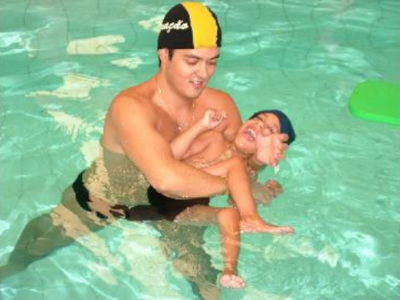
PT performing Inside Leg Rotation (Watsu technique) with 4 year old client with cerebral palsy[18]Manipulatives for reaching and trunk control:
Play with water toys (watering cans, boats, balls, floating shapes) to practice reaching, walking, trunk control; encourage movement in the water with the toys
“Fun Balance”
Try to lie prone, sit and/or stand on a floating board, floating noodle, and ball
Stretch & Cool-Down (15 min):
“Watsu” with music: for relaxation and ROM
Outcome
Patient saw a change in 13 points on the PBS (Pre-intervention: 42/56, Post-intervention: 55/56) which substantially reduces her probability of falling. With a minimal clinically important difference (MCID) of 2 points on the MAS,[20] her spasticity was also significantly reduced bilaterally over the 10 week period:
Hamstrings (MAS pre: 4, post: 2)
Quadriceps: (MAS pre: 3, post: 1)
Hip flexors (MAS pre: 4, post: 1)
Plantar flexors (MAS pre: 4, post: 2)
At the 6 week mark onward, the patient also had a noticeably larger stride length and increased gait velocity. This likely contributed to the reduction in 5.1 seconds in her TUG test and reduction of 60.9m in the 6MWT using her newly fitted gait aid. Although there is no MCID established for GMFCS level II for CP, there is a minimal detectable change of 47.4m for children with CP at a GMFCS level III[21]. Therefore, it can be hypothesized that reduced spasticity and increased ROM in her lower limbs had a positive functional outcome effect on the patient's gait pattern, which resulted in an increase in her capacity for mobility and ambulation.
Correspondingly, the patient also saw improvements by 11 points (MCID 6)[22] in TCMS, specifically in dynamic sitting balance and dynamic reaching. These changes were observed in the reduction in patient trunk away during ambulation. There was also noticeably less trunk sway during ambulation as weight distribution appeared equal upon foot contact, and the patient’s shoulders remained stacked over the hips.
In addition, some referrals to other health care professionals are necessary to address aspects of the patient's function that PT intervention cannot directly address:
Referral to occupational therapist for decreased fine motor skills and toileting
Referral to orthotist for new AFOs as she has outgrown her current pair
Referral to speech language pathologist to improve communication with unfamiliar persons
Discussion
A four year old patient diagnosed with spastic diplegic cerebral palsy was referred for physiotherapy services in order to be fitted for a new gait aid and to prepare the patient for kindergarten in the fall. The patient presented with poor balance, limited ROM and moderate to severe hypertonicity in the plantar flexors, hip flexors, adductors and hamstrings. These findings put the patient at an increased risk of falling and appeared to limit her gross motor functioning, ambulation and gait function. Rehabilitation goals included: increasing balance to reduce the risk of falls, reducing spasticity and tone, and improving AROM and ambulation endurance in order to walk to school and play with other children.
Hydrotherapy was selected as an appropriate intervention to improve the patient’s symptoms, and reduce her limitations in functional activity and participation. Evidence shows that performing exercises such as walking in water can: improve joint alignment, reduce impact to allow for more rigorous exercise like running and jumping, increase strength, and increase ease of movement[7]. Although there is stronger evidence to support treadmill training, the patient has a more meaningful connection with swimming, finding it fun and motivating. The authors' hypothesis was that two 45 minute sessions of hydrotherapy a week for 10 weeks would make a clinical difference on the patient’s spasticity, balance and functional mobility. Following the intervention, the patient’s ambulation distance increased, and her balance improvements significantly reduced her fall risk.
Broader implications of hydrotherapy intervention can extend to other conditions that present with spasticity, including multiple sclerosis[23], spinal cord injury[24], and stroke patients[25]. Management will vary depending on the presentation of each individual and their disease specific functional classification.
References
↑ 1.01.11.21.3Lai, C., Liu,W., Yang, T., Chen, C.,Wu, C., & Chan, R. Pediatric aquatic therapy on motor function and enjoyment in children diagnosed with cerebral palsy of various motor severities. Journal of Child Neurology. 2015:30:200–208. doi:10.1177/0883073814535491
↑Centers for Disease Control and Prevention. Data and statistics from cerebral palsy. Available from: https://www.cdc.gov/ncbddd/cp/data.html (accessed 5 May 2019).
↑ 7.07.17.27.37.47.57.67.77.8Roostaei, M., Baharlouei, H., Azadi, H., & Fragala-Pinkham, MA. Effects of aquatic intervention on gross motor skills in children with cerebral palsy: A systematic review. Physical & occupational therapy in pediatrics. 2017:37:496-515.doi:10.1080/01942638.2016.1247938
↑ 8.08.18.2Kelly, M., & Darrah, J. Aquatic exercise for children with cerebral palsy. Developmental Medicine & Child Neurology. 2005:47:838–842. doi:10.1017/S0012162205001775
↑Dhote, S. N., Khatri, P. A., & Ganvir, S. S. (2012). Reliability of "Modified timed up and go" test in children with cerebral palsy. Journal of Pediatric Neurosciences. 2012; 7(2): 96–100. https://dx.doi.org/10.4103%2F1817-1745.102564
↑ 11.011.1Novak, I., Mcintyre, A., Morgan, C., Campbell, L., Dark, L., Morton, N., et al. A systematic review of interventions for children with cerebral palsy: state of the evidence. Developmental Medicine & Child Neurology. 2013; 55(10):885-910. doi: 10.1111/dmcn.12246
↑ 12.012.112.2Dewar, R., Love, S., & Johnston, L. M. Exercise interventions improve postural control in children with cerebral palsy: a systematic review. Developmental Medicine & Child Neurology. 2014; 57(6): 504-520. doi: 10.1111/dmcn.12660
↑Begnoche, D. M., Chiarello, L. A., Palisano, R. J., Gracely, E. J., McCoy, S. W., & Orlin, M. N. Predictors of independent walking in children with CP. Physical Therapy. 2016; 96(2): 183–192. https://doi.org/10.2522/ptj.20140315
↑Baker R., Harvey A., Martin L. A systematic review of common physiotherapy interventions in school-aged children with cerebral palsy. Physical & Occupational Therapy in Pediatrics. 2010; 30(4):294-312. doi: 10.3109/01942638.2010.500581
↑Willoughby, K., Dodd, K. J., & Shields, N. A systematic review of the effectiveness of treadmill training for children with cerebral palsy. 2009; 31(24): 1971-1979. doi: 10.3109/09638280902874204
↑Crowley, J., Arnold, S., McEwen, I., & James, S. Treadmill Training in a Child with Cerebral Palsy: A Case Report. Physical & Occupational Therapy In Pediatrics. 2009:29:1:60-70 doi: 10.1080/01942630802574866
↑ 17.017.1Ballaz, L., Plamondon, S., & Lemay, M. Group aquatic training improves gait efficiency in adolescents with cerebral palsy. Disability and Rehabilitation. 2011:33:1616-1624. doi: 10.3109/09638288.2010.541544
↑Thompson P, Beath T, Bell J, et al. Test-retest reliability of the 10-metre fast walk test and 6-minute walk test in ambulatory school-aged children with cerebral palsy. Dev Med Child Neurol. 2008;50(5):370-376. doi: 10.1111/j.1469-8749.2008.02048.x
↑Marsico, P., Mitteregger, E., Balzer, J. & A van Hedel, H. Trunk control measurement scale: reliability and discriminative validity in children and young people with neuromotor disorders. Developmental Medicine & Child Neurology. 2017; 59(7): 706-712. https://doi.org/10.1111/dmcn.13425
↑Ellapen, T. J., Hammill, H. V., Swanepoel, M. & Strydom, G. L. The benefits of hydrotherapy to patients with spinal cord injuries. African Journal of Disability. 2018;7(0): 450. https://doi.org/10.4102/ajod.v7i0.450
↑Furnari, A., Calabrò, R. S., Gervasi, G., La Fauci-Belponer, F., Marzo, A., Berbiglia, F., et al. Is hydrokinesitherapy effective on gait and balance in patients with stroke? A clinical and baropodometric investigation. Brain Injury. 2014; 28(8): 1109-1114. https://doi.org/10.3109/02699052.2014.910700

_with_4_year_old_client_with_cerebral_palsy.png)