When refering to evidence in academic writing, you should always try to reference the primary (original) source. That is usually the journal article where the information was first stated. In most cases Physiopedia articles are a secondary source and so should not be used as references. Physiopedia articles are best used to find the original sources of information (see the references list at the bottom of the article).
If you believe that this Physiopedia article is the primary source for the information you are refering to, you can use the button below to access a related citation statement.
Exercise and physical training are biological stressors. The body reacts similarly to exercise as it does to other stressors.[1]
Stress disrupts homeostasis and this leads to an adaptive response.[2]
The body's responses to a single bout of exercise are regulated by the principles of homeostasis. Homeostasis is defined as the ability of the body to maintain a stable internal environment for cells by closely regulating various critical variables such as pH, acid-base balance, oxygen tension, blood glucose concentration and body temperature.[3]
Specifically, in exercise – muscle contractions disturb homeostasis resulting in various responses.
The type of adaptation is dependent on the overload stimulus.
It is important for clinicians using exercise as a modality to understand the biological process of adaptation.[4]
Stress
Stressor = anything that causes stress or elicits the stress response
Acute responses to training - i.e. how the body responds to one bout of exercise
Physiological, metabolic and neuromuscular changes that persist for the duration of the exercise bout and are in proportion to the increase in metabolic rate
Metabolic rate = "metabolism per unit time especially as estimated by food consumption, energy released as heat, or oxygen used in metabolic processes"[7]
Oxygen consumption is a measure of metabolic rate (VO2 Max)[8]
When exercise stops, oxygen consumption decreases and returns to baseline measures a few hours after exercise[9]
The metabolic rate a few hours after moderate exercise is the same as the metabolic state before the exercise bout
Changes are transient
Chronic phase:
When exercise bouts are repeated regularly, longer-term changes occur
Training-induced adaptations occur and these are associated with improvement in exercise performance
Has more refined motor coordination to perform specific tasks
The nature of training adaptations is dependent on the type of exercise (endurance vs strength training)[11]
Recovery
Recovery is defined as "the set of processes resulting in an athlete's renewed ability to meet or exceed previous performance levels"[12]
Recovery period is defined as "the time necessary for the various physiological parameters that were altered by exercise to return to resting values"[12]
Recovery should occur after each training session
The metabolic rate should revert to the level it was before the start of exercise on the previous occasion
The time course of recovery differs, depending on the marker of recovery
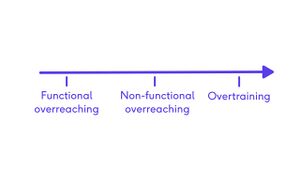
Management of overtraining in competitive athletes is necessary as there is often an imbalance in wanting to continuously improve performance with training, but insufficient recovery periods between training sessions.[14]
Exercise dose can be quantified through wearable devices measuring the[15]:
Intensity
Distance
Impact forces
Exercise response = the athlete’s outcome from a training session
Overload Principle
The overload principle states that habitually overloading a system causes it to respond and adapt[16][17]
The overload principle can be quantified according to load (intensity and duration), repetition, rest and frequency[18]
Load refers to the intensity of the exercise stressor. For example, in strength training it can refer to the amount of resistance or in swimming it can refer to speed. The greater the load, the greater the fatigue and recovery time needed.
Repetition refers to the number of times that a load is applied.
Rest refers to the time interval between repetitions.
Frequency refers to the number of training sessions per week.
Practical ways to do this:
Increasing the weight
Increasing the distance
Increasing the intensity
Decreasing the rest period between sets and/or sessions.
The overload principle forms the base of all training programmes and assists athletes in reaching peak performance.[4]
At rest, the physiological, metabolic and endocrine systems of the body are in equilibrium (homeostasis)
A muscle contraction causes disruption of homeostasis
Responses to the disruption of homeostasis are designed to meet the demands of increased metabolic rate or the need to produce muscle power and maintain the body’s internal environment during exercise.
Examples of transient homeostatic changes include[9]:
Altered blood flow to active muscles
Increased heart rate
Increased oxygen consumption
Increased rate of perspiration
Increased body temperature
Secretion of stress hormones such as ACTH (Adrenocorticotropic Hormone), cortisol and catecholamines
Increased glycolytic flux
Altered recruitment of muscles
The magnitude of these changes/responses is dependent on the interaction of factors such as[9]:
Type of muscle action
Duration of activity
Whether the individual has been exposed to the activity before
Ambient conditions also impact homeostatic response. Examples of ambient conditions[20]:
Temperature
Altitude
Wind speed
Inter-individual differences in response to the same exercise stimulus explain why some individuals adapt faster than others when exposed to the same training stimulus.[21] Reasons for this include[22][23]:
Pre-training phenotype
Pre-training autonomic function
The timing and composition of nutritional intake may also modulate the training response[23]
Exercise-Associated Signal
The exercise-associated signal that introduces training-induced adaptation is dependent on[23]:
Type of muscle contraction
Duration of the exercise bout
Intensity of the exercise bout
Frequency of the exercise bout
The mechanical signal is converted to primary and secondary messages for adaptation
These messages activate pathways involved in protein synthesis or degradation
This results in adaptations associated with performance changes
Signal can also be affected by the recovery period between exercise sessions
For example, training-induced expression of messenger RNA of several oxidative enzymes are upregulated 24 hours after an exercise bout[24]
Endurance training leads to muscles becoming more resistant to fatigue
Strength training leads to muscles becoming stronger, more powerful and sometimes bigger
Exercise-Induced Adaptations at Cellular Level
The primary stimulus for exercise-induced adaptations is a combination of[9][25]:
Endurance training increases resistance to fatigue or following training; adaptations occur and more work can be done in the same time compared to before training or at the same submaximal intensity. Thus, it takes longer to fatigue when/after training.
Increase in mitochondrial content after 4 weeks – results in an increase in oxidative capacity of the muscle
These changes are lost when regular training stops
Time course of endurance training adaptations:
Changes in VO2 max, cardiac output and stroke volume start within 3 weeks, but continue linearly for at least 12 weeks[28]
An improvement in VO2 max can be seen for at least 12 months[29], but if there is insufficient training stress/load the the increase in VO2 max will reach a plateau after 3 weeks[30]
Heart rate (HR) at a given submaximal intensity drops within 3 months[29]
At a fixed submaximal workload, the perception of effort decreases as the training status improves
This can be related to:
Reduced disturbance in homeostasis which occurs at a fixed submaximal workload after training compared to before
The athlete is more efficient and less oxygen is used at a fixed submaximal load
This is demonstrated by:
Slower breathing rate
Lower heart rate
Lower blood lactate concentration
More fat used as fuel during submaximal exercise
Demonstrated in a laboratory when the volume of carbon dioxide produced and the volume of oxygen consumed are measured - this is known as the Respiratory Exchange Ratio (RER)
RER – close to 1 when glucose and glycogen are the main fuel sources and decreases to 0.7 when free fatty acids are the main fuel source during exercise[31]
In an untrained person, exercising at submaximal intensity, RER = around 1, indicating that mainly glucose is used as fuel
RER of an endurance athlete = 0.8 -0.9 indicating that fatty acids and glucose are oxidised for fuel
The rate of glycogen utilisation decreases during submaximal exercise after endurance training. As a result, it takes longer for glycogen stores to become depleted. Fatigue during endurance training is associated with glycogen depletion. Thus, if glycogen depletion can be delayed, the onset of fatigue will be delayed and will occur at a later stage.[32]
The musculoskeletal system is fundamental in exercise physiology. The strength of a muscle is mostly determined by its cross sectional area. Therefore size is key.
Mechanical Work performed by a muscle is the amount of force applied by the muscle multiplied by the distance over which the force is applied.[35]
Muscle Strength is the maximal amount of tension or force that a muscle or a muscle group can voluntarily exert on a maximal effort when the type of muscle contraction, segment velocity and joint angle is specified.[36]
Muscle Strength = ability of a muscle to produce force
The power of a muscle contraction is different from muscle strength because power is a measure of the total amount of work that the muscle performs in a unit period of time. It is generally measured in kilogram meters (kg-m) per minute.[35]
Muscle power = the ability of a muscle to do work over time. Thus, it is an interaction between the force of contraction and speed of contraction
Muscle endurance is defined as the ability to perform repeated contractions against a resistance or maintain a contraction for a period of time.
Normal daily activities require minimal strength while certain sports depend on high levels of muscle strength, such as weightlifting. Sports like gymnastics require more muscle power than muscle strength.
Adaptation of Overload Stimulus for Strength Training
Ways to alter training stimuli to impose training overload include:
Manipulate the number and intensity of repetitions
Manipulate the recovery time between repetitions, sets and sessions
Manipulate the frequency of training sessions
Change the weight used
Manipulate the number of sets per exercise
Type of resistance exercise
Order of exercise
The outcome of resistance training is dependent on the overload stimulus and the type of resistance training. The interplay between these variables can influence[17]:
Muscle strength
Muscle endurance
Muscle hypertrophy
Muscle power
Several factors influence the muscle’s capacity to generate force. These are[17]:
Initially, increases in strength are a result of changes in the neural system. For example, an untrained individual will notice an almost immediate increase in strength when starting a resistance training programme. Initially, there are no changes in muscle size.
Signs of an increase in muscle size or hypertrophy occur after about 4 weeks of consistent training
There is a significant change in size after 8 to 12 weeks of resistance training
Muscle sizes are determined mainly by genetic and anabolic hormone secretion. Training can add another 30 to 60 percent of muscle hypertrophy, mostly from increased muscle fibre diameter, but in a small part also from an increased number of fibres (hyperplasia).
Increase in ATP and phosphocreatine amounts available
Increased stored glycogen and triglyceride
Thus enhancing both aerobic and anaerobic systems
Additional manufacturing and incorporation of contractile proteins such as actin and myosin into existing myofibrils will increase the cross-sectional area of the muscle
The increase in cross-sectional area is directly proportional to the force that the muscle can produce
Factors that influence the rate and size of the muscle increases after training include:
Age
Biological sex
Genotype
Maximum voluntary contraction
Voluntary strength depends on the maximal activation of the agonist muscle, but also minimal activation of the antagonist muscle, and support from the synergistic and stabilising muscles.
An untrained muscle cannot be fully activated. This may be because the Golgi tendon organ is activated, which inhibits agonist muscle recruitment.[40]
After strength training, this inhibition appears to be overridden
During the first 3 to 4 weeks after resistance training there is an increase in maximal voluntary contraction – an increase in surface EMG activity of the agonist muscle is also seen during this period. This confirms the change in neural drive to the muscle and indicates that more muscle fibres can be recruited after training compared to a maximal contraction before training.[41]
Once hypertrophy occurs, fewer muscle fibres are recruited during a submaximal contraction, which is seen by reduced EMG activity.
Other evidence of neural adaptation after resistance training is visible in the cross-over effect, where strengthening one limb increases strength in the contralateral untrained limb.[4]
Adaptations are compromised if endurance and strength training occurs at the same time.[11]
Gains in strength are reduced if additional endurance training occurs simultaneously. This is due to a suppressed hypertrophic response in the muscle that may be related to an elevated catabolic state induced by endurance training.[11]
There is evidence showing that aspects of vascularisation and oxidative enzyme activity may be increased with concurrent training. Various molecular signalling processes induced in skeletal muscle by endurance exercise can inhibit pathways regulating protein synthesis and stimulate protein breakdown. Regulating pathways in this manner may reduce the capacity for muscle hypertrophy.[42]
↑Chu B, Marwaha K, Sanvictores T, Ayers D. Physiology, stress reaction. InStatPearls [Internet] 2021 Jun 8. StatPearls Publishing.
↑Powers SK and Howley ET. Exercise Physiology: Theory and Application to Fitness and Performance.10th edition. North Ride, NSW, Australia. McGraw Hill. 2014
↑ 4.04.14.24.3Lambert, M. Principles of Exercise Physiology and Adaptation Course. Plus, 2022.
↑Cunanan AJ, DeWeese BH, Wagle JP, Carroll KM, Sausaman R, Hornsby WG, Haff GG, Triplett NT, Pierce KC, Stone MH. The general adaptation syndrome: a foundation for the concept of periodization. Sports Medicine. 2018 Apr;48(4):787-97.
↑Burton I, McCormack A. The implementation of resistance training principles in exercise interventions for lower limb tendinopathy: A systematic review. Physical Therapy in Sport. 2021 Jul 1;50:97-113.
↑ 17.017.117.217.3Maestroni L, Read P, Bishop C, Papadopoulos K, Suchomel TJ, Comfort P, Turner A. The benefits of strength training on musculoskeletal system health: practical applications for interdisciplinary care. Sports Medicine. 2020 Aug;50(8):1431-50.
↑Brooks G, Fahey TD, Baldwin KM.Exercise Physiology: Human Bioenergetics and its Applications. 4th Edition. Boston. McGraw Hill. 2005.
↑Bouchard C, Rankinen T. Individual differences in response to regular physical activity. Medicine and science in sports and exercise. 2001 Jun 1;33(6; SUPP):S446-51.
↑ 23.023.123.2Mann TN, Lamberts RP, Lambert MI. High responders and low responders: factors associated with individual variation in response to standardized training. Sports Medicine. 2014 Aug;44(8):1113-24.
↑Hackney AC. Molecular and physiological adaptations to endurance training. InConcurrent aerobic and strength training 2019 (pp. 19-34). Springer, Cham.
↑ 29.029.129.2Scharhag-Rosenberger F, Meyer T, Walitzek S, Kindermann W. Time course of changes in endurance capacity: a 1-yr training study. Medicine & Science in Sports & Exercise. 2009 May 1;41(5):1130-7.
↑RC. Hickson, JM. Hagberg, AA. Ehsani, JO. Holloszy, Time course of the adaptive responses of aerobic power and heart rate to training., Med Sci Sports Exerc, volume 13, issue 1, pages 17-20, 1981,
↑Yin L, Li N, Jia W, Wang N, Liang M, Yang X, Du G. Skeletal muscle atrophy: From mechanisms to treatments. Pharmacological Research. 2021 Oct 1;172:105807.
↑ 35.035.1Hall JE. Guyton and Hall Textbook of Medical Physiology, 12e. 12th edition. Philadelphia, Pa: Saunders; 2010. p1120
↑Foss ML, Keteyian SJ, Fox EL. Fox’s Physiological Basis for Exercise and Sport. 6th edition. Boston, Mass: William C Brown Pub; 1998. p 620
↑Hornsby WG, Gentles JA, Haff GG, Stone MH, Buckner SL, Dankel SJ, Bell ZW, Abe T, Loenneke JP. What is the impact of muscle hypertrophy on strength and sport performance?. Strength & Conditioning Journal. 2018 Dec 1;40(6):99-111.
↑Chalmers G. Strength training: Do Golgi tendon organs really inhibit muscle activity at high force levels to save muscles from injury, and adapt with strength training?. Sports Biomechanics. 2002 Jul 1;1(2):239-49.
↑Pucci AR, Griffin L, Cafarelli E. Maximal motor unit firing rates during isometric resistance training in men. Experimental physiology. 2006 Jan;91(1):171-8.
↑Lambert MI. General adaptations to exercise: Acute versus chronic and strength versus endurance training. InExercise and human reproduction 2016 (pp. 93-100). Springer, New York, NY.

_continuum.jpg)