When refering to evidence in academic writing, you should always try to reference the primary (original) source. That is usually the journal article where the information was first stated. In most cases Physiopedia articles are a secondary source and so should not be used as references. Physiopedia articles are best used to find the original sources of information (see the references list at the bottom of the article).
If you believe that this Physiopedia article is the primary source for the information you are refering to, you can use the button below to access a related citation statement.
The World Health Organization recommends that older adults do 150 to 300 minutes of moderate or 75 to 150 minutes of vigorous aerobic activity weekly.
Muscle-strengthening activity should target all major muscle groups on two or more days per week, with multicomponent balance and strength training on three or more days.
Exercise prescription should reflect functional ability rather than age, starting with light, short bouts for people who are deconditioned and changing one variable at a time.
Most older adults can safely begin exercise without medical clearance, but inactive people with known cardiovascular, metabolic or renal disease, or suggestive symptoms, need clearance first.
Older adults vary widely in their health, fitness, function and goals. Physical activity prescription should therefore reflect a person’s functional ability, not just their chronological age.[1] This page uses the World Health Organization (WHO) guidelines on physical activity and sedentary behaviour as a starting point to explore how much physical activity an older adult should do, which activities they should prioritise, and how population guidelines can be translated into individualised programmes.[1]
Defining Older Adults and Healthy Ageing
An older adult is a person aged 65 years or older.[2] Some guidelines also include adults aged 50 to 64 years who have clinically significant chronic conditions or physical limitations that affect movement, fitness or physical activity,[3] but this page focuses on people aged 65 years and over.
WHO defines healthy ageing as “the process of developing and maintaining the functional ability that enables wellbeing in older age.”[4] Healthy ageing does not mean being free of all disease.[1]
Physiological Changes Associated with Ageing
Ageing is associated with physiological changes across multiple body systems, including the cardiovascular, respiratory, neurological, musculoskeletal and sensory systems.[1][5] Reduced aerobic capacity lowers exercise tolerance and can contribute to frailty and to the risk of cardiovascular and metabolic disease. Loss of muscle mass affects metabolic health and recovery and can lead to sarcopenia, while declining strength and power make it harder to rise from a chair or to respond quickly after a trip. Reduced bone mass can lead to osteopenia or osteoporosis, increasing the risk of fracture if a fall occurs. Changes in balance, neuromotor function and reaction time affect walking confidence and increase the risk of falls. Older adults also have less physiological reserve, meaning they have less capacity to recover and adapt when the body is under strain from illness or injury.[1][6]
WHO Physical Activity Guidelines
WHO recommends that older adults engage in aerobic activity, muscle-strengthening activity and varied multicomponent activity, and that they limit sedentary time.[7][8]
Aerobic Activity
Older adults should aim for 150 to 300 minutes of moderate-intensity aerobic activity per week, or 75 to 150 minutes of vigorous-intensity activity, or an equivalent combination of the two.[8] This is not a maximum amount. Older adults can exceed these amounts for additional health benefits.[7] Aerobic activities include brisk walking, swimming, cycling, dancing and hiking. The choice of activity will ideally reflect a person’s preferences and experience.[1]
Muscle Strengthening
WHO recommends muscle-strengthening activity involving all major muscle groups, at moderate or greater intensity, on at least two days per week.[7] Muscle strength declines with age, and resistance training is one way to combat this.[9][10] Strength supports everyday tasks such as rising from a chair, climbing stairs, carrying shopping and recovering from a trip. There is a range of options for strength training, including free weights, resistance bands, machines and body-weight exercises; the type of resistance is less important than providing an appropriate and progressive stimulus.[1][10] Muscle power (i.e. the ability to produce force quickly) also declines substantially with age,[11] and selected older adults may benefit from power training introduced gradually.[1][12]
Multicomponent Activity
Multicomponent activity combines functional balance and strength training to enhance functional capacity and prevent falls. All older adults are encouraged to engage in varied multicomponent activity at moderate or greater intensity on three or more days per week.[7] Suitable activities include stepping in different directions, tandem standing and walking, reaching outside the base of support, negotiating obstacles and tai chi. These activities must be sufficiently challenging to be effective, but the challenge should be introduced and progressed safely.[1]
Flexibility
The WHO guidelines do not address flexibility separately, but the American College of Sports Medicine (ACSM) recommends flexibility work on at least two days per week.[13] Stretches should be held for 30-60 seconds to the point of feeling tightness. Exercise options include yoga, Tai Chi, pilates or specific stretches that focus on every major joint (hip, shoulder, knee, back and neck).[1]
Sedentary Time
WHO recommends that older adults limit the time they spend being sedentary and replace it with physical activity of any intensity, including light activity.[7] Physical activity is not just structured exercise. It includes everyday movement, such as walking for transport, gardening and household tasks.[1]
Remember, some activity is better than none. Older adults who cannot meet the full recommendations because of health or functional limitations should be as active as their abilities allow.[8]
Judging Intensity Relative to Capacity
Intensity can be described in absolute terms, as the energy cost of a task in METs, or in relative terms, as a proportion of the person’s maximal capacity, such as a percentage of VO2max or heart rate reserve.[14] WHO uses the following absolute thresholds:[7]
Physical activity: absolute intensity
light: 1.5 to < 3 METs
moderate: 3 to < 6 METs
vigorous: 6 METs or more
For older adults, it is often more useful to judge effort relative to the person’s fitness, because the same task can place very different demands on different people. For example, walking at four kilometres per hour may feel easy for a 68-year-old who plays tennis and walks five kilometres several times a week, but demanding for an 81-year-old who has been inactive for several years.[1]
Several practical measures can be used to estimate relative intensity, both in the clinic and at home, including:
Perceived exertion: on a 0 to 10 scale, moderate activity is around 5 to 6 and vigorous activity around 7 to 8.
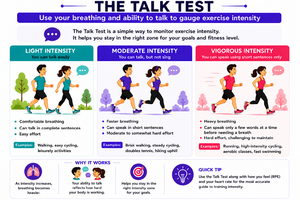
The talk testTalk test: at moderate intensity, a person can talk but not sing, while at vigorous intensity they can only say a few words before pausing for breath.[15][16]
Heart rate reserve: moderate intensity corresponds to roughly 40 to 59 per cent of heart rate reserve and vigorous intensity to 60 to 89 per cent.[17]
Note that heart rate is a less reliable guide to intensity in people taking beta-blockers, so perceived exertion and the talk test may be better choices for them. These methods are also easy for people to use at home.[18]
Just knowing these guidelines does not guarantee a person will become more active. Answering the following questions can help clinicians create an individualised programme that works for the person in front of them.
Can They Do It?
Chronological age is a poor indicator of what an older adult can do, so the assessment must consider current function.[1] Standardised tests provide a baseline for monitoring change. Some examples for older adults include:
It is also valuable to ask the person what they are finding hard now. Their answer will help identify functional areas to work on, and link the programme to goals that are important to them, such as getting out of the bath or keeping up with grandchildren.[1]
Is It Safe?
According to WHO, pre-exercise medical clearance is generally unnecessary. People who are not currently active but have no contraindications can start exercising and build up gradually, and those who already do regular moderate-intensity activity can progress gradually to vigorous activity.[8] Age alone is not a contraindication.[1] Placing unnecessary barriers in the way of activity can be counterproductive, because inactivity and deconditioning have consequences of their own.[23][24]
However, screening tools can help identify the people who do need medical clearance. The ACSM pre-participation screening algorithm, for example, is designed to detect people who may be at increased risk of a cardiac event during exercise.[25] In this algorithm, people who are physically inactive and have known cardiovascular, metabolic or renal disease, or signs or symptoms suggestive of these diseases, should obtain medical clearance before starting exercise of any intensity.[25] Signs and symptoms in the ACSM algorithm are chest, neck, jaw or arm pain or discomfort that may be ischaemic, shortness of breath at rest or on mild exertion, dizziness or syncope, orthopnoea or paroxysmal nocturnal dyspnoea, ankle oedema, palpitations or tachycardia, intermittent claudication, a known heart murmur, and unusual fatigue or breathlessness with usual activities.[25] Anyone who develops new symptoms as they increase their activity should also be reviewed by a medical provider.[8]
Clinicians should also be aware of any medications that affect heart rate, blood pressure, blood glucose or balance, as these can influence both exercise risk and how intensity is monitored.[26]
Will They Do It?
A well-designed programme will only be effective if the person takes part, so adherence needs to be considered from the start.[27][28] Common barriers among older adults include fear of falling or injury, pain, low motivation, cost, limited social support, poor access to facilities and environmental factors (e.g. uneven pavements, poor lighting, bad weather).[29]
Fear of falling can become self-reinforcing. A person who has fallen may walk less, become weaker, and lose confidence in their balance. This can lead them to walk even less. Advising this person to "move more" is unlikely to break this cycle. Graded exposure, appropriate balance and strength exercises and repeated successful experiences can rebuild confidence alongside physical capacity.[1][30]
How Will We Progress It?
ACSM advises that older adults who are deconditioned or have functional limitations should begin with light-intensity, short-duration activity, and progress according to tolerance and preference.[13] For an inactive person, "150 minutes a week" can sound overwhelming, whereas "a ten-minute walk after breakfast three days per week" may sound achievable as a starting point.[1]
Once the starting level feels manageable, the programme should be progressed so that improvements continue.[31] There are several ways to do this for each component. Aerobic activity can be progressed by increasing the duration, adding another day or increasing the intensity. Strength exercises can be made harder by adding repetitions, improving movement control or adding resistance, such as holding a weight. For sit-to-stands, lowering the chair height also increases the challenge. Balance exercises can be progressed by narrowing the base of support, reducing sensory input (e.g. closing the eyes), changing the surface, or increasing the speed or complexity of the task.[1]
Changing one variable at a time shows how the person responds to each change, and repeating the baseline tests periodically shows overall progress.[1]
Clinical tip: Start low and go slow when needed, but do not stay low forever. Adaptation continues only if the exercise stimulus keeps pace with the person’s improving capacity.[1]
Combining Components in a Single Session
Taken together, the guidelines may seem like a lot to fit into a week. However, aerobic, strength and balance training do not need to be done separately. WHO’s multicomponent recommendation already brings balance and strength training together, and all three can be included in the same session.[7]
↑ 10.010.1Wiedenmann T, Held S, Morat T, Rappelt L, Isenmann E, Berndsen E, et al. The effects of different resistance training modalities on muscle strength in community-dwelling older adults: a network meta-analysis. Gerontology. 2025;71(7):576-588.
↑Garber CE, Blissmer B, Deschenes MR, Franklin BA, Lamonte MJ, Lee IM, et al. American College of Sports Medicine position stand. Quantity and quality of exercise for developing and maintaining cardiorespiratory, musculoskeletal, and neuromotor fitness in apparently healthy adults: guidance for prescribing exercise. Med Sci Sports Exerc. 2011 Jul;43(7):1334-59.
↑ 25.025.125.2Riebe D, Franklin BA, Thompson PD, Garber CE, Whitfield GP, Magal M, Pescatello LS. Updating ACSM's recommendations for exercise preparticipation health screening. Med Sci Sports Exerc. 2015 Nov;47(11):2473-9.
↑Schlicht JA, Wingood M, Heled Y, Weitzel K, Rogers ME, Seffens PR. The physical activity vital sign for older adults: Time for an update. Journal of the American Medical Directors Association. 2024 Aug 1;25(8).