When refering to evidence in academic writing, you should always try to reference the primary (original) source. That is usually the journal article where the information was first stated. In most cases Physiopedia articles are a secondary source and so should not be used as references. Physiopedia articles are best used to find the original sources of information (see the references list at the bottom of the article).
If you believe that this Physiopedia article is the primary source for the information you are refering to, you can use the button below to access a related citation statement.
Bending, followed by twisting and turning, were the more commonly cited movements that caused back injuries.
Strains and sprains from lifting loads improperly or from carrying loads that are either too large or too heavy are common hazards associated with manually moving materials.
When using smart lifting practices, people are less likely to suffer from back sprains, muscle pulls, wrist injuries, elbow injuries, spinal injuries, and other injuries caused by lifting heavy objects[1].
The following principles of safe lifting should be covered whenever you treat a patient with Lower back pain.
Principles of Safe Lifting
Assess the immediate area and load to be lifted.
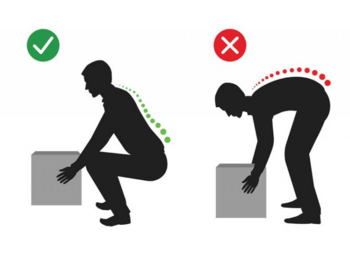
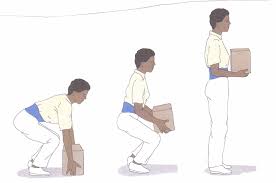
Bend the knees to lower the body to the level of the load.
Keep feet shoulder width apart to ensure a broad, stable base.
Keep the back straight (though not necessarily erect).
Use a firm, palmar grip.
Keep the arms close to trunk.
Keep the load / weight close to the Centre of gravity and within the Base of support.
Point / pivot the feet in the direction of the movement. Never rotate the trunk while lifting.
Lift using the strong muscles in the legs, rather than the postural muscles in the trunk.
If the load is too heavy for one person, wait until you can get help.
Important Things To Remember
Use mechanical means (e.g. hand trucks, pushcarts, etc.) when possible for heavier or awkward loads.
Easier and safer to push than to pull.
Keep loads as close to the body as possible and do not twist while lifting, carrying, or setting down a load. Nose, shoulders, hips, and toes should all be facing the same direction.
Minimize reaching.
Stoop or squat if the load is below you and use a ladder if it is too high.
As a general rule, bend at the knees, not the hips.
Get help when needed.
Plan ahead for all parts of the lift: lifting, carrying, and setting down.
Try to utilize proper handholds while lifting. If an item does not have a good handhold, think of ways to remedy this, such as placing the item in a container with good handholds, creating a safe and proper handhold with an appropriate tool, etc.
Use personal protective equipment where needed, such as gloves with good grip and steel-toed boots where appropriate.
Clear pathway before carrying, lifting, pushing or pulling.
Implement rest breaks and job rotation for frequent and/or heavy lifting.
Place items to be lifted within the “power zone”. ie close to the body, between the mid-thigh and mid-chest of the person doing the lifting. This is the area where the arms and back can lift the most with the least amount of effort.