When refering to evidence in academic writing, you should always try to reference the primary (original) source. That is usually the journal article where the information was first stated. In most cases Physiopedia articles are a secondary source and so should not be used as references. Physiopedia articles are best used to find the original sources of information (see the references list at the bottom of the article).
If you believe that this Physiopedia article is the primary source for the information you are refering to, you can use the button below to access a related citation statement.
The development of the International Classification of Functioning, Disability and Health (ICF) framework helped to transform patient care into a more holistic, patient-centred approach.[1] However, the use of ICF in rehabilitation remains limited.[2][3][4] The World Health Organization (WHO) Family of International Classifications (FIC) webpage is a powerful resource and educational tool for all information related to the ICF and other classifications.[5]
International Classification of Functioning, Disability and Health (ICF) - a core member of the WHO family of classifications. The ICF was developed to describe functioning and disability, and how a person's functioning relates to a dynamic interaction between health conditions and environmental and personal factors.[6]
International Classification of Diseases (ICD)- currently in its eleventh revision. It serves as "the main basis for comparability of statistics on causes of mortality and morbidity between places and over time".[7] The ICD-11 replaced the ICD-10 and had the following innovations:
Ability for online coding tool
Remote access to ICD-11 content and services
Enhanced capability to capture and combine clinically relevant characteristics of cases
International Classification of Health Interventions (ICHI) - belongs to the WHO family of classifications and was developed to standardise the collection and exchange of information on diagnosis, functioning and intervention for statistical and health care reimbursement purposes.[8][9] Procedures found in the ICHI include medical and surgical, rehabilitation, assistance with functioning, prevention and public health.[10] The ICHI was found to be adequate for the collection of international statistics.[11]
Other Classifications:
International Classification of Diseases for Oncology
International Classifications of Primary Care
Technical Aids for Persons with Disabilities
Others
Tab: International Classification of Functioning, Disability and Health (ICF)
ICF Home Page
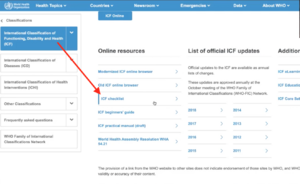
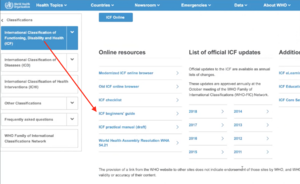
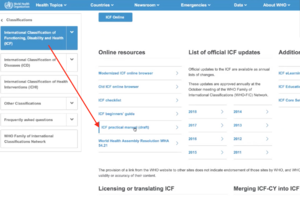
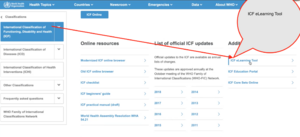
From the home page, click on the ICF tab (see image).
ICF Online
ICF Categories
Components include: Body functions, body structures, activities and participation, and environmental factors. Each component can be positive and negative.
Each component is comprised of various domains. These are sets of related physiological functions, anatomical structures, actions, tasks, areas of life, and external influences.
Categories (or units of classification) are included within each domain.
The following are examples of the components and their domains:
Component: Body Function / Domain: Sensory functions and pain
Component: Body Structure / Domain: Structures related to movement
Component: Activities and Participation / Domain: Community, social and civic life
Component: Environmental Factors / Domain: Support and relationships
ICF Qualifiers are numeric codes that are used to describe the extent of the functioning or disability in given category. They are coded as one or more numbers following a point (separator) after the code. The first number is a generic qualifier and the following numbers are the qualifiers for specific components.
Generic:
0 - no problem
1 - mild problem
2 - moderate problem
3 - severe problem
4 - complete problem
8 - not specified
9 - not applicable
Specific:
Qualifier to measure the localisation of the impairment
Qualifier to measure the extent to which an environmental factor acts as a facilitator or barrier (environmental factor qualifier)[6]
Example: Facilitator
+0 - no facilitator
+1 - mild facilitator
+2 - moderate facilitator
+3 - substantial facilitator
+4 - complete facilitator
+8 - not specified (the environmental factor is a facilitator, but there is insufficient information to quantify the extent of the facilitative impact)
Example: Barrier
0 - no barrier
1 - mild barrier
2 - moderate barrier
3 - severe barrier
4 - complete barrier
8 - not specified (the environmental factor is a barrier, but there is insufficient information to quantify the extent of the problem)
9 - not applicable
ICF coding example: d410.28 where d=component (Activities and Participation), 4=domain (Mobility), 10=second level category (changing body position), .2=qualifier (moderate difficulty), 8=capacity (not specified).[6]
Additional feature: Visualisation of the viewed items (see image on right). This feature helps users understand how everything is connected in the classification.
ICF-based instrument to be used along with the ICF full or short version to obtain and record information from an interview, medical record, direct observation, or direct conversation with a patient on the functioning and disability of an individual[12]
Can be used as a Patient Reported Outcome (PRO) measure
Functioning assessed with the ICF checklist can enable a better understanding of self-reported disability on a region-specific outcome measure[13]
ICF checklist can help to detect clinical and social problems experienced by patients with a work-related injury during rehabilitation and the return-to-work process[14]
The main components of the ICF checklist include:
Information about patient's demographics
ICF categories and domains with qualifiers
Open area for general and clinical notes and contextual information, including personal factors which are not coded in the classification
Development of the ICF core sets helped to decrease barriers to the use of the ICF framework in clinical practice and provide "a practical information platform for routinely collected data".[15] It contains a selection of ICF categories (set of codes) for specific health conditions, groups and/or settings.[16] These codes can be brief or comprehensive, and they help to produce a very specific ICF-based documentation form, as each user can choose what is relevant to his or her clinical practice.[5] ICF core sets are valid and relevant for patients and clinicians in specific rehabilitation settings.[17] The list of the code sets are as follows:
Generic
Rehabilitation
Environmental factors
Conditions:
Musculoskeletal
Cardiopulmonary
Neurological
Neurodevelopmental
Psychiatric
Other
ICF Research Branch
The ICF research branch is the entity that works with the WHO. Their mission is to "seek a better understanding of disability through multidisciplinary research".[18] The following items are housed on this website:
↑Almutairi NA, Almarwani MM. Knowledge and use of the International Classification of Functioning, disability and health (ICF) and ICF Core Sets for musculoskeletal conditions among saudi physical therapists. Musculoskelet Sci Pract. 2022 Aug;60:102573.
↑Khuman R, Patel R. Knowledge and use of International Classification of Function (ICF) Core Sets in Clinical Practice by Indian Physiotherapist. Conference paper, 2019
↑ 5.05.1Saleeby P. ICF Educational and Clinical Resources Course. Physiopedia 2022
↑Donada M, Della Mea V, Cumerlato M, Rankin N, Madden R. A System for Supporting Development and Update of the International Classification of Health Interventions (ICHI). Stud Health Technol Inform. 2018;247:895-899
↑Zaiss A, Dauben HP. ICHI – International Classification of Health Interventions : Prozedurenklassifikation im Spagat zwischen Statistik und Abrechnung [ICHI-International Classification of Health Interventions : A balancing act between the demands of statistics and reimbursement]. Bundesgesundheitsblatt Gesundheitsforschung Gesundheitsschutz. 2018 Jul;61(7):778-786. German.
↑Fung KW, Xu J, Ameye F, Burelle L, MacNeil J. Evaluation of the International Classification of Health Interventions (ICHI) in the coding of common surgical procedures. Journal of the American Medical Informatics Association, 2022, 29 (1):43–51.
↑Soberg HL, Engebretsen KB, Juel NG, Roe Y, Brox JI. Associations between shoulder pain and functioning on the ICF checklist and the disabilities of the arm, shoulder, and hand scale–a cross-sectional study. Disability and Rehabilitation. 2020 Oct 8;42(21):3084-91.