
Humpty Dumpty Falls Prevention Scale
Original Editor - Momina Khalid
Top Contributors - Janine van Dyk, Pacifique Dusabeyezu, Momina Khalid and Ewa Jaraczewska
Top Contributors - Janine van Dyk, Pacifique Dusabeyezu, Momina Khalid and Ewa Jaraczewska
Purpose
The Humpty Dumpty Falls Scale (HDFS), is a seven-item assessment scale used to document age, gender, diagnosis, cognitive impairments, environmental factors, response to surgery/sedation, and medication usage, it is one of several instruments developed to assess fall risk in pediatric patient. [1]
Factors
Factors that may increase a child’s risk of a fall include:
- Pre-school age
- Disabilities or limited mobility
- Neurological diagnosis
- Psychological and/or behavioral disorders
- Confusion, delirium or neurological impairment
- Limited or difficult communication abilities
- Poor vision
- Use of assistance technology
- Following anesthesia or sedation [2]
Technique
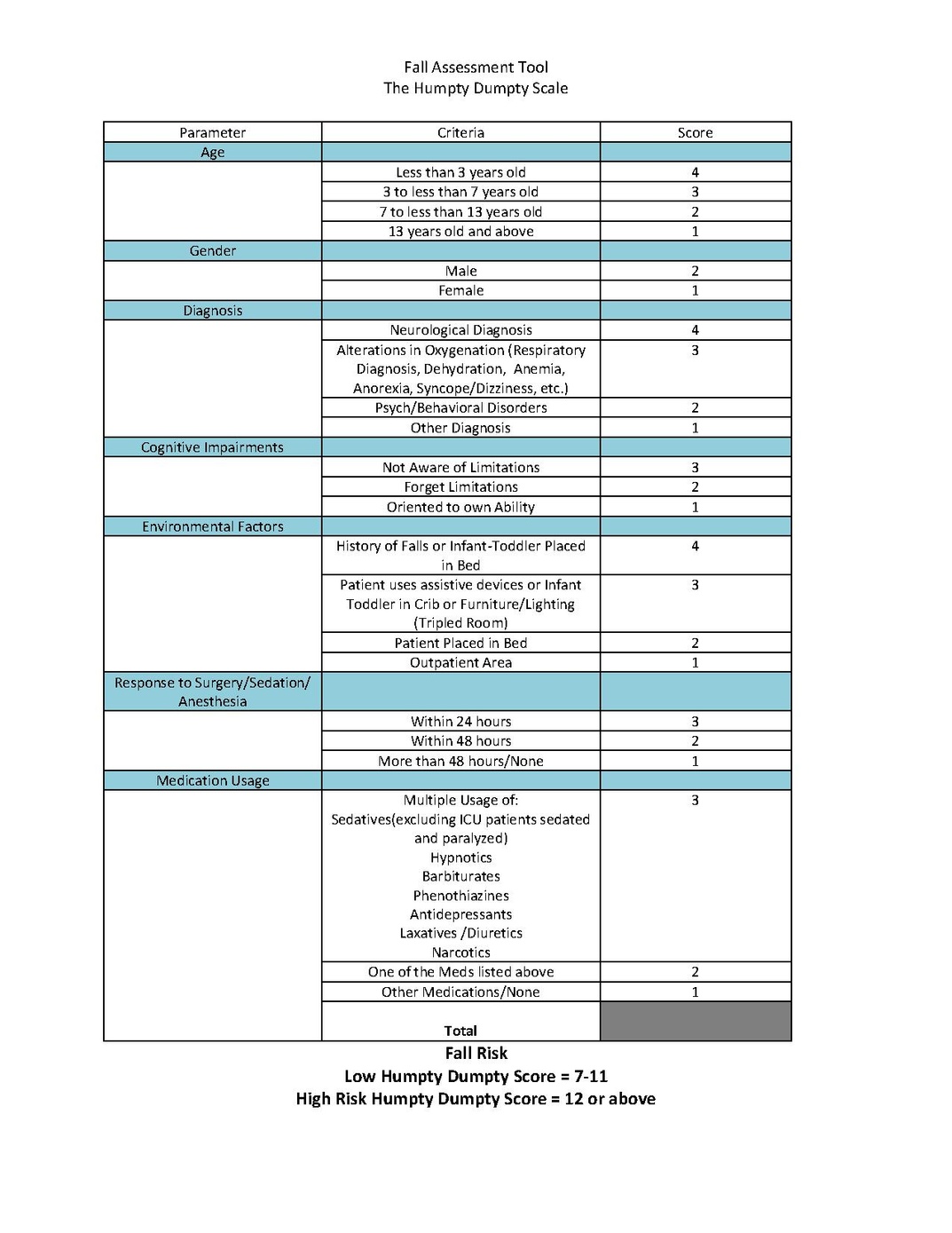
Score
With a score of 7-11 it is consider a low risk, and with a score of 12 or above the risk is high. [3]
Evidence
The modified scale demonstrated a sensitivity of 84% and specificity of 57%. [2]
Resources
Paediatric fall and prevention program.
References
- ↑ Bj P, Ls H, D C, Dm J. Clinical Relevance of the Humpty Dumpty Falls Scale in a Pediatric Specialty Hospital [Internet]. Pediatric nursing. 2014.
- ↑ 2.0 2.1 Sarik DA, Hill-Rodriguez D, Gattamorta KA, Gonzalez JL, Esteves J, Zamora K, et al. The revised Humpty Dumpty Fall Scale: An update to improve tool performance and predictive validity. Journal of Pediatric Nursing. 2022 Nov;67:34–7.
- ↑ Kejururawatan B. BKJ-BOR-PPK-Fall 6 Pind 2/2018 HUMPTY DUMPTY FALL RISK ASSESSMENT SCALE CHART(PAEDIATRIC) [Internet]. [cited 2024 Aug 15]. Available from: https://hq.moh.gov.my/nursing/wp-content/uploads/2019/03/BKJ-BOR-PPK-Fall-6-Pind-2-2018-04032019.pdf