
Emerging Trends and Challenges in Global Health
Top Contributors - Jess Bell and Ewa Jaraczewska
Introduction
Our concept of global health is continuing to evolve. Global health has its roots in "tropical medicine", and was closely connected with the legacy of colonialism and imperialism (this has been termed Global Health 1.0). The focus then shifted to a model where wealthier countries helped those with less (i.e. Global Health 2.0). Our current model, Global Health 3.0, focuses on collective actions to manage shared responsibilities and risks.[1][2] When considering global health, it is important to remember that many interconnected systems contribute to health equity or inequality, including the environment and climate, economics, food, class or social position and urbanisation.
Emerging Trends in Global Health
While epidemics and infectious diseases continue to pose threats to health systems and population health worldwide, non-communicable diseases (NCDs) account for 74% of all deaths globally.[3] Seven of the top ten leading causes of death globally are NCDs.[4]
"Causes of death are not uniformly distributed between populations; rather, large variability in the leading causes often reflects important social and geographical differences."[5]
The following images illustrate the leading causes of death in 2000 and 2019 across countries with different income levels. You will see that there are key differences across countries, with lower-income countries experiencing a higher death rate from communicable diseases.
-
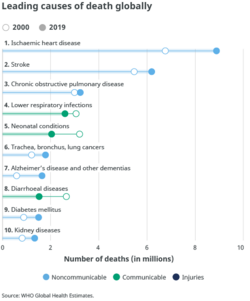 WHO leading causes of death globally
 -
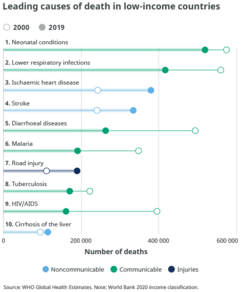 WHO leading causes of death in low-income countries


-
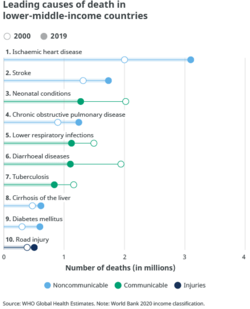 WHO leading causes of death in lower-middle-income countries
 -
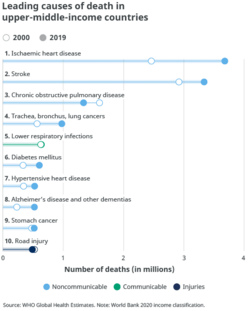 WHO leading causes of death in upper-middle-income countries


Please note that these figures are pre-COVID-19 pandemic. In 2021, COVID-19 was the second leading cause of death globally, replacing stroke.[4][5] However, even during the COVID-19 pandemic, NCDs caused 78% of all non-COVID deaths.[6]
Epidemiological Transition
The epidemiological transition from communicable and infectious diseases to NCD health burdens varies across regions and countries. This shift is complex, but can be attributed to a range of factors, including changes in socioeconomic status, industrial and technological advances and changes in our physical and social environments.
An epidemiological transition model "describes the changing relationship between humans and their diseases":[7]
- the first transition was around 10,000 YBP (years before present) when there was a shift to agriculture. This led to "a pattern of infectious and nutritional diseases still evident today"[7]
- the second transition occurred during the last 200 years, where there was a decrease in the number of infectious diseases and an increase in non-communicable or chronic diseases[7]
- it is argued that the global population is currently experiencing a third epidemiological transition, one that is characterised by new, re-emerging and antibiotic-resistant diseases in addition to the burden of non-communicable diseases and injuries
If you would like further information on the third epidemiological transition, please see:
- Harper K, Armelagos G. The changing disease-scape in the third epidemiological transition. International journal of environmental research and public health. 2010;7(2):675-97.
- Barrett R, Kuzawa CW, McDade T, Armelagos GJ. Emerging and re-emerging infectious diseases: the third epidemiologic transition. Annual review of anthropology. 1998;27(1):247-71.
Non-communicable Diseases
NCDs are defined as chronic diseases which are not passed from person to person. The four main groups of NCDs are:
- cardiovascular diseases
- cancer
- chronic respiratory diseases
- diabetes
These four groups of conditions cause over 80% of all premature NCD-related deaths.[3]
Non-communicable Disease Risk Factors
Risk factors such as physical inactivity, unhealthy diets, tobacco use, alcohol use and air pollution are linked to an increasing risk of developing NCDs.[3][8]
These risk factors are commonly referred to as modifiable risk factors - i.e. they are framed as factors that individuals can control:
- for example: physical inactivity is considered a modifiable risk factor, but physical activity trends are declining globally, particularly among young people. In 2016, 81% of students aged between 11 and 17 years were not meeting recommended physical activity levels.[9]
However, it is critical to reflect on how power, privilege and structural determinants contribute towards the inequitable distribution of these risk factors,[10] which ultimately results in non-communicable disease inequities in certain equity-deserving communities. If you would like to refresh these topics, please see: Overview of Global Health.
Using our example of decreasing levels of physical activity, various contributing factors may mean that physical inactivity is more prevalent in certain communities. These factors include, but are not limited to:
- socioeconomic status, leading to decreased access to physical activity opportunities
- gender equality and norms
- technology and social media
- road safety and infrastructure
- healthy built environments
- accessible green spaces for all abilities
- social and cultural factors
Further downstream in the health system, accessing rehabilitation services for individuals experiencing NCDs can also be challenging. For example, residents in remote communities may have higher out-of-pocket costs for transportation, need to take time off work, or simply not be able to access services, leading to poorer health outcomes.
"When applying a global health perspective, I challenge rehabilitation professionals to increase their understanding of the underlying historical and systemic drivers of these risk factors. This can enable rehabilitation professions to continue to provide health education and interventions at an individual level, while advocating and promoting upstream interventions." -- Derek Lai
The following articles discuss specific structural factors and NCDs in different global contexts:
- Physical inactivity, built environments, obesity within communities of colour:
- Lovasi GS, Hutson MA, Guerra M, Neckerman KM. Built environments and obesity in disadvantaged populations. Epidemiol Rev. 2009;31:7-20.
- Corporation and commercial determinants on unhealthy commodities:
- Mialon M. An overview of the commercial determinants of health. Global Health. 2020 Aug 17;16(1):74.
- Air pollution exposure and discriminatory policies within housing in the United States:
- Lane HM, Morello-Frosch R, Marshall JD, Apte JS. Historical redlining is associated with present-day air pollution disparities in U.S. cities. Environ Sci Technol Lett. 2022 Apr 12;9(4):345-50.
- Climate change and socioeconomic determinants:
- Savage A, Bambrick H, McIver L, Gallegos D. Climate change and socioeconomic determinants are structural constraints to agency in diet-related non-communicable disease prevention in Vanuatu: a qualitative study. BMC Public Health. 2021 Jun 26;21(1):1231.
- For further information on NCDs, please see:
- World Health Organization, Noncommunicable diseases
- Non-Communicable Diseases
- For further information on communicable diseases, please see:
Climate Change and Global Health
"The multiple and simultaneously rising risks of climate change are amplifying global health inequities and threatening the very foundations of human health."[11]
The impact of climate change on population health is widely known and understood.[11][12] High temperatures, extreme drought, water insecurity, etc. from climate change have wide-reaching effects.[11]
Furthermore, as illustrated in the following links, climate impact is not distributed equally; nations that have contributed the lowest emissions are experiencing the most impact. This disproportionate burden is thrust onto countries with fewer resources to mitigate the effects of climate change:
- World Mapper: CO2 emissions 2020
- World Mapper: Ecological footprint of consumption 2019
The following videos highlight some of the impacts of climate change on human health:
As rehabilitation professionals, climate change impacts our work in many ways depending on where we live. A few examples are listed below:
- air pollution and wildfires exacerbate respiratory conditions[14]
- heat waves and rising temperatures affect cardiorespiratory conditions and physical activity levels[15][16]
- our populations most vulnerable to extreme heat exposure (i.e. adults aged more than 65 years and infants aged less than 1 year) now experience "twice as many heatwave days as they would have experienced in 1986–2005"[11]
- increased injury rates from motor vehicle accidents, falls and extreme weather events (e.g. floods, storms, changes in temperature etc.)[17]
- climate change affects the prevalence of vector-borne diseases,[18] and associated neurological and musculoskeletal conditions
If you are interested in learning more, or being involved in the intersection of the environment and physiotherapy, you might like to read more about the Environmental Physiotherapy Association (EPA). The EPA is an international network of physiotherapists that explores meaningful ways to contribute towards environmentally responsible physiotherapy practice.
The following resource is also useful, but please note that it is not freely available:
- Stanhope J, Maric F, Rothmore P, Weinstein P. Physiotherapy and ecosystem services: improving the health of our patients, the population, and the environment. Physiother Theory Pract. 2023 Feb;39(2):227-40.
The Role of Rehabilitation Professionals Within Emerging Trends
In addition to continuing to increase the accessibility and affordability of rehabilitation services in communities, it is important to look at the role of rehabilitation professionals in addressing the risk factors of non-communicable diseases.
Promoting physical activity is one area where rehabilitation professionals are well-positioned to have an impact. As discussed, physical activity is shown to prevent non-communicable diseases, improve mental wellness, contribute to reducing carbon emissions and increase social capital.
In 2018, the World Health Organization released their Global Action Plan for Physical Activity 2018-2030 "More Active People for a Healthier World". This global action plan is targeting a 15% reduction in physical inactivity in adolescents and adults by 2030. Their high-level objectives are to:[19]
- create active societies
- create active environments
- create active people
- create active systems
This framework highlights that promoting physical activity requires a systems-wide framework, involving partners across multiple sectors, including health, urban design, transportation, sports and recreation. Strategies involve actions on individual, community and societal levels, including:[19]
- building physical activity programmes for different groups
- encouraging physical activity in advocacy and policy-setting environments, such as neighbourhoods and cities
These actions should aim to address underlying causes that have led to health and social inequalities.[19]
This framework suggests several pathways where rehabilitation professionals can have a role, such as:[19]
- promoting active mobility (e.g. walking, cycling, rolling), including safe, inclusive and accessible modes of transportation that increase physical activity while reducing emissions
- supporting the framework’s objective of increasing physical activity for all people of all abilities across the lifespan in various settings (e.g. health settings, community venues, family environments, schools and workplaces)
- providing training for professionals within or outside the healthcare sector to increase the physical activity levels of all community members, and ensuring that these physical activity experiences are culturally appropriate
References
- ↑ Canadian Institutes of Health Research. Global Health 3.0. CIHR's Framework for Action on Global Health Research 2021-2026, 2021.
- ↑ Physiopedia, Overview of Global Health.
- ↑ 3.0 3.1 3.2 World Health Organization. Noncommunicable diseases. Available from: https://www.who.int/news-room/fact-sheets/detail/noncommunicable-diseases (accessed 7 August 2024).
- ↑ 4.0 4.1 World Health Organization. The top 10 causes of death. Available from: https://www.who.int/news-room/fact-sheets/detail/the-top-10-causes-of-death (accessed 7 August 2024).
- ↑ 5.0 5.1 GBD 2021 Causes of Death Collaborators. Global burden of 288 causes of death and life expectancy decomposition in 204 countries and territories and 811 subnational locations, 1990-2021: a systematic analysis for the Global Burden of Disease Study 2021. Lancet. 2024 May 18;403(10440):2100-2132. Erratum in: Lancet. 2024 May 18;403(10440):1988.
- ↑ World Health Organization. COVID-19 eliminated a decade of progress in global level of life expectancy. Available from: https://www.who.int/news/item/24-05-2024-covid-19-eliminated-a-decade-of-progress-in-global-level-of-life-expectancy (accessed 11 August 2024).
- ↑ 7.0 7.1 7.2 Harper K, Armelagos G. The changing disease-scape in the third epidemiological transition. International journal of environmental research and public health. 2010;7(2):675-97.
- ↑ Andrade CAS, Mahrouseh N, Gabrani J, Charalampous P, Cuschieri S, Grad DA, et al. Inequalities in the burden of non-communicable diseases across European countries: a systematic analysis of the Global Burden of Disease 2019 study. Int J Equity Health. 2023 Jul 28;22(1):140.
- ↑ Guthold R, Stevens GA, Riley LM, Bull FC. Global trends in insufficient physical activity among adolescents: a pooled analysis of 298 population-based surveys with 1·6 million participants. Lancet Child Adolesc Health. 2020 Jan;4(1):23-35.
- ↑ Manderson L, Jewett S. Risk, lifestyle and non-communicable diseases of poverty. Global Health. 2023 Mar 2;19(1):13.
- ↑ 11.0 11.1 11.2 11.3 Romanello M, Napoli CD, Green C, Kennard H, Lampard P, Scamman D, et al. The 2023 report of the Lancet Countdown on health and climate change: the imperative for a health-centred response in a world facing irreversible harms. Lancet. 2023 Dec 16;402(10419):2346-94.
- ↑ Magnano San Lio R, Favara G, Maugeri A, Barchitta M, Agodi A. How antimicrobial resistance is linked to climate change: an overview of two intertwined global challenges. Int J Environ Res Public Health. 2023 Jan 17;20(3):1681.
- ↑ Duke University. Understanding How Climate Change Impacts Human Health. Available from: http://www.youtube.com/watch?v=T7fRYQeOS18 [last accessed 12/08/2024]
- ↑ Tran HM, Tsai FJ, Lee YL, Chang JH, Chang LT, Chang TY, et al. The impact of air pollution on respiratory diseases in an era of climate change: A review of the current evidence. Sci Total Environ. 2023 Nov 10;898:166340.
- ↑ Abrignani MG, Lombardo A, Braschi A, Renda N, Abrignani V. Climatic influences on cardiovascular diseases. World J Cardiol. 2022 Mar 26;14(3):152-69.
- ↑ Bernard P, Chevance G, Kingsbury C, Baillot A, Romain AJ, Molinier V, et al. Climate change, physical activity and sport: A systematic review. Sports Med. 2021 May;51(5):1041-59.
- ↑ Hou K, Zhang L, Xu X, Yang F, Chen B, Hu W. Ambient temperatures associated with increased risk of motor vehicle crashes in New York and Chicago. Sci Total Environ. 2022 Jul 15;830:154731.
- ↑ Socha W, Kwasnik M, Larska M, Rola J, Rozek W. Vector-borne viral diseases as a current threat for human and animal health-one health perspective. J Clin Med. 2022 May 27;11(11):3026.
- ↑ 19.0 19.1 19.2 19.3 Global action plan on physical activity 2018–2030: more active people for a healthier world. Geneva: World Health Organization; 2018.