
Home-Based Rehabilitation Education and Training Following Knee Arthroplasty
Original Editor - Stacy Schiurring
Top Contributors - Stacy Schiurring and Jess Bell
Why Spend Time on Education After Knee Arthroplasty?
Structured education programmes can significantly improve patient outcomes following knee arthroplasty. Research shows that knee arthroplasty education programmes are most effective when they address pain management, mobility and exercise. They will ideally be multidisciplinary and should target affective and psychomotor learning domains to improve patients' attitudes, beliefs, behaviours, and practical skills.[1]
Education can be delivered both preoperatively and postoperatively in a variety of ways, including oral instructions, written materials, videos, and group sessions.[1] A 2022 study[2] found that patients who participated in preoperative education experienced shorter hospital stays and had significantly improved physiotherapy performance (e.g. greater walking distance and improved knee flexibility).[2]
Rehabilitation professionals are well-positioned to deliver these programmes due to their knowledge of movement science, joint biomechanics, and functional recovery. They can address both the physical and functional challenges patients face during recovery, including pain, mobility limitations, and activity restrictions, as well as complications such as stiffness, muscle weakness, and reduced range of motion (ROM), providing patients with evidence-based strategies for optimal recovery.
Home-Based Rehabilitation Education Topics
Home-based rehabilitation education topics following knee arthroplasty can be wide-ranging, from pain management to home safety. These topics will be explored in more detail below. Some topics, such as pain and oedema management, are discussed in relation to several interventions.
Continuous Passive Motion
A continuous passive motion (CPM) machine is a motorised medical device that provides gentle and constant passive range of motion (PROM) to a joint. The aim of CPM after knee arthroplasty is to (1) improve postoperative stiffness and scar formation, (2) maintain or improve postoperative knee ROM, (3) and reduce pain.[3] CPM has been incorporated into postoperative knee arthroplasty protocols for decades. However, there is a lack of evidence on the benefits of its use, including in terms of functional outcomes and improvements in ROM,[4] joint stiffness and/or pain.[5][6] The use of CMP is surgeon-specific, but patient tolerance must be considered when using a CPM machine.
Therapy protocol: While there is no standard CPM protocol,[7] CPM orders typically specify several key parameters, such as: (1) duration of use, including how many hours per day, and for how many weeks the device should be used; (2) target flexion and extension ROM, although the starting ROM depends on the patient tolerance (NB: full extension is typically written as 0° flexion on a CPM machine); (3) speed, which is usually set at 1-2 cycles through the specified ROM per minute;[8] and (4) "hold" times at the end ranges of motion (not included in all instructions). CPM settings can be adjusted or progressed based on the patient's tolerance and patients can stop the CPM at any time using a push button. CPMs can be used in combination with pain and oedema management strategies, such as medication and cryotherapy.
CPM machine set-up: A knee CPM machine should be adjusted to best fit the length of the patient's lower leg and thigh. Their ankle should also sit at a comfortable resting angle in the machine. For optimal comfort and effective passive ROM: (1) ensure that the patient's knee joint lines up with the CPM machine's flexion (or hinge) point; and (2) make sure the patient's hip is positioned so that the patient's knee points up toward the ceiling.


The following optional video demonstrates how to set up a CPM machine for a patient following knee arthroplasty:
For more in-depth information about CPM machines, please see this optional article.
Compression
Compression therapy is the application of external pressure (e.g. through graduated compression stockings or bandages) to improve circulation, decrease oedema and inflammation, and improve pain and knee stability.[10] Research suggests that compression therapy is useful in oedema management.[11] When compression is combined with cryotherapy, patients have less oedema, report less pain, and demonstrate improved functional ability.[12] Similarly, when compression is combined with elevated positioning, patients have less oedema and improved ROM.[13]
Knee- or thigh-length compression stockings are usually recommended acutely after surgery, with thigh-length stockings being preferred.[14] Later in recovery, some patients may benefit from the use of a knee sleeve as it provides continued mild compression and tactile cues for stability. The benefits of compression therapy are limited by patient compliance with their wearing schedule and proper donning of the stockings (see below).
Therapy protocol: Patients are typically encouraged to wear compression stockings as much as possible, especially when they are out of bed with their surgical limb in a dependent position. Wearing time is gradually reduced over time.[10]
Education topics to cover include: (1) how to don and doff compression stockings, including how to use a sock aid; (2) advice to don stockings with the surgical limb elevated. This should ideally be done first thing in the morning before the patient has had the surgical limb in a dependent position; (3) how to check for and avoid wrinkles in stockings and folding the stocking over; pressure is increased in areas of folding, which puts the patient at risk of pressure injuries.
The following optional video demonstrates different ways to don compression stockings:
For more in-depth information on compression therapy, please see this optional article.
Cryotherapy
Cryotherapy is the application of cold over the knee arthroplasty surgical site. After knee arthroplasty, it is commonly applied via ice packs, commercial cold packs, and specialised devices, such as the CryoCuff, which provides continuous cold and pressure via a motorised pump. Cryotherapy works through several interconnected physiological mechanisms to reduce pain, oedema, and inflammation following injury or surgery.
The effectiveness of cryotherapy depends on the method used, duration of application, temperature of the cold source, and the depth of subcutaneous fat.[16] Research shows cryotherapy is a valid and beneficial modality for improving pain (although this is not always statistically significant[17]), oedema, inflammation, and knee mobility following knee arthroplasty in the acute phase of healing. There is less evidence to support its use after the initial stage of surgical recovery.[17][18][19] Research suggests that combining cryotherapy with compression provides improved oedema management, circulation, and overall patient comfort.[16]
Therapy protocol: The most evidence-supported approach appears to be intermittent cryotherapy applied in 15-20 minute sessions, multiple times per day (typically 3-6 times) during the first week postoperatively.[19] [20] However, there is no consensus regarding optimal parameters such as timing, temperature, frequency, and duration. This indicates that while cryotherapy is beneficial, the specific protocols vary significantly across studies.[20]
For more in-depth information on cryotherapy, please see this optional article.
Energy Conservation
Energy conservation encompasses a wide range of techniques that aim to help patients manage and optimise their level of fatigue and pain over the course of a day.[21] Energy conservation techniques are valuable in many rehabilitation settings and situations, including for patients following knee arthroplasty. The overall principles of energy conservation can be summarised using the six "Ps":[22]
- Prioritise: identify the most important activities and tasks, focusing on those that are essential for daily living and well-being.
- Plan: develop a schedule or plan for the day, breaking down tasks into manageable steps and allowing for rest breaks.
- Pace yourself: take your time, avoid rushing, and include rest periods throughout activities.
- Positioning: maintain good posture, avoid excessive bending or reaching, and use assistive devices to minimise physical strain.
- Positive attitude: focus on what you can do today and the progress you have made, celebrate even small successes.
- Pursed lip breathing: practise pursed lip breathing to improve airflow and reduce breathlessness, especially for those with pre-existing breathing conditions. To learn more about pursed lip breathing, please see this optional article.
For more in-depth information about specific energy conservation techniques, please see this optional article.
Exercise/Mobility Self-Efficacy
Exercise self-efficacy is a person's belief in their ability to successfully engage in and maintain a regular exercise routine. This can be expanded to include beliefs about mobility ability for patients following knee arthroplasty. Participating in regular exercise and mobility (e.g. therapy and activities of daily living) helps improve strength, functional ability, and endurance, and reduce pain.[23]
A 2022 qualitative study[24] examined factors that influence exercise adherence following total knee arthroplasty and identified six interconnected themes. Rehabilitation professionals can adapt education and training to account for these factors.[24]
- Self-regulation: includes the patient's ability to plan and manage their exercise routines. Clinical examples include: encouraging patient-centred goals based on their interests, assisting patients to make a daily schedule or set alarms to perform their exercises, timing therapy activities around a pain medication schedule, and home modification recommendations to improve a person's ability to mobilise through their home.
- Knowledge of exercise: relates to a person's understanding of the benefits of exercise and proper techniques. To check a patient's knowledge, clinicians can have a patient explain how exercises or mobility make them feel stronger and demonstrate exercises or mobility teachings back to the therapist. The patient can also teach this information to their care provider under the therapist's supervision.
- Postoperative complications: include any surgical complications that can impede exercise. This can include a lack of understanding of the use of cryotherapy, positioning, mobility, and pain medications.
- Comorbidities: these are other health conditions that can have an impact on exercise capacity.
- Social support: includes family and community encouragement during recovery. Rehabilitation professionals can provide information on local exercise or support groups the patient can access either virtually or, as they progress their rehabilitation, in-person. Family and friends can be included in exercise and mobility training.
- Lack of guidance: includes insufficient direction from rehabilitation providers on exercise progression. Methods to ensure adequate guidance include providing exercise and mobility handouts and recording exercises or training sessions on the patient's mobile phone for later review.
Referrals to psychology can be required if the patient is demonstrating pain catastrophising (the tendency to magnify the threat of pain and feel helpless when experiencing pain) and/or kinesiophobia (fear of movement or re-injury). A 2023 study[25] found that these tendencies were significantly associated with poor exercise adherence in patients following a total knee arthroplasty. Importantly, this study found that these negative psychological responses did not directly impact exercise behaviour alone, but rather worked indirectly through their effect on exercise self-efficacy. These findings suggest that when patients catastrophise about their pain or develop fears about movement, their confidence in exercising diminishes, which can lead to reduced exercise adherence.[25]
Positioning
Flexion contracture prevention: Understandably, patients tend to seek a position of comfort following knee arthroplasty, which is often knee flexion (e.g. they place a pillow under their knee when in bed). To prevent flexion contractures, patients should avoid prolonged positioning in excessive flexion, such as sitting in low chairs or deep sofas that force the knee beyond comfortable flexion angles. When resting, whilst some flexion may be beneficial initially for oedema control, patients should balance this with periods of full extension to maintain range of motion. The key is achieving a balance between short-term positioning for symptom management and long-term positioning strategies that prevent contracture development and promote optimal functional outcomes.[26] Rehabilitation professionals can provide education on: (1) elevating seating surfaces, by adding a firm cushion to a chair or couch or utilising a bedside commode or elevated toilet seat during toileting; (2) avoiding placing a pillow under the surgical knee while supine; (3) appropriate exercises to promote knee extension (e.g. quadriceps sets, terminal knee extension).
Leg elevation for oedema management: Leg elevation is an evidence-based intervention for managing postoperative oedema following knee arthroplasty by promoting venous return. Optimal positioning involves lying flat with the legs elevated approximately 6 inches above heart level. Being consistent with elevation above the heart is essential for reducing postoperative oedema. Regular elevation throughout the day, combined with appropriate support surfaces (e.g. pillows or wedges) to maintain proper positioning, can significantly reduce postoperative oedema and associated pain while promoting optimal healing conditions.[27]
Please watch these two optional videos if you would like further information on positioning following knee arthroplasty. The video on the left discusses positioning and elevating the surgical limb while at rest while the video on the right discusses postoperative sleeping positions.
Weight-bearing: Some patients may have postoperative weight-bearing limitations in place if there have been surgical complications (e.g. non weight-bearing, partial weight-bearing), but this is rare. However, weight-bearing asymmetry is commonly seen following knee arthroplasties. Weight-bearing asymmetry is the unequal distribution of weight or force between the affected (surgical) and unaffected (non-surgical) limbs during activities like standing, walking, or transfers. After knee arthroplasty, weight-bearing asymmetry can be caused by factors such as pain, muscle weakness, and postoperative leg length discrepancies.[30] Normalising the compensatory movement patterns resulting from weight-bearing asymmetry is often a primary goal of physiotherapists and occupational therapists.
Skin and Incision Line Care
Incision line care and monitoring: The location of a patient's incision line after knee arthroplasty depends on which surgical technique was used. Patients may also have small wounds or incision lines around the primary incision line if drains (e.g. Jackson Pratt or JP drain) were placed to assist with post-surgical drainage and oedema. These drains are typically removed before discharge home.[31] Surgeons issue wound care instructions after hospital discharge or after the surgical follow-up appointment. When appropriate, the surgeon or wound care specialist will remove any stitches, sutures, or staples used to close the surgical site. Some surgeons utilise a medical grade glue or "liquid stitches" to close the surgical site, which dissolve over time.
-
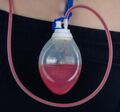 Example of a JP drain in place.
 -
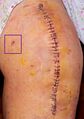 Post-surgical incision line with staples in place. The dark purple box shows the location of a post-surgical drain that has been removed.
 -
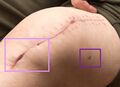 Incision line after staples have been removed. The light purple box shows two areas of incision line dehiscence, and the dark purple box shows the location of a post-surgical drain.
 -
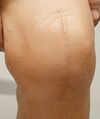 Healed incision line after knee arthroplasty surgery.
_drain.jpeg)


For the first few days after surgery, a healthy incision line may be red, oedematous, and may potentially have bruising around the surgical area. As the incision heals, there will be a decrease in periwound (the area directly around the wound) redness, oedema, and bruising. It is important to monitor the appearance of the incision line itself—it should remain closed (approximated) with no noticeable openings or gaps. It is normal to note a small amount of bloody, clear, or blood-tinged drainage the first few days after surgery. If drainage is present, it should gradually decrease.[31][32]
Monitoring an incision line includes watching for signs and symptoms of infection, such as: (1) increased redness or a hardening (induration) that spreads beyond the incision line periwound, (2) the wound area is hot to the touch and/or tender, (3) increased pain, (4) cloudy, yellow, green, or brown drainage (purulent drainage), (5) a foul odour coming from the wound. Other signs and symptoms of a more serious infection include (6) fever above 37.8 °C (100°F) which could be accompanied by chills, (7) nausea and/or vomiting, and (8) the incision line opening up (dehiscence). The surgeon should be notified if any of these signs and symptoms are found during a therapy visit.[33]
Scar massage: An incision becomes a scar through a complex four-phase healing process which includes (1 haemostasis, (2) inflammation, (3) proliferation, and (4) maturation (remodelling phase). Following surgical closure, the wound initially clots and forms granulation tissue during the inflammatory phase. The injured tissue is repaired by collagen deposition, collagen remodelling and eventual scar formation. Maturation starts around week 3 and can last up to 12 months. During this time, the collagen fibres form into small parallel bundles. These bundles ultimately determine the final appearance of the scar. Scar massage should begin approximately 3-8 weeks after knee arthroplasty surgery.[32]
Scar massage techniques involve the application of gentle direct pressure to the area around and over the scar to promote healing and smoothing out of the incision. This is done using the finger pads of the first and second fingers, or the thumb. Regular massage helps break down adhesions and improve scar pliability. Ideally, scar massage should be performed 1 to 2 times per day for 5-10 minutes. There are three main types of motions used during scar massage:[34]
- Linear motions are drawn along the length of the scar and are useful to reduce skin tension
- Circular motions are used to break down fibrous tissue and promote better alignment of underlying soft tissue
- Cross-friction motions are made perpendicular to the scar to break down adhesions and promote tissue mobility
Using a mild unscented lotion is helpful to reduce friction over the scar site during the massage, and provide extra hydration to the area.[34]
Please watch this optional video if you would like to see a demonstration of different types of scar massage. It also provides an excellent example of adhesions and decreased skin mobility after knee arthroplasty surgery.
Resources
Clinical Resources
- Energy Conservation (Elsevier): provides information on energy conservation education in a rehabilitation context
Care Provider Resources and Information
- Preparing for and Recovering After Hip or Knee Replacement Surgery (Agency for Healthcare Research and Quality): contains useful information on home set-up and equipment recommendations
References
- ↑ 1.0 1.1 Kim TW, Kim SH. Effectiveness of patient education on total knee arthroplasty: A systematic review and meta‐analysis. Journal of clinical nursing. 2023 Jun;32(11-12):2383-98.
- ↑ 2.0 2.1 Jones ED, Davidson LJ, Cline TW. The effect of preoperative education prior to hip or knee arthroplasty on immediate postoperative outcomes. Orthopaedic Nursing. 2022 Jan 1;41(1):4-12.
- ↑ Harvey LA, Brosseau L, Herbert RD. Continuous passive motion following total knee arthroplasty in people with arthritis. Cochrane Database of Systematic Reviews. 2014(2).
- ↑ Yang X, Li GH, Wang HJ, Wang CY. Continuous passive motion after total knee arthroplasty: a systematic review and meta-analysis of associated effects on clinical outcomes. Archives of physical medicine and rehabilitation. 2019 Sep 1;100(9):1763-78.
- ↑ Gil-González S, Barja-Rodríguez RA, López-Pujol A, Berjaoui H, Fernández-Bengoa JE, Erquicia JI, Leal-Blanquet J, Pelfort X. Continuous passive motion not affect the knee motion and the surgical wound aspect after total knee arthroplasty. Journal of Orthopaedic Surgery and Research. 2022 Jan 15;17(1):25.
- ↑ Richter M, Trzeciak T, Kaczmarek M. Effect of continuous passive motion on the early recovery outcomes after total knee arthroplasty. International Orthopaedics. 2022 Mar 1:1-5.
- ↑ Rutherford RW, Jennings JM, Dennis DA. Enhancing recovery after total knee arthroplasty. Orthopedic Clinics. 2017 Oct 1;48(4):391-400.
- ↑ Bennett LA, Brearley SC, Hart JA, Bailey MJ. A comparison of 2 continuous passive motion protocols after total knee arthroplasty: a controlled and randomized study. The Journal of arthroplasty. 2005 Feb 1;20(2):225-33.
- ↑ YouTube. Kinetec CPM Machine | LHSCCanada. Available from: https://www.youtube.com/watch?v=KxyL35LVNZw [last accessed 10/June/2025]
- ↑ 10.0 10.1 Cleveland Clinic. Compression Therapy. Available from: https://my.clevelandclinic.org/health/treatments/23449-compression-therapy (accessed 12/June/2025).
- ↑ Christensen LM, Arnesen CE, Möller S, Hyldig N. The effect of compression therapy on post-surgical swelling and pain after total knee arthroplasty. International Journal of Orthopaedic and Trauma Nursing. 2021 Apr 1;41:100815.
- ↑ Schröder D, Pässler HH. Combination of cold and compression after knee surgery: A prospective randomized study. Knee Surgery, Sports Traumatology, Arthroscopy. 1994 Sep;2:158-65.
- ↑ Khalil SS, Gaad EG, Diab TM. Synergistic Effect of Compression Therapy and Leg Position on Patients Post Total Knee Arthroplasty Swelling, Pain and Range of Motion. Assiut Scientific Nursing Journal. 2022 Feb 1;10(28.):145-54.
- ↑ Williams LA, Owen TD. Above-knee versus below-knee stockings in total knee arthroplasty. The Annals of The Royal College of Surgeons of England. 2006 May;88(3):302-5.
- ↑ YouTube. How To Put on Compression Stockings Easily- By a Lymphedema Physical Therapist | Cancer Rehab PT. Available from: https://www.youtube.com/watch?v=-g-8b2TFD6Q [last accessed 12/June/2025]
- ↑ 16.0 16.1 Aggarwal A, Adie S, Harris IA, Naylor J. Cryotherapy following total knee replacement. Cochrane Database of Systematic Reviews. 2023(9).
- ↑ 17.0 17.1 Wyatt PB, Nelson CT, Cyrus JW, Goldman AH, Patel NK. The role of cryotherapy after total knee arthroplasty: a systematic review. The Journal of Arthroplasty. 2023 May 1;38(5):950-6.
- ↑ Quesnot A, Mouchel S, Salah SB, Baranes I, Martinez L, Billuart F. Randomized controlled trial of compressive cryotherapy versus standard cryotherapy after total knee arthroplasty: pain, swelling, range of motion and functional recovery. BMC Musculoskeletal Disorders. 2024 Feb 28;25(1):182.
- ↑ 19.0 19.1 Krampe PT, Bendo AJ, Barros MI, Bertolini GR, Buzanello Azevedo MR. Cryotherapy in knee arthroplasty: Systematic review and meta-analysis. Therapeutic hypothermia and temperature management. 2023 Jun 1;13(2):45-54.
- ↑ 20.0 20.1 Yang L, Zhan YF, Zhai ZJ, Ruan H, Li HW. Mechanisms and parameters of cryotherapy intervention for early postoperative swelling following total knee arthroplasty: A scoping review. Journal of Experimental Orthopaedics. 2025 Jan;12(1):e70197.
- ↑ Royal College of Occupational Therapists. Lift Up Your Everyday Managing energy. Available from:https://www.rcot.co.uk/learn-about-occupational-therapy/ot-advice/lift-up/energy (accessed 12/June/2025).
- ↑ Optimum Health Solutions. Energy Conservation. Available from: https://opt.net.au/optimum-life/energy-conservation/ (accessed 12/June/2025).
- ↑ Neupert SD, Lachman ME, Whitbourne SB. Exercise self-efficacy and control beliefs: Effects on exercise behavior after an exercise intervention for older adults. Journal of aging and physical activity. 2009 Jan 1;17(1):1-6.
- ↑ 24.0 24.1 Bakaa N, Chen LH, Carlesso L, Richardson J, Shanthanna H, Macedo L. Understanding barriers and facilitators of exercise adherence after total-knee arthroplasty. Disability and Rehabilitation. 2022 Oct 9;44(21):6348-55.
- ↑ 25.0 25.1 Zhou Y, Gao W, Gao S, Guo X, Liu M, Cao C. Pain catastrophizing, kinesiophobia and exercise adherence in patients after total knee arthroplasty: the mediating role of exercise self-efficacy. Journal of pain research. 2023 Dec 31:3993-4004.
- ↑ Boonen B, Schotanus MG, Kerens B, Hulsmans FJ, Tuinebreijer WE, Kort NP. Patient-specific positioning guides for total knee arthroplasty: no significant difference between final component alignment and pre-operative digital plan except for tibial rotation. Knee Surgery, Sports Traumatology, Arthroscopy. 2017 Sep;25:2809-17.
- ↑ Standford Health. Total Knee Arthroplasty Rehabilitation Guidelines. Available from: https://www.sanfordhealth.org/-/media/org/files/medical-professionals/resources-and-education/6-total-knee-arthroplasty-rehabilitation-guideline.pdf (accessed 12/June/2025).
- ↑ YouTube. You CAN Have A Pillow Under The Knee After Knee Replacement Surgery. Why? And Explanation | Dr. Samantha Smith PT. Available from: https://www.youtube.com/watch?v=s1uGSUkQRDM [last accessed 12/June/2025]
- ↑ YouTube. How To Sleep After Knee Replacement (with demonstrations) | Dr. Samantha Smith PT. Available from: https://www.youtube.com/watch?v=ZZfjAoCTGGo [last accessed 12/June/2025]
- ↑ Christiansen CL, Bade MJ, Weitzenkamp DA, Stevens-Lapsley JE. Factors predicting weight-bearing asymmetry 1 month after unilateral total knee arthroplasty: a cross-sectional study. Gait & posture. 2013 Mar 1;37(3):363-7.
- ↑ 31.0 31.1 Vince K, Chivas D, Droll KP. Wound complications after total knee arthroplasty. The Journal of arthroplasty. 2007 Jun 1;22(4):39-44.
- ↑ 32.0 32.1 Jette DU, Hunter SJ, Burkett L, Langham B, Logerstedt DS, Piuzzi NS, Poirier NM, Radach LJ, Ritter JE, Scalzitti DA, Stevens-Lapsley JE. Physical therapist management of total knee arthroplasty. Physical therapy. 2020 Sep;100(9):1603-31.
- ↑ My Health Alberta. Incision Care After Surgery. Available from: https://myhealth.alberta.ca/Health/pages/conditions.aspx?hwid=tc4128spec (accessed 13/June/2025).
- ↑ 34.0 34.1 MD Anderson Cancer Center. 6 things to know about scar massage. Available from: https://www.mdanderson.org/cancerwise/scar-massage-after-cancer-treatment--6-things-to-know.h00-159702279.html (accessed 13/June/2025).
- ↑ YouTube. Scar Massage INCREDIBLE 8-Weeks After Knee Replacement | The sports you love on YouTube TV. Available from: https://www.youtube.com/watch?v=_DJItq1vk18 [last accessed 16/June/2025]