When refering to evidence in academic writing, you should always try to reference the primary (original) source. That is usually the journal article where the information was first stated. In most cases Physiopedia articles are a secondary source and so should not be used as references. Physiopedia articles are best used to find the original sources of information (see the references list at the bottom of the article).
If you believe that this Physiopedia article is the primary source for the information you are refering to, you can use the button below to access a related citation statement.
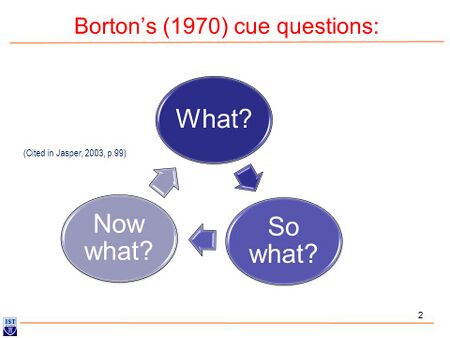
Borton's development framework is a fairly straightforward and easy to implement reflective framework. This enables you to reflect without having the structure in front of you, therefore a favoured one of many health care professionals and advocated by professional bodies.
The framework was developed in the 1970s and essentially involves 3 questions only, which is what makes it appealing. [1]
What?
This questions prompts the reflector to describe what has happened by
What were the roles of the people involved?
What was my role?
What were the problems
What happened
What did I do?
So What?
This is the analysis of the reflection.
What was the outcome?
What did you learn?
What was important?
What Now?
This is one of the most important sections of a reflection. This section focuses on what will you do next / what does your learning experience mean for future practice?
What do you need to do now?
What were the consequences?
How do you resolve the situation / improve the outcome?
How will what have you learnt from this experience change your future practice? [2]
References
↑White S,Fook J, Gardner F. Critical Reflection in Health and Social Care. Maidenhead: Open University Press, 2006