
Balance Assessment
Top Contributors - Angeliki Chorti, Kim Jackson and Mohamed A Hassanin
Introduction
Balance is the ability to evenly distribute body weight in static positions such as standing or during movement so that the person doesn’t fall or can recover from any external disturbances to this state; in other words, balance is closely related to the position of body’s center of gravity (static balance), or maintaining a stable position when performing activities (dynamic balance). [1]
Balance deficits can occur due to various disorders or diseases in our body. Imbalance symptoms like falls, dizziness and vertigo are common in the world-wide community e.g. dizziness 17 - 30%, and for vertigo 3 - 10%.[2] Falls are a critical health concern as they do not only impact quality of life but also rise the associated costs of health or medical care services. [3] Impaired balance has also been proposed as an early risk indicator for atherosclerotic disease. [4]
In the following sections, we introduce traditional and modern assessment methods to enhance an efficient pick up of balance deficits with our patients.
Traditional Balance Assessment
Traditionally, balance is measured with subjective-scoring methods that tend to be lengthy and have demonstrated some demerits such as high ceiling effect, reliance on the clinician's skills and interpretation, poor repeatability and reliability. [5]
History taking
This may include the patient's subjective complaints on balance issues and falls. Some comorbidities or treatments may be associated with balance problems and should be noted appropriately e.g. medications, medical problems causing instability etc.
Balance Questionnaires
- Activity-specific Balance Confidence (ABC)
- Falls Efficacy Scale (FES)
- Modified Falls Efficacy Scale (MFES) - expanded from the FES to 14 items
Static balance assessment
- Functional reach test
- Battery of single static balance assessment items: single limb stance, tandem stance,
Static and Dynamic Balance assessment
- The Berg Balance Scale
- Pediatric Balance Scale (PBS) (modified version of the Berg Balance Scale for the pediatric population)
- Fullerton Advanced Balance scale (FAB)
- Balance Evaluation Systems Test
Dynamic Balance tests (Gait activities)
Objective methods for balance assessment
These include force plates and optoelectronic motion capture systems that are not in common use due to their high cost, time consumption, complex operation and inconvenience. There is a need for a quantitative objective tool for clinicians and broader population to use in daily practice.

Modern Balance Assessment
At-home monitoring of balance would be helpful to the individual who is prone to experience poor stability or increased fall risk. Clinical balance assessment may help assess fall risk and/or determine the underlying reasons for balance disorders, [7] but most of the traditional ways to assess balance are merely subjective, that's why more research, effort and time were put into the investigation of more accurate methods of assessment, and some ways have been found to be effective and easier.
Measurements collected from sensors and devices, and machine learning applications are rapidly evolving making their clinical use more widely accepted. Such sensor-based methods include laboratory force plates, accelerometers worn on the body, and more recently, 3D motion capture devices and RGB-D sensors. [8] Accelerometers and gyroscopes are cost-effective, portable, easy to use devices, facilitating balance and gait evaluation in real-world settings even at homes. These instruments are embedded in common electronic devices such as smartphones provided with software programmes known as applications or apps that evaluate gait or balance in the general population.
Wearable Inertial Sensors
A wearable inertial sensing unit typically includes accelerometers, gyroscopes, and magnetometers. By fusing the data from accelerometers, gyroscopes, and/or magnetometers, human motion can be measured with good accuracy. [9]
A triaxial accelerometer measures the proper linear acceleration of movements in a sensor-fixed three-dimensional (3D) frame; measured data include both motion and gravity components.[10]
Gyroscopes are motion sensors used to measure angular velocity and orientation. [11]
Magnetometers measure magnetic field or magnetic dipole moment.
Some of the potential benefits of using wearable inertial devices for balance assessment in clinical settings include:
- Low cost.
- Small dimensions.
- Light weight.
- No need of camera-based systems.
- Absence of any limitation of the testing environment to a laboratory.
- Continuous and objective assessment of activities of daily living.
- Possibility of a quantitative assessment of tremor in terms of amplitude and frequency.
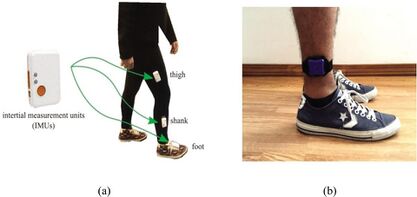
Example for IMU application to lower extremity.

The most common and promising areas of application of IMUs are gait analysis, instrumented clinical tests; daily-life activities, and tremor. Gait analysis performed by using IMUs may allow for suitably assessing upright gait stability. In the next future, these devices will also be combined with other machines, for example embedded in video-game based therapy and in neuro-robots for rehabilitation.[12]
Nintendo Wii Balance Board

The Wii balance board (WBB) is designed to test balance, which attracts considerable attention as a new generation device. WBB includes four load cells that relay coordination of the user's position in the form of center of pressure, similarity can be observed between the WBB and force platform, WBB can test balance by lap view to make the software.
WBB has advantages such as collecting and analysing the data, and it can be used in clinical setting and laboratories at a low cost and convenience.[13]
Further advantages of using WWB are:
- Less hardware damage.
- Easily collecting data with no mathematical complications using MATLAB "a programming language".
- Reliable and valid data for sensitive data such as COP "center of pressure".
- Use with a laptop and the Balancia software "which doesn't cost much".[13]
RGB-D Sensor-Based Instrument for Sitting Balance Assessment
Sitting balance is an important aspect of overall motor control, particularly for individuals who are not able to stand. Typical clinical assessment methods for sitting balance rely on human observation, making them subjective, imprecise, and sometimes time-consuming.[8][14] Sensor-based methods of balance assessment have multiple advantages, including:
- Objective data, they avoid inter-operator variability, and participants may act more naturally
- Their ability to capture data from multiple parts of the body simultaneously.
- 3D motion capture devices are more precise and can significantly reduce data collection times.[8]
Red-Green-Blue-Depth (RGB-D) sensors have been widely used in many applications including rehabilitation, [15][16] evaluation of patients with Parkinson’s disease, [17] assessments of workplace ergonomics, [18] and assessments of balance and postural control[19].
Microsoft Kinect™ to Assess Standing Balance
The Microsoft Kinect™ is an inexpensive RGB-D sensor to assess standing balance during clinical tests of postural control. The Kinect device incorporates a color video camera and a depth camera to create a 3D map of the area in front of the sensor and uses a forest algorithm in close to real time to determine the location of the subject’s body joints. The sensor can recognise 25 body joints representing the major joints and limbs positions the human body.

The Kinect offers some advantages over other 3D camera body tracking systems in that it is both portable and affordable, and minimally intrusive, as it does not require the subject to wear markers on the body. In addition, the Kinect’s potential as a component of financially accessible and medically beneficial therapy and alert systems.[21]
However, there are limitations, including:
- Difficulty in capturing fine movements, fixed location and limited range of capture.
- Lack of biomechanical accuracy in the shoulder joint,
- Limitations in fall risk reduction methodologies.
- More spatially accurate for large body movements than small body movements .[17]
- Slightly less accurate in identifying sitting body movements than standing body movements.[22]
On evaluating the efficacy of using the Kinect for balance assessment in comparison to 3D motion analysis system, the Kinect is found slightly less accurate but the data collected was quite reliable to use for the assessment of body movements and postural control during common clinical tests especially for step times of gait during balance recovery when balance is lost and fall is initiated.[19] [23] Other slight body movements may not be detected accurately by the Kinect, which would result in an unchanged COM. [24][25]
Mobile Phone Applications
The number of smartphone apps for self-managed or professional health assessment is rapidly developing and continues growing in all groups of population[26][27]. Thus, due to the situation described, apps targeted to assess the body balance need to be validated and regulated in order to offer an accurate service that supports an adequate training programme, through the same app or leads by a therapist.
There are several commercial software developers that offer mobile Health solutions without evidence in their results. However, the risks to patient safety and professional reputation are real, and some considerations should be taken into account. [28]Here, we are displaying several attempts for validating some mobile phone applications to assess balance, including the K-D balance, MyAnkle, Y-Med balance and BalanceLab.

1. King-Devick (K-D) Balance Application
The K-D Balance app is an application available for Apple products created to measure triaxial coordinate data via the internal accelerometer of the mobile device and give a quantitative assessment of balance performance. The balance score is derived from algorithm. [29]
The reliability measurements of the K-D composite (ICC, 0.42) is fair to good. This lower-than-expected reliability may in part be attributed to the use of young, healthy, and active subjects with limited variability between participants.[30]
2. Gait & Balance (G&B) Application

The Gait and Balance app is a smartphone application that analyses gait and balance through the inertial sensors of the smartphone. G&B includes six gait and balance assessment tasks. [31]The gait tasks are designed to be performed at the user’s preferred walking speed over approximately 10 m. Each gait task consists of four walks of 6 s duration. The included tasks are:
- Walk in a straight line facing forwards.
- Walk in a straight line while turning head from side to side.
While static balance tasks included are four static test (30 sec for each) conditions to evaluate postural sway. Users are required to stand as still as possible on:
- Firm surface with eyes open.
- Firm surface with eyes closed (absent visual information).
- Compliant surface with eyes open (altered proprioceptive feedback).
- Compliant surface with eyes closed (absent visual information and altered proprioceptive information).
The app shows an excellent validity and high reliability for postural stability and gold-standard kinematic data. For walking tasks, there was moderate-to-excellent validity for G&B App measures of walking speed, step length and step time, but step length variability, step length asymmetry, step time variability and step time asymmetry had poor validity and reliability. [32]

3. MyAnkle Application
"MyAnkle” is a smartphone application that was developed to assess standing balance as an alternative to the BBS in assessing overall balance among patients and healthy volunteers when the eyes are closed, regardless of limb dominance.[33] [34]
The validity of MyAnkle smartphone application is supported while closing eyes. However, this is not the case for eyes open in addition the application failed to discriminate between patients and healthy people and -similarly to Biodex Balance system- the one week test- retest reliability seems to be insufficient for accurate follow up so clinicians should be cautious with findings. [27]
4. Y-MED Application

Balance Y-MED is a smartphone application that uses a motion accelerometer sensor with its base in a smartphone which has been tested for its reliability and suitability for use as a convenient tool for assessing the postural balance in everyday life. However, Y-MED validity and reliability cannot be confirmed for balance assessment in patients with chronic low back pain. [35][36]
5. BalanceLab Application
Postural instability is a risk factor for falls in older adults. It is possible to detect postural stability using an integrated accelerometer (ACC) sensor in a smartphone. Therefore, a novel ACC-based smartphone application running on the Android operating system called BalanceLab was created and tested. This application has moderate to excellent validity and test-retest reliability (ICC = 0.76–0.91).[37]
Summary
Balance deficits are abundant among different body system disorders. These can't be ignored while assessing or following our patients or when describing home programmes for them as a kind of external feedback. Traditional methods with their many hinders create the need for valid, reliable, easily accessible, money-wise and friendly-use assessment methods for balance. Mobile smartphone applications seem to be promising but need further scientific evidence for validation.
References
- ↑ Mahmoudi F, Rahnama N, Daneshjoo A, Behm DG. Comparison of dynamic and static balance among professional male soccer players by position. J Bodywork Movement Ther. 2023 Oct 1;36:307-12.
- ↑ Murdin L, Schilder AGM. Epidemiology of Balance Symptoms and Disorders in the Community. Otol Neurotol. 2015 Mar;36(3):387–92.
- ↑ Burns E, Stevens J, Lee R. The direct costs of fatal and non-fatal falls among older adults — United States J Safety Res. 2016; 58: 99-103.
- ↑ Nordström A, Nordström P. Impaired Balance Predicts Cardiovascular Disease in 70-Year-Old Individuals-An Observational Study From the Healthy Aging Initiative. J Am Heart Assoc. 2024 Oct;13(19):e035073.
- ↑ Oh-Park M, Mehta N. Assessment and Treatment Of Balance Impairments. AAPM&R. Available from: https://now.aapmr.org/assessment-and-treatment-of-balance-impairments/ [accessed 29/12/2024]
- ↑ Noamani A, Nazarahari M, Lewicke J, Vette AH, Rouhani H. Validity of using wearable inertial sensors for assessing the dynamics of standing balance. Med Eng Phys. 2020 Mar;77:53–9.
- ↑ Mancini M, Horak FB. The relevance of clinical balance assessment tools to differentiate balance deficits. Eur J Phys Rehabil Med. 2010; 46(2): 239-48.
- ↑ 8.0 8.1 8.2 Bartlett K, Camba J. An RGB-D sensor-based instrument for sitting balance assessment. Multimed Tools Appl. 2023; 82(18): 27245–68.
- ↑ Ansah S, Chen D. Wearable-Gait-Analysis-Based Activity Recognition: A Review. Int J Smart Sens Intell Syst. 2022 Jan 1;15(1).
- ↑ Ghislieri M, Gastaldi L, Pastorelli S, Tadano S, Agostini V. Wearable inertial sensors to assess standing balance: A systematic review. Sensors (Basel). 2019; 19(19): 4075.
- ↑ Passaro VMN, Cuccovillo A, Vaiani L, Carlo M, Campanella CE. Gyroscope Technology and Applications: A Review in the Industrial Perspective. Sensors (Basel). 2017 Oct 7;17(10):2284.
- ↑ Iosa, Marco; Picerno, Pietro; Paolucci, Stefano; Morone, Giovanni (2016). Wearable inertial sensors for human movement analysis. Expert Review of Medical Devices, (), 1–19. doi:10.1080/17434440.2016.1198694
- ↑ 13.0 13.1 Park DS, Lee G. Validity and reliability of balance assessment software using the Nintendo Wii balance board: usability and validation. J Neuroeng Rehabil. 2014;11(1):99.
- ↑ Arora T, Oates A, Lynd K, Musselman KE. Current state of balance assessment during transferring, sitting, standing and walking activities for the spinal cord injured population: a systematic review. J Spinal Cord Med 2020; 43(1):10–23.
- ↑ Bo APL, Hayashibe M, Poignet P. Joint angle estimation in rehabilitation with inertial sensors and its integration with Kinect. 2011 Annual International Conference of the IEEE Engineering in Medicine and Biology Society, Boston, MA, USA. 2011: 3479-83
- ↑ Seo NJ, Fathi M, Hur P, Crocher C. Modifying Kinect placement to improve upper limb joint angle measurement accuracy. J Hand Ther. 2016; 29(4): 465 - 73.
- ↑ 17.0 17.1 Galna B, Barry G, Jackson D, Mhiripiri D, Olivier P, Rochester L (2014) Accuracy of the Microsoft Kinect sensor for measuring movement in people with Parkinson’s disease. Gait Posture 39(4):1062–1068
- ↑ Diego-Mas JA, Alcaide-Marzal J (2014) Using Kinect™ sensor in observational methods for assessing postures at work. Appl Ergon 45(4):976–985
- ↑ 19.0 19.1 Clark RA, Pua YH, Fortin K, Ritchie C, Webster KE, Denehy L, Bryant AL (2012) Validity of the Microsoft Kinect for assessment of postural control. Gait Posture 36(3):372–377
- ↑ Milosevic B, Leardini A, Farella E. Kinect and wearable inertial sensors for motor rehabilitation programs at home: state of the art and an experimental comparison. BioMedical Engineering OnLine. 2020 Apr 23;19(1).
- ↑ Webster D, Celik O (2014) Systematic review of Kinect applications in elderly care and stroke rehabilitation. J Neuroeng Rehabil 11(1):108
- ↑ Xu X, McGorry RW (2015) The validity of the first and second generation Microsoft Kinect™ for identifying joint center locations during static postures. Appl Ergon 49:47–54
- ↑ Shani G, Shapiro A, Oded G, Dima K, Melzer I. Validity of the microsoft kinect system in assessment of compensatory stepping behavior during standing and treadmill walking. European Review of Aging and Physical Activity. 2017 Dec;14(1):1-1.
- ↑ Yang Y, Pu F, Li Y, Li S, Fan Y, Li D. Reliability and validity of Kinect RGB-D sensor for assessing standing balance. IEEE Sensors Journal. 2014 Jan 2;14(5):1633-8.
- ↑ Clark RA, Pua YH, Oliveira CC, Bower KJ, Thilarajah S, McGaw R, Hasanki K, Mentiplay BF. Reliability and concurrent validity of the Microsoft Xbox One Kinect for assessment of standing balance and postural control. Gait & posture. 2015 Jul 1;42(2):210-3.
- ↑ Duncan PW, Studenski S, Chandler J, Prescott B. Functional reach: predictive validity in a sample of elderly male veterans. J Gerontol 1992; 47: M93–M98.
- ↑ 27.0 27.1 Abdo N, ALSaadawy B, Embaby E, Rehan Youssef A. Validity and reliability of smartphone use in assessing balance in patients with chronic ankle instability and healthy volunteers: A cross-sectional study. Gait & Posture. 2020 Oct;82:26–32.
- ↑ Morera, E. P., De la Torre Díez, I., Garcia-Zapirain, B., López-Coronado, M., and Arambarri, J., Security recommendations for mHealth apps: Elaboration of a developer’s guide. J. Med. Syst. 40(6):152, 2016.
- ↑ Zhang C, Talaber A, Truong M, Vargas BB. K-D Balance: An objective measure of balance in tandem and double leg stances. Digital Health [Internet]. 2019 Nov 4 [cited 2022 Mar 19];5:2055207619885573. Available from: https://www.ncbi.nlm.nih.gov/pmc/articles/PMC6831964/
- ↑ Krause DA, Anderson SE, Campbell GR, Davis SJ, Tindall SW, Hollman JH. Responsiveness of a Balance Assessment Using a Mobile Application. Sports health. 2020 Jan 21;12(4):401–4.
- ↑ Olsen S, Rashid U, Allerby C, Brown E, Leyser M, McDonnell G, et al. Smartphone-based gait and balance accelerometry is sensitive to age and correlates with clinical and kinematic data. Gait & Posture. 2023 Feb 1;100:57–64.
- ↑ Rashid U, Barbado D, Olsen S, Alder G, Elvira JLL, Lord S, et al. Validity and Reliability of a Smartphone App for Gait and Balance Assessment. Sensors. 2021 Dec 25;22(1):124.
- ↑ McHorgh N, editor. Finding balance with a new mobile app. Pursuit [Internet]. 2014 [cited 2024 Aug 19];17(1):12. Available from: https://www.eecg.utoronto.ca/~jayar/CAM/pursuit_spring_-2014_final_.pdf
- ↑ Shah N, Aleong R, So I. Novel Use of a Smartphone to Measure Standing Balance. JMIR Rehabilitation and Assistive Technologies. 2016 Mar 29;3(1):e4.
- ↑ Park SD, Kim JS, Kim SY. Reliability and validity of the postural balance application program using the movement accelerometer principles in healthy young adults. Physical Therapy Korea. 2013;20(2):52-9.
- ↑ Amin N, Bassem El Nahass, Ibrahim M. Validity and reliability of balance Y-MED application in chronic mechanical low back pain patients. Bulletin of Faculty of Physical Therapy. 2022 Apr 6;27(1).
- ↑ Pooranawatthanakul K, Siriphorn A. Testing the validity and reliability of a new android application-based accelerometer balance assessment tool for community-dwelling older adults. Gait & Posture. 2023 Jul 1;104:103-8.