
Lower Limb Prosthetic Introduction
Original Editor - Francois Friedel, Hmayak Tarakhchyan and Sarah Evans as part of the World Physiotherapy Network for Amputee Rehabilitation Project
Top Contributors - Admin, Tarina van der Stockt, Tony Lowe, Naomi O'Reilly, Kim Jackson, Stacy Schiurring, Jess Bell, Ewa Jaraczewska, Rachael Lowe, Simisola Ajeyalemi, Amrita Patro and Amanda Ager
Introduction to Physiotherapy and Lower Limb Prosthetics
Physiotherapists work closely with patients with limb loss throughout rehabilitation and should collaborate closely with the prosthetist. Although they do not need to understand every technical aspect of the prosthesis and its fitting, a working knowledge is important. They should also obtain the manufacturer's information for the specific components prescribed. In particular, physiotherapists should understand the following:[1][2]
- Proper prosthetic fit and alignment: this will enable the therapist to evaluate whether the cause of a gait deviation or pain is a result of the prosthesis.
- The function of the different prosthetic components, so they can teach the person to use the prosthesis optimally and select the correct gait training strategy for the components involved.
- Correct donning of the prosthesis and what to do if the socket sits uncomfortably.
Basic Biomechanical Principles Review
Before considering the physiotherapist's role, prosthetic prescription, or fabrication, it helps to understand two basic biomechanical principles that underpin how a prosthesis interacts with the body.
Pressure and surface area. Pressure is force distributed over an area (P = F/A). A prosthetic socket applies force to the residual limb over its surface, so spreading that force over a larger area reduces the pressure at any single point. This has a direct implication for socket design: if an uncomfortable area of the socket is simply cut away rather than properly modified, the remaining surface area becomes smaller. The same force is then concentrated over that smaller area, increasing pressure, which can worsen pain over time rather than relieve it.
A 2025 systematic review of methods for measuring transfemoral socket comfort found that pressure and shear at the socket-limb interface, along with volume fluctuation and pistoning, remain important but incompletely understood.[3]

Ground reaction force. The ground reaction force (GRF) is the force the ground exerts back on the body during weight-bearing, equal and opposite to the force the body exerts on the ground. In an intact limb, muscles generate an opposing moment around each joint to balance the GRF. In a person with an amputation, some of that muscular control is missing, so the prosthesis and its alignment must be able to compensate for that missing control. For example, a transtibial prosthetic foot is typically built stiff enough to resist unwanted dorsiflexion, since there's no functioning ankle musculature to control it. This is why alignment is not just a comfort adjustment; moving the prosthesis relative to the GRF changes the mechanical demands placed on the person's residual limb and remaining joints.
The following video provides an overview of pressure, surface area, ground reaction forces, and the multidisciplinary team's role in prosthetic prescription.
If you would like to read more on biomechanics and how movement can affect prostheses, see: Biomechanics.
The Multidisciplinary Team
Prosthetic rehabilitation is most effective when delivered by a multidisciplinary team. Beyond the physiotherapist and prosthetist, the wider team may include the surgeon, specialist nurses, social workers, rehabilitation psychologists and recreational therapists, each contributing to different aspects of a person's recovery and long-term adjustment to limb loss.[5]
Shared decision-making should sit at the centre of this model: providers and the person with limb loss (along with family members or carers where appropriate) weigh the available evidence, the risks and benefits of different options, and the individual's own values and preferences together, rather than following a fixed treatment pathway. This is particularly relevant during prosthetic prescription, where component choice can involve genuine trade-offs between function, cosmesis, durability and cost.[6][7][8]
Prosthetic Prescription
During prosthetic prescription, the multidisciplinary team decides on the type of device to be fabricated, along with the socket design, the various types of components, and the choice of suspension. All of these decisions are very important for the rehabilitation process that follows.[9]
It should be noted that the evidence base underpinning prosthetic prescription is not uniform across all patient groups. A 2026 scoping review of consensus statements, recommendations and guidelines found that the large majority focus on prosthetic feet and knees for people with transtibial and transfemoral amputation, while comparatively little guidance exists for paediatric prostheses, joint disarticulation prostheses, or componentry for bone-anchored (osseointegrated) limbs.[9] Clinicians should be aware of where robust guidance exists and where prescription decisions rely more heavily on individual clinical reasoning and patient-specific factors.
Fabrication of the Prosthesis
The fabrication of the prescribed prosthesis also goes through various stages that could considerably influence the rehabilitation and physiotherapy programme planned after the first fitting. These fabrication steps are:
- Casting
- Positive mould
- Rectification
- Assembling
- Alignment
- Cosmetic finishing
Prosthetic Components
Standardised international terminology for prosthetics and orthotics is maintained by the International Organization for Standardization (ISO 8549 series), covering general terms, terms relating to external limb prostheses, and terms relating to limb amputation.[10]
Replacing the movements of the human body with prosthetic components is a complex task. Prosthetic components can imitate these movements, but can never fully replace them. Generally, the higher the level of imitation, the greater its complexity and cost. With the loss of sensory input and proprioception, the person with limb loss must rely solely on the sensory capabilities of their residual limb and body, which may affect confidence during gait. However, modern prosthetic technologies offer a wide range of components, especially for lower limb prostheses, that manage to replace the major movements and enable users to walk.
Components of a prosthetic fit include:[11]
- A comfortable and well-aligned socket
- Suspension
- Knee joint
- Foot
- Other components: pylon, offsets, adapters, etc.
Below are some examples of common prosthetic components and the correlation between prosthetic design and gait.
-
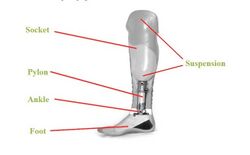 Transtibial prosthetic components
 -
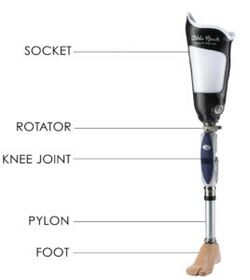 Transfemoral prosthetic components


Assembling/Alignment
Once the socket fits comfortably, the prosthetist attaches the other components (e.g. the foot, knee, and any additional hardware) to build the complete prosthesis. This step is known as assembling.
Next, the prosthetist adjusts the position and angles of these components relative to one another and to the person's body to ensure the prosthesis functions correctly and works in harmony with the body's biomechanics. This step is called alignment. Like socket fit, alignment requires clinical skill and careful, iterative adjustment. Getting it right is essential to achieving the best possible functional outcome for the user. Alignment is not a single event but a progressive process, refined across three distinct stages as the prosthesis moves from the workbench to active use: initial bench alignment, static alignment, and dynamic alignment.
Initial “Bench” Alignment. Carried out on the workbench, without the person present. The prosthetist positions and attaches the socket to the rest of the prosthetic leg using an alignment device, following the manufacturer's technical instructions for the components selected. The exact settings depend on the socket design, the components used, and the person's usual shoe heel height, since this affects the leg's overall length and angle. This step gets the prosthesis into an approximate, safe starting position before the person tries it on.
Watch the following presentations to learn more about transfemoral and transtibial initial alignment (use the pause button to examine each slide).
Static Alignment. Carried out at the first fitting session, with the person present and the wider team involved. The prosthetist checks and adjusts the alignment while the person sits, stands, and bears weight on the prosthesis. This step allows for any needed correction in the height, tilt, and positioning of the components to suit the person's individual body and posture. This fine-tuning happens before the person takes their first steps on the prosthesis.
Watch the following presentations to learn more about transfemoral and transtibial static alignment (use the pause button to examine each slide).
Dynamic Alignment. Carried out during gait training, while the person is walking. The prosthetist observes how the person walks and makes further alignment adjustments to correct any gait deviations, applying general principles of gait analysis to the individual's movement pattern.
Watch the following presentation on transtibial dynamic alignment if you would like to learn more (use the pause button to examine each slide).
Cosmesis
Once the socket fits well, the alignment is finalised, and the person has completed their rehabilitation programme (i.e. successfully performing the exercises and activities set out in the treatment plan), the multidisciplinary team can move to finalise the prosthesis. This means locking in all adjustments made so far and completing the cosmetic finish, which shapes and covers the prosthesis to suit the person's appearance and lifestyle. Preferences vary widely: a young, sporty user might choose bright, visible colours, while another person might prefer a finish that closely matches the colour and texture of their remaining leg.
As with component and technology choices, the cosmetic finish selected also depends on the person's financial resources and the funding or coverage available to them, since prices vary considerably between options.
Possibilities with Technology
Emerging technology aims to connect the prosthetic leg directly with the person's nervous system, so the user can 'feel' the prosthesis moving rather than relying on visual and mechanical cues alone. A 2025 review of these neuroprosthetic approaches described progress on two fronts: restoring sensation in the area of the missing limb, and using signals from the person's own residual muscles to control the prosthesis. The long-term goal is a bidirectional neuroprosthesis, one that can both sense the environment and act on it, much like a natural limb.[17] A less invasive route toward similar benefits is haptic feedback, which uses vibration or other mechanical stimuli against the skin to convey information about the position and movement of the prosthesis; another 2025 review found this approach can improve users' balance and sense of limb position.[18]
A related but distinct development is osseointegration, in which the prosthesis is attached directly to the person's remaining bone via a surgically implanted fixture, removing the need for a socket altogether. A 2025 article estimated that more than 10,000 people worldwide have now received an osseointegration implant, while also noting that complications, cost, and a continued need for long-term evidence remain real barriers to this becoming more widely available.[19]
References
- ↑ Engstrom B, Van de Ven C, editors. Therapy for amputees. Elsevier Health Sciences; 1999.
- ↑ Prosthetics. AustPar. Australian Physiotherapists in Amputee Rehabilitation. Available from: http://www.austpar.com/portals/prosthetics/prosthetics.php [Accessed 28 Dec 2017]
- ↑ Tiesler LM, Edel M, Wang F, Pieroh P, Drossel WG, Carabello A, Zipplies D, Heyde CE, Schleifenbaum S. Objective measurement methods for the evaluation of socket comfort in patients with transfemoral amputation: a systematic review. Frontiers in Bioengineering and Biotechnology. 2025 May 30;13:1576729.
- ↑ Physiopedia. Greg Halford talks about biomechanics and prosthetics. Available from: https://youtu.be/GQ0m2Qqapj4
- ↑ VA/DoD Clinical Practice Guideline for Rehabilitation of Individuals with Lower Limb Amputation, Version 3.0. Department of Veterans Affairs, Department of Defense; 2024/2025. Available from: https://www.healthquality.va.gov/guidelines/Rehab/amp/LLA-CPG_2024-Guideline_final_20250110.pdf (last accessed: 01/August/2026).
- ↑ Sjödin LW, Lapidus LJ, Torbjörnsson E. Perspectives on communicating information and shared decision-making in patients undergoing transtibial amputation. J Patient Cent Res Rev. 2025 Sep 30;12(4):213-222.
- ↑ Anderson CB, Fatone S, Mañago MM, Swink LA, Hager ER, Kittelson AJ, Christiansen CL, Magnusson DM. Improving shared decision-making for prosthetic care: A qualitative needs assessment of prosthetists and new lower-limb prosthesis users. Prosthet Orthot Int. 2023 Feb 1;47(1):26-42.
- ↑ Anderson CB, Fatone S, Christiansen CL. A narrative review of prosthesis design decision making after lower-limb amputation for developing shared decision-making resources. Curr Phys Med Rehabil Rep. 2024 Mar;12(1):26-38.
- ↑ 9.0 9.1 Earley EJ, Awad ME, Milius DW, Melton DH, Gaffney BM, Stoneback JW. Consensus, Recommendations, and Guidelines for Prosthetic Limb Prescription: A Scoping Review. JPO: Journal of Prosthetics and Orthotics. 2026 Jul 1;38(3):e91-102.
- ↑ International Organization for Standardization. Prosthetics and Orthotics Vocabulary - part 1: General terms for the external limb prosthesis and external orthoses. Available from: https://www.iso.org/obp/ui/#iso:std:iso:8549:-1:ed-2:v1:en (accessed 01/August/2026).
- ↑ Highsmith MJ, Kahle JT, Miro RM, Orendurff MS, Lewandowski AL, Orriola JJ, Sutton B, Ertl JP. Prosthetic interventions for people with transtibial amputation: Systematic review and meta-analysis of high-quality prospective literature and systematic reviews. Journal of Rehabilitation Research & Development. 2016 Feb 1;53(2).
- ↑ Parts of Your Prosthesis. Available from: limb-loss.org https://youtu.be/_C976jbNgYk [Accessed 01/01/2018]
- ↑ AmputeeOT: How An Above Knee (AK) Prosthetic Leg Works Available from: https://youtu.be/ZCUAnH3epRQ
- ↑ MOOR Ortotika in Protetika / MOOR Orthotics & Prosthetics. Above knee amputee cosmesis. Available from: https://youtu.be/XkEjF3EG7wQ
- ↑ The London Prosthetic Centre. Silicone Cosmesis. Available from: https://youtu.be/JzWZerGZr_c
- ↑ TED. New bionics let us run, climb and dance | Hugh Herr. Available from: https://youtu.be/CDsNZJTWw0w
- ↑ Mariscal DM, Driscoll B, Huang H, Fisher LE. Somatosensory restoration and neural control strategies in lower-limb prostheses. npj Biomedical Innovations. 2025 Dec 2;2(1):44.
- ↑ Karimi M, Yeganeh N, Makarov I, Sverrisson AÖ, Gunnarsson KF, Briem K, Brynjólfsson S, Kristjánsson Á, Unnthorsson R. Haptic feedback systems for lower-limb prosthetic applications: a review of system design, user experience, and clinical insights. Bioengineering. 2025 Sep 18;12(9):989.
- ↑ Wnuk-Scardaccione A, Bilski J. Breaking barriers—the promise and challenges of limb osseointegration surgery. Medicina. 2025 Mar 20;61(3):542.